
The Elusive Value of Data

This article was originally published in Medium.
Introduction
In today’s digital age, data is often hailed as the new oil, a valuable resource driving innovation and growth. However, unlike oil, the value of data is not easily quantified. While commercial valuations provide a monetary figure, they fail to capture the true essence of data’s worth. The real value of data emerges only when it is applied to specific business challenges, where its quality and relevance can significantly impact decision-making.
The Complexity of Data Valuation
Data’s value extends far beyond its market price. It lies in its potential to solve business problems, drive efficiencies, and uncover new opportunities. However, this potential is often overlooked when data is viewed solely through a commercial lens.
The value of data is intrinsically linked to its quality. Key dimensions of data quality include:
- Accuracy: How correct and reliable the data is.
- Completeness: Whether all necessary data is present.
- Timeliness: The relevance of data in relation to the time it is used.
- Relevance: How pertinent the data is to the specific business need.
Contextual Value of Data
The value of data varies significantly depending on the business context. For example, data that is invaluable for a marketing campaign might be less critical for operational efficiency. Understanding the specific business challenge is crucial to assessing the true value of data.
The concept of fit-for-purpose data emphasizes that data’s value is determined by its ability to meet specific business needs. High-quality data that is relevant and timely can greatly enhance decision-making processes, leading to better outcomes.
Unused Data: Costs, Liabilities, and Opportunities
Unused data is not just a missed opportunity; it also incurs costs and poses risks. Storing and managing unused data can be expensive, and there are liabilities associated with data breaches or retaining data beyond legal limits.
Unused data can also be seen as an option for future use, akin to option theory in investing. As new technologies and business needs emerge, previously unused data can become valuable. This perspective encourages businesses to consider the potential future value of their data.
Elevating Data to the Balance Sheet
Recognizing the immense value of data, some forward-thinking organizations have begun to treat data as a tangible asset on their balance sheets. For instance, Highways England has pioneered this approach, acknowledging data’s critical role in their operations and strategic planning. This shift not only reflects data’s intrinsic value but also encourages more rigorous management and utilization practices.
C-Level Oversight
Moreover, the responsibility for overseeing data assets should be elevated to the C-suite, directly reporting to the CEO. The LEGO Group exemplifies this model, where Data, Digital, and Technology are given the same level of importance as HR, Finance, and Operations. By embedding data stewardship at the highest organizational level, companies can ensure that data-driven strategies are aligned with overall business objectives, fostering a culture that prioritizes data quality, security, and innovation.
This approach encompasses the entire lifecycle of data, from its creation to its ultimate use in generating value through well-informed decision-making. By managing data from “birth to cradle,” organizations can maximize its potential, ensuring that every piece of data contributes to strategic insights and operational efficiencies.
Supporting Evidence
Peter Dröll of the European Commission estimated that about 80% of industrial data is currently not being used. This staggering figure highlights the untapped potential of data in the industrial sector.
Back in 2008, Jim Crompton, then a Chevron fellow, noted an 80% annual growth of technical data and a 60% compound annual growth of business (unstructured) data over the past two years. Sixteen years later, these growth rates have likely increased, underscoring the exponential rise in data generation.
Data as a Unique Asset
Data is a unique kind of asset because it is not depleted by use. In fact, data often becomes more valuable the more it is used. Some liken data to fine wine, which matures and becomes more valuable with proper care and attention. This characteristic makes data fundamentally different from traditional resources, which are consumed and diminished over time.
The Subjective Nature of Data
As a geophysicist, I know that what I consider data for one usage, I may call noise in another. This highlights the subjective nature of data valuation. Data that is crucial for one analysis might be irrelevant or even considered noise in a different context. This subjectivity further complicates the process of quantifying data’s value.
The Shell Value Loop©️
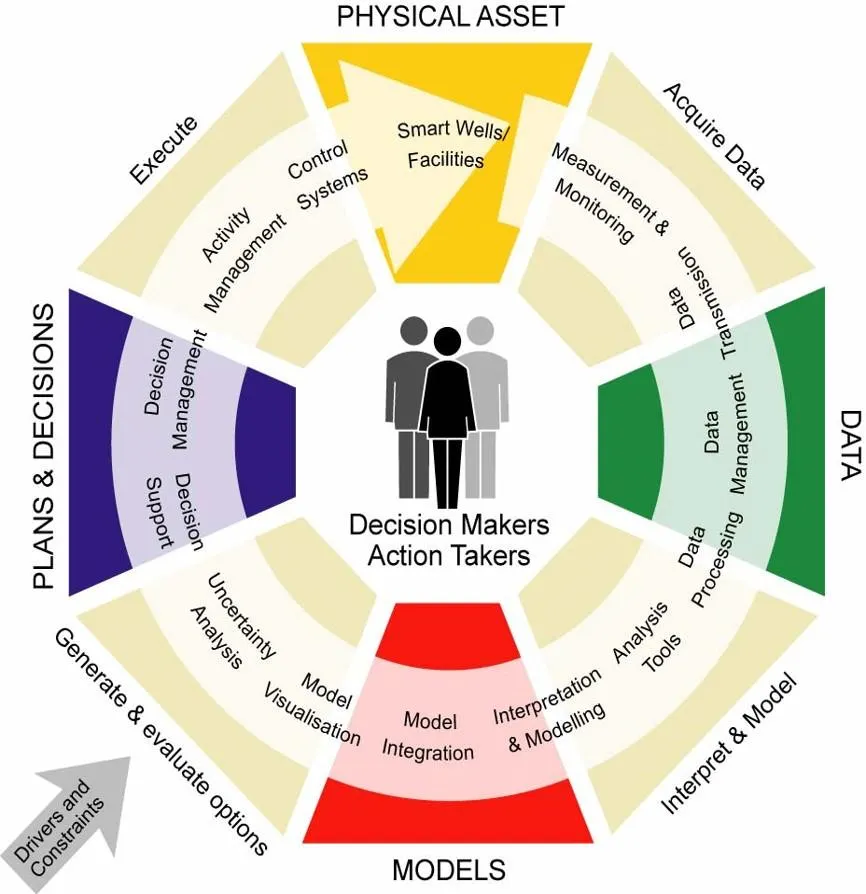
In the early 2000s, Shell introduced the concept of the value loop©️ or octogram, which emphasizes the timeliness of the process from data capture to the implementation of decisions in the real world. If this process takes too long or is interrupted, the intrinsic value of the data can be reduced or even lost altogether. Data often has a ‘best before’ date, meaning its value is highest when it is fresh and relevant to the current context. Delays in processing and utilizing data can diminish its effectiveness and impact.
The Importance of Right-Time Data
The value loops operate on different timeframes: control systems in split seconds, operations in minutes and hours, logistics in days and weeks, reservoir management in months and years, and field development in years and decades. This means that “real time” is not always the right term; instead, it should be “right-time,” in accordance with the dominant (often physical) time constants governing the different loops. It is also where you may define the best before date for the time the well-informed decisions need to be executed in reality.
Conclusion
The value of data is complex and context-dependent. It cannot be easily quantified without considering the specific business challenges and the quality dimensions of the data. As businesses continue to generate and collect vast amounts of data, it is essential to develop strategies for assessing and leveraging its value. By focusing on fit-for-purpose data, considering future opportunities, and ensuring timely use, businesses can unlock the true potential of their data.

- Introduction
- The Complexity of Data Valuation
- Contextual Value of Data
- Unused Data: Costs, Liabilities, and Opportunities
- Elevating Data to the Balance Sheet
- C-Level Oversight
- Supporting Evidence
- Data as a Unique Asset
- The Subjective Nature of Data
- The Shell Value Loop©️
- The Importance of Right-Time Data
- Conclusion