
What Are Knowledge Embeddings?
While a knowledge graph is designed for humans and machines to understand relationships through logic (for example, Product A is manufactured in Factory B), many modern AI algorithms, especially deep learning, require numerical data to function.
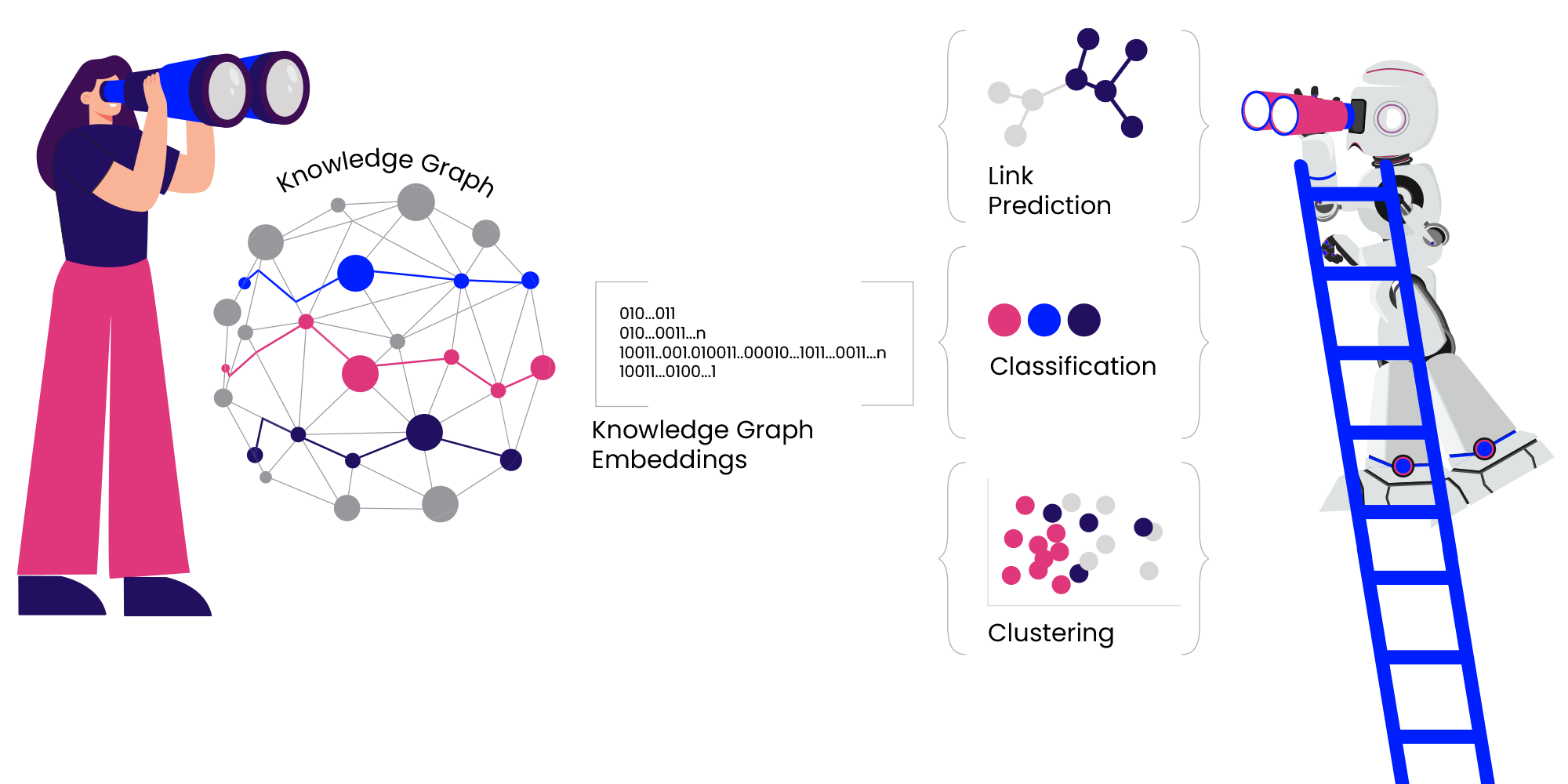
Knowledge graph embeddings are the bridge between these two worlds. They transform the entities (nodes) and relationships (edges) of a graph into low-dimensional numerical vectors (lists of numbers).
The goal is to represent the graph in a way that preserves its structure: entities that are “close” or “similar” in the graph are represented by numbers that are mathematically close to each other in a vector space.
Why do we need embeddings?
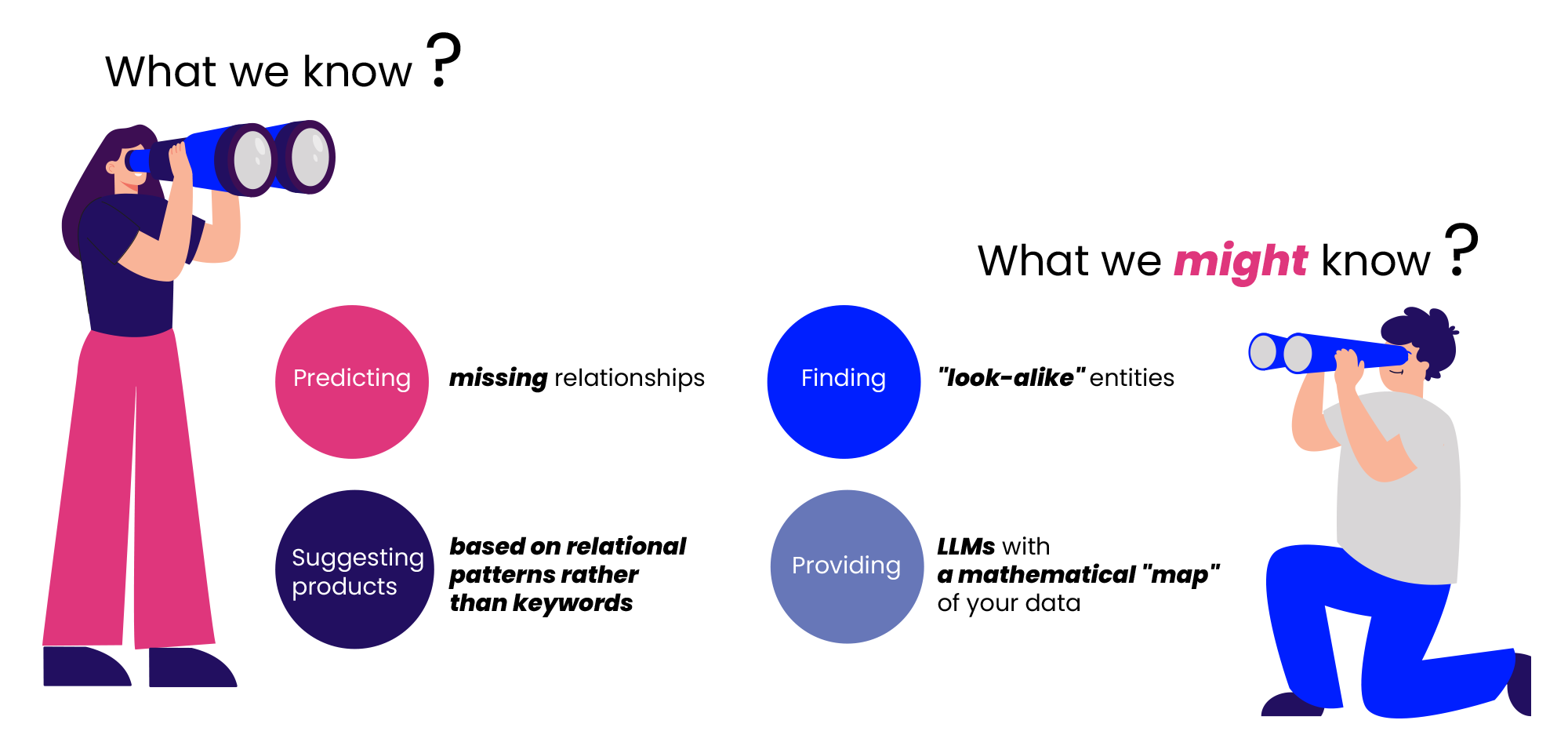
Standard graph queries (like SPARQL) are excellent for finding “what we know.” However, they struggle with “what we might know.” Embeddings enable:
- Link prediction: Predicting missing relationships (for example, “Based on our data, there is an 85% chance that Supplier X is a subsidiary of Company Y”).
- Similarity discovery: Finding “look-alike” entities that aren’t explicitly linked but behave similarly in the data.
- Recommendation engines: Suggesting products, research papers, or clinical trials based on complex relational patterns rather than just keywords.
- Powering GraphRAG: Providing large language models (LLMs) with a mathematical “map” of your data to improve the accuracy of generative AI responses.
Main characteristics of knowledge graph embedding models
Here are some of the key characteristics of these models:
- Efficient computation: Operations on embeddings in a Euclidean space, such as vector addition or finding the distance/similarity between vectors, are computationally efficient. This efficiency is beneficial for tasks like entity resolution, relationship prediction, and graph completion.
- Dimensionality reduction: knowledge graphs can be highly complex and large, consisting of numerous nodes (entities) and edges (relationships). Embeddings help reduce this complexity by mapping high-dimensional graph structures into a lower-dimensional vector space while preserving important information.
- Semantic similarity: By embedding entities and relationships into a continuous space, similar entities and relationships can be positioned closer to each other in the vector space. This makes it easier to perform tasks like clustering, classification, and link prediction.
Knowledge graph embedding methods
Several models and techniques have been developed for creating knowledge graph embeddings. Some popular ones include:
- TransE (Translating Embeddings (Bordes et al. 2013): Projects both entities and relationships into the same space such that the relationship is represented as a translation operation between the entities.
- DistMult (Yang et al. 2014): Uses a bilinear formulation for relationships, with separate embeddings for each entity and a diagonal matrix for each relationship.
- ComplEx (Trouillon et al. 2016): Extends DistMult by using complex-valued embeddings, allowing it to better capture asymmetric relationships.
- Node2Vec and DeepWalk (Grover and Leskovec 2016): Extend the concept of word embeddings (like Word2Vec) to graphs by performing random walks on the graph to create sequences of nodes, which are then embedded similarly to words in sentences.
- Graph Convolutional Networks (R-GCNs) (Schlichtkrull et al. 2018): Use neural network architectures adapted for graph data, allowing for more flexible and powerful embeddings that can incorporate additional node features
Knowledge graph embedding frameworks provide implementations of various models:
- LibKGE – PyTorch-based library for KGE models training and evaluation with a special focus on reproducible research.
- PyKeen (Python Knowledge Graph Embeddings) – a library that provides implementations of various KGE models
- AmpliGraph– an open-source Python library for KGE models, primarily used for link prediction.
- OpenKE (Open-source Knowledge Embedding) toolkit for knowledge representation learning
- DGL-KE (Deep Graph Library for Knowledge Embedding) – built on top of the Deep Graph Library (DGL) and is optimized for training large-scale knowledge graph embeddings efficiently using multiple GPUs and machines
Conclusion
Knowledge graph embeddings are the key to moving from data storage to data intelligence. They take the rich, connected information within a knowledge graph and make it “legible” for the most advanced AI models on the market.
With Graphwise, the journey from raw data to predictive insights is shorter than ever, providing a trusted semantic backbone that powers both human decisions and autonomous AI.