
From Data to Decisions — How GraphRAG Accelerates Time to Insight and Boosts ROI
Generative AI adoption is rising, but without the proper foundation, it often produces inconsistent or unverifiable results. Learn how GraphRAG helps teams cut decision latency, improve accuracy, and turn complex data into trusted insights.

Main Takeaways
- Data without context is the real problem — traditional RAG matches keywords but misses relationships, leaving analysts validating results instead of making decisions.
- Graph structure closes the accuracy gap — grounding AI in connected entities and relationships lifts accuracy from 35–40% to 80–95% in real deployments.
- Every answer is traceable — outputs link back to verified sources, making results auditable and easier to trust across compliance-heavy environments.
- The ROI is concrete — token costs drop up to 80%, queries run 40% faster, and teams save 30+ minutes per search.
Despite significant AI investments, many companies struggle to turn raw data into real business value. Data teams spend a lot of time cleaning and validating information — stretching decision timelines and eroding confidence in results. Instead of drowning in spreadsheets and siloed reports, teams need insights they can act on — but that rarely happens.
At the core of the problem is context. Traditional Retrieval Augmented Generation (RAG) systems retrieve information, but they may not understand how pieces of data connect and support each other. Graphwise’s GraphRAG changes this by adding a graph-based layer of relationships that helps AI interpret meaning beyond just text. The result is faster, traceable, and more reliable insights — giving organizations a clearer path from raw data to confident decisions and measurable ROI.
This post examines how data complexity and decision latency impact enterprise performance — and how GraphRAG’s graph-based architecture transforms information into a strategic advantage.
The data-to-decision challenge
Data lives in silos, search tools return fragments, and generative AI models often deliver answers that sound confident but can’t be verified. Analysts spend more time validating than deciding, and insight turns into a waiting game. Recent studies show that even the best models still get things wrong one out of every three times.
Traditional retrieval and vector-based RAG models often fall short when faced with complex enterprise data. Common challenges include:
- Shallow context — Results may match keywords but miss domain-specific meaning.
- Inaccurate or hallucinated answers — AI can sometimes hallucinate, producing information that sounds correct but isn’t real. It can confidently provide incorrect answers without verifiable sources.
- Scalability limits — As data grows in size and complexity, system performance declines, slowing decision-making.
- High operational costs — Frequent or redundant Large Language Model (LLM) queries to retrieve and validate data increase compute usage and require extra manual checks. This drives up time and expenses for teams managing the system.
It’s no surprise that 49% of AI leaders report difficulty demonstrating the value of their AI investments. Without a solution that links data, context, and meaning — the sheer volume of information can become more of a barrier than a competitive advantage.
Introducing GraphRAG: grounded, context-aware AI
Most AI tools can pull up information, but they rarely explain how one piece connects to another. In practice, this means teams get answers without understanding their context — and verifying them takes time. Graphwise GraphRAG approaches the problem differently. It layers a knowledge graph-based semantic structure over organizational data, connecting documents, entities, and relationships.
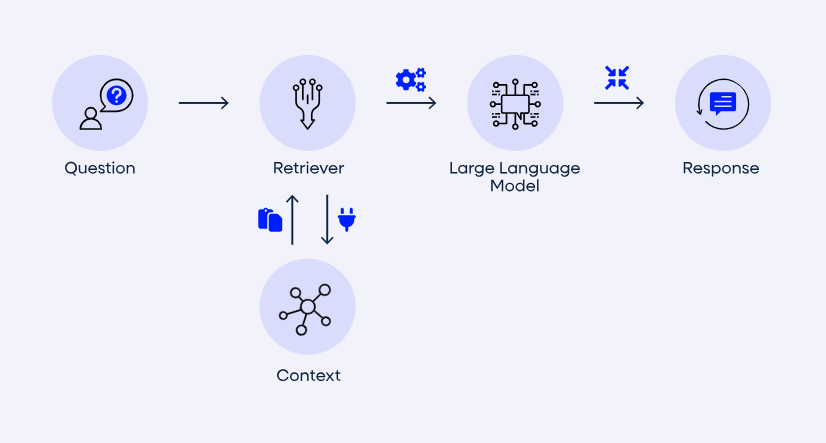
GraphRAG architecture
Unlike traditional RAG approaches that send chunks of text to a model, GraphRAG provides structured entity data along with descriptions, properties, and interconnections. This gives the AI a richer understanding of the data and how different elements relate to one another — providing teams with answers they can trust. For example, Graphwise helped a leading European manufacturer unify scattered product information into a central searchable hub, enabling teams to retrieve verified product specifications quickly
When you ask a question, GraphRAG doesn’t just match keywords; it also considers the context. It examines the relationships between concepts and retrieves answers supported by actual sources. The outcome is faster, more reliable insights. Analysts spend less time verifying results and more time making decisions, while AI outputs become easier to trust and apply across business processes.
What makes GraphRAG stand out:
- Context-aware retrieval — Preserves document meaning and relationships to deliver richer and more precise responses.
- Traceable insights — Every output links back to its verified source, improving transparency and trust.
- Efficiency at scale — Reduces LLM costs through smarter retrieval and minimal redundant queries.
- Scalable architecture — Handles millions of records and multilingual datasets without performance loss.
- Improved accuracy — Minimizes hallucinations and manual validation by grounding AI responses in connected, real-world data.
By uniting structure with intelligence, GraphRAG transforms disconnected data into a reliable foundation for faster, more confident decisions.
How GraphRAG works
GraphRAG turns complex queries into clear, actionable answers by combining structured knowledge with AI. Here’s how it works.
Smart formation
GraphRAG starts with a built-in assistant — a smart query builder — that helps users shape their questions. As you type, it suggests relevant concepts and completes terms, making it easier to ask precise, domain-specific queries without guessing the right wording.
Semantic retriever
Once the query is set, the retriever scans the knowledge graph to find information that matches the question. It identifies both directly relevant data and related concepts, providing the AI with the context needed to generate meaningful answers.
Conversational generation
The language model processes the query and the retrieved context. It delivers responses enriched with background details, and users can continue the interaction with follow-up questions. This allows the AI to refine or expand answers based on the conversation.
Document recommendation
After generating an answer, a recommendation system identifies relevant documents and summaries from the company’s knowledge base. All sensitive data stays internal, and the AI does not need access to the entire knowledge base.
Advanced RAG summary
The RAG then delivers relevant results. Each outcome is traceable back to its source, making it easy for teams to verify information and act with confidence.
Real-world use cases and industry impact of GraphRAG
GraphRAG isn’t just a theoretical improvement over traditional retrieval systems — it’s already proving its value across industries. The following are some real-world examples that show how graph-based retrieval not only improves precision but also transforms how teams interact with their data.
Global manufacturing
A global manufacturer of hydraulic systems needed a faster, more reliable way for engineers to access technical knowledge. Their existing helpdesk, powered by a standard VectorRAG setup, often produced incomplete results.
Graphwise replaced it with a GraphRAG model built on a structured taxonomy of products, incident categories, and recurring support questions. Technical manuals were analyzed and transformed into a connected knowledge graph linking parts, systems, and issues. Within days, accuracy rates improved from around 35–40% to nearly 80%.
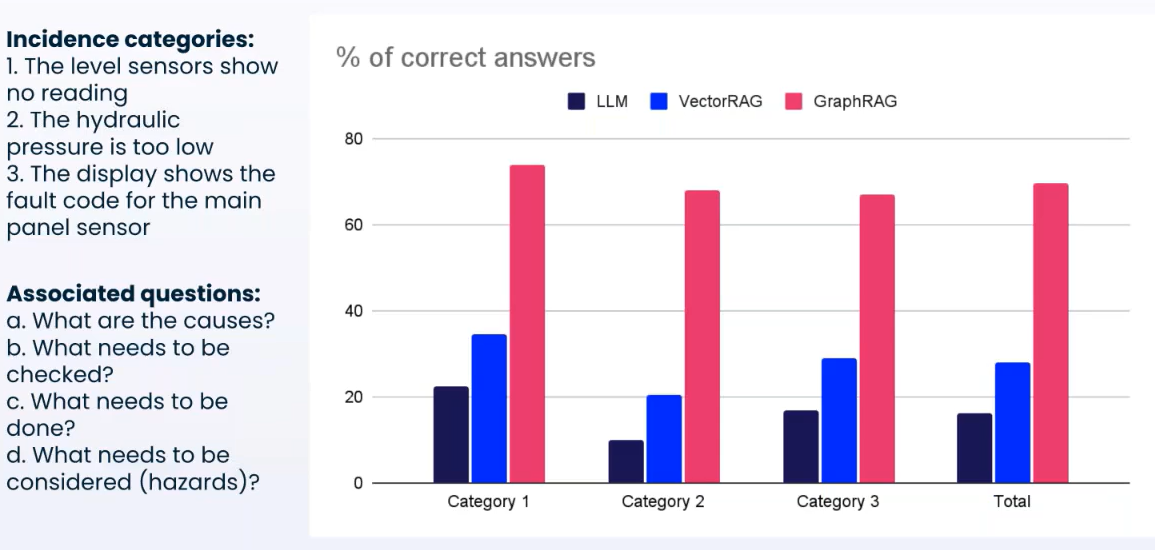
% of correct answers achieved by LLM vs. VectorRAG vs. GraphRAG
Research organizations
One of Europe’s largest research organizations wanted to simplify how staff accessed internal policy information. With hundreds of multilingual policy documents, finding accurate answers to compliance-related questions was time-consuming and often confusing.
Graphwise introduced a GraphRAG-powered AI assistant trained on more than 500 policy documents and gold-standard question-answer pairs. Unlike the earlier vector-based setup, the new system mapped relationships among policies, terms, and departments. This enabled the AI to understand the context behind each query and achieve a correct answer rate of over 95%.
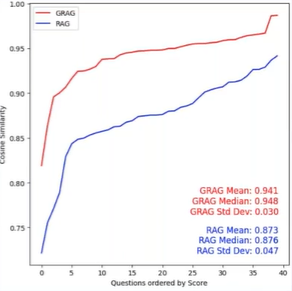
Comparison of the level of accuracy for vectorRAG and GraphRAG
Pharma and biopharma companies
In global pharmaceutical companies, data sits across countless silos — from early-stage research to large-scale production. Much of this information exists in different formats, making it hard for teams to trace product development histories or locate the right data during audits and regulatory reviews.
Using Graphwise GraphRAG, a pharma company began linking structured and unstructured data into unified knowledge graphs, turning scattered information into AI-ready content. This structured foundation allowed GraphRAG to scale seamlessly across millions of records, delivering faster insights for R&D and compliance.
Software vendors
A compliance software vendor turned to Graphwise to improve its self-service support portal, where accuracy and clarity are essential. Their existing vector-based RAG model often produced vague or incomplete answers, which created issues for users relying on precise repair or configuration steps.
With DOM GraphRAG, the company transformed its structured Darwin Information Typing Architecture(DITA) content into a knowledge graph that preserved document hierarchy and context. This allowed the system to understand how different pieces of information connect, producing answers that reflect real meaning rather than surface matches.
Consulting firms
Consultancies are exploring GraphRAG to unify knowledge across disconnected content silos, improving collaboration, content access, and operational agility. At EY, for example, the initiative focused on scaling enterprise knowledge management to support AI-driven applications.
Content from across the organization is richly tagged according to enterprise taxonomies, maintaining links to original sources and preserving context. This approach breaks down long-standing silos, allowing teams to access accurate, reliable information and enabling AI systems to provide contextualized, trustworthy insights.
You can learn more about GraphRAG’s real-world impact by watching our webinar.
The measurable ROI of GraphRAG
GraphRAG delivers clear, quantifiable impact across accuracy, efficiency, productivity, and growth.
Key outcomes include the following:
- AI accuracy and reliability — Teams see AI outputs reach 90–100% accuracy, with a 26% improvement in overall AI performance.
- Efficiency and cost — Token usage can drop by up to 80%, manual tagging is reduced by 60%, and duplicate work drops by half.
- Productivity and speed — Time to action is nearly three times faster, searches run 40% quicker, and teams save more than 30 minutes per query.
- Innovation and growth — Collaboration improves across teams, and organizations can unlock up to 25% growth in revenue by leveraging insights more effectively.
- Compliance and governance — It offers automated mapping, risk flagging, and consistent auditability — making governance simpler and more reliable.
Conclusion
Having more data doesn’t automatically translate into better decisions. True value comes when insights are timely, reliable, and actionable. Graphwise GraphRAG helps organizations make sense of complex, scattered information by connecting data, context, and relationships into a grounded, verifiable view.
Teams can move faster, spend less time validating results, and focus on decisions that matter. With measurable ROI across accuracy, efficiency, and productivity, GraphRAG transforms data into a strategic advantage rather than a burden.
Want to learn how GraphRAG brings the power of knowledge graphs to RAG systems?
