

Generative AI promises speed, but in legal and compliance, hallucinations create unacceptable risks and costly rework. This article explains how GraphRAG bases AI on verifiable facts to ensure accuracy, audit trails, and faster regulatory responses for measurable ROI.
Legal and compliance teams are under pressure to keep up with constant regulatory changes while maintaining absolute accuracy. Meanwhile, growing volumes of fragmented data increase the risk of errors, and one mistake can cost millions.
Financial institutions like Citigroup face penalties of up to $136 million for data management failures. Similarly, the Securities and Exchange Commission (SEC) recently charged nine investment advisers and three broker-dealers $4 million to $12 million in penalties for recordkeeping failures.
Many organizations have turned to artificial intelligence (AI) as a solution. Although 79% of law firms have adopted AI tools, only a fraction have genuinely transformed their operations. The reason is a lack of trust in AI outputs, since traditional large language models (LLMs) made up information up to 45% of the time in legal contexts.
LLMs create compliance risks and make teams spend excessive time verifying AI-generated insights, rather than using them with confidence.
This article explores how graph retrieval-augmented generation (GraphRAG) addresses these challenges through semantic grounding. It discusses how it delivers measurable ROI through transforming legal and compliance teams’ approach to data.
Understanding the hallucination crisis in legal AI
We must first assess the scale of the hallucination problem to understand why compliance teams hesitate to fully embrace generative AI. In high-stakes environments, “mostly accurate” is never accurate enough.
The scale of the problem
The error rates in specialized fields remain dangerously high despite the hype surrounding generative AI. Even the best-performing legal AI products hallucinate in about one out of six instances. When answering very specific legal queries, the hallucination rates for language models can range from 69% to 88%.
AI is also being used in healthcare, so hallucinations are here, too. GPT-4 hallucination rates are 28.6% in medical systematic reviews, with precision as low as 13.4%. The weakness of standard LLMs is their probabilistic nature, which predicts the next likely word rather than verifying the facts.
We are already seeing real consequences of AI-generated fabricated case law appearing in legal briefs and judicial opinions. For example, Deloitte was supposed to repay the Albanese government after using generative AI to produce a $440,000 report on the welfare system. The report was riddled with errors, false references, and incorrect footnotes.
This incident highlights that even major consultancies are not immune to the risks of ungrounded AI. When an organization relies on a system that makes up facts, they pay twice, once for the technology and again for the cleanup.
Why are hallucinations especially dangerous in compliance
Hallucination may be a quirky error in creative writing or marketing. But it’s a liability in compliance because it requires factual accuracy—errors can lead to legal issues. Also, professional liability turns personal, and the Model Rules of Professional Conduct place responsibility on legal professionals to supervise AI-generated work.
Failing to put proper verification processes in place can trigger disciplinary action, sanctions, and loss of licensure, plus long-term reputational damage.
The manual verification burden
The manual verification burden exacerbates the problem. Legal professionals spend 60-80% of their time verifying AI outputs, rather than focusing on strategic analysis. Document review processes that might take days or weeks with traditional manual approaches remain time-consuming even with AI assistance because every output must be checked for accuracy.
This inflates expenses in an hourly billing model—what should be efficient becomes a costly loop of checks and corrections. Furthermore, AI amplifies rather than alleviates the workload without better grounding.
What makes GraphRAG different: The semantic grounding advantage
The solution to the hallucination is in changing how AI retrieves and processes information. This is where GraphRAG distinguishes itself from standard retrieval methods. GraphRAG works on knowledge graphs. These are structured representations where entities, regulations, policies, and clauses are explicitly connected through defined relationships.
From probabilistic guessing to structured knowledge
Standard RAG systems use vector-based retrieval that breaks documents into text chunks. An LLM receives retrieved text chunks as context to synthesize information, then generates a coherent output.
Yet this process relies entirely on the model’s learned patterns about what language should look like—probability. If the model has learned patterns that associate certain phrases or concepts, it may generate outputs that match those patterns even if no explicit connection exists in the source documents.
GraphRAG transitions from plain text chunks to structured entity information. It includes a graph database, Graphwise GraphDB, as a source of contextual information sent to the LLM. An LLM generates the final text, but the verified graph structure constrains its generation. The model cannot hallucinate relationships that do not exist in the graph structure. It can only conclude explicitly mapped connections.
Consider a compliance scenario, a legal professional queries whether a specific data processing practice violates GDPR requirements. The LLM in a traditional RAG system retrieves GDPR documentation and information about the data processing practice. It then produces an answer based on patterns it has learned from legal reasoning.
The response may sound authoritative and even cite the retrieved documents. However, the real reasoning still happens inside the model’s probabilistic inference process. In GraphRAG, the system traverses the knowledge graph from the data processing practice node to related policy, regulation, and enforcement precedent nodes.
The relationships between these entities are clearly defined, capturing whether a practice falls under a specific GDPR article, has prompted enforcement actions, and which safeguards meet the requirements. The answer comes from these defined connections rather than from general linguistic patterns.
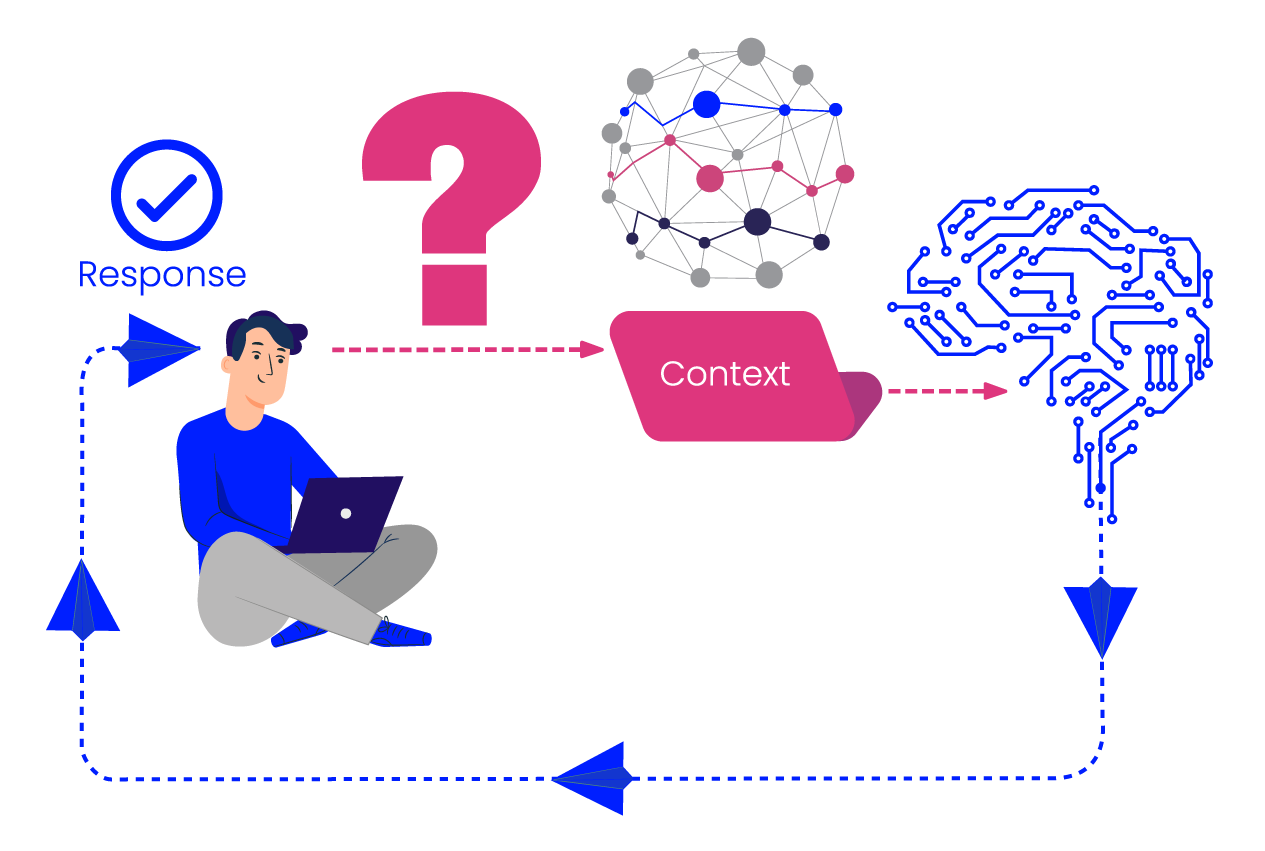
Graphwise platform overview
Explainability and audit trails
GraphRAG brings trust in compliance through auditability. Every answer traces back through knowledge graph relationships and provides transparent reasoning. Compliance professionals can see exactly which regulations, precedents, and policies supported a particular conclusion.
When auditors ask how the organization reached a compliance determination, the answer includes source citations and the explicit relationship path from the query through the graph to supporting evidence.
This transparency addresses professional liability concerns. Compliance professionals can point to a documented, verifiable reasoning chain—here’s the regulation, here’s our control—and satisfy the Model Rules of Professional Conduct requirement to supervise AI-generated work.
The accuracy improvement
The impact of semantic grounding is measurable, as it reduces hallucinations to single-digit percentages, compared to the 45% baseline for ungrounded LLMs. In enterprise implementations, organizations report moving from 60% accuracy in traditional RAG deployments to over 90% accuracy with GraphRAG.
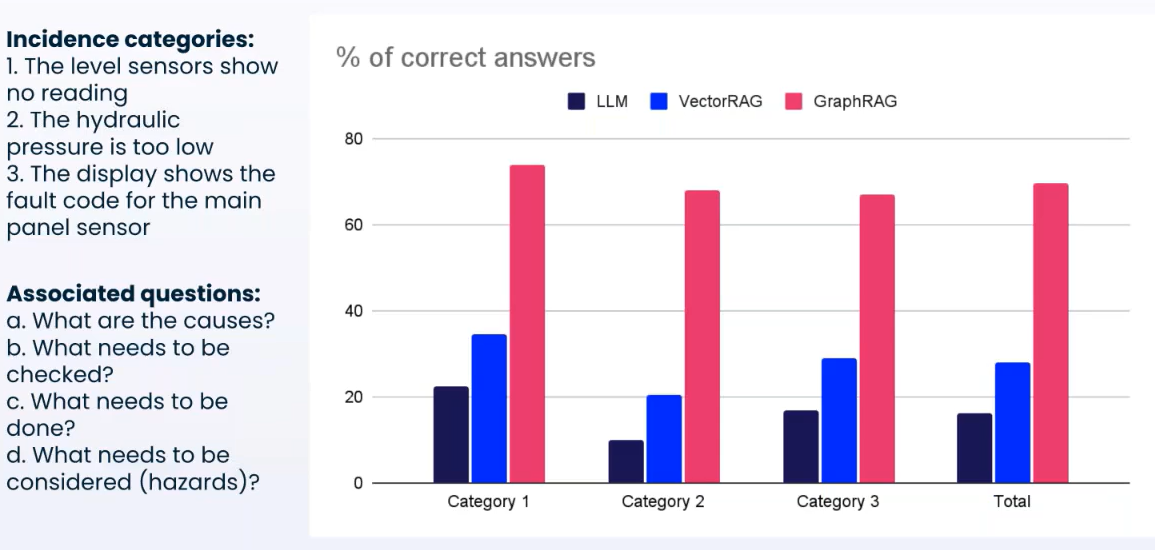
% of correct answers achieved by LLM vs. VectorRAG vs. GraphRAG
The ROI case: Measurable impact across compliance workflows
The improved accuracy and explainability with GraphRAG yield ROI across time efficiency, cost reduction, risk mitigation, increased speed, and improved decision quality.
Dramatic time savings
The one immediate ROI comes from reclaiming lost hours. AI-powered legal document review, when grounded by GraphRAG, reduces processing time by 60-80%. Legal teams can handle vastly larger volumes of data without increasing headcount.
Policy interpretation and management also accelerate dramatically. Manual compliance work requires teams to collect relevant documents, process physical and digital files by converting them to searchable formats, and conduct reviews for relevance and regulatory requirements.
GraphRAG-powered policy management eliminates these time-consuming manual processes. It redirects resources to strategic analysis of compliance gaps and control optimization. Furthermore, document automation saves up to 90% of time on legal document creation.
Cost reduction through reduced manual review
The reduction in manual review effort through semantic grounding and accurate AI outputs considerably lowers operational expenses. Firms stop paying high-value professionals to act as spellcheckers for their AI by eliminating the expensive iterative verification cycles caused by hallucinated content.
Also, there are lower audit preparation costs. Automated systems effortlessly maintain detailed compliance records and remove the costly “audit scramble” common in compliance departments.
Risk mitigation and audit cost savings
Beyond cost reduction, GraphRAG lowers professional liability exposure by providing accurate, explainable outputs that reduce malpractice risk. It also drives regulatory compliance improvements. Real-time monitoring, rather than quarterly reviews, prevents violations before they occur.
Shifting from reactive to proactive management reduces penalties, as firms can identify compliance gaps before audits rather than discovering them during reactive audits.
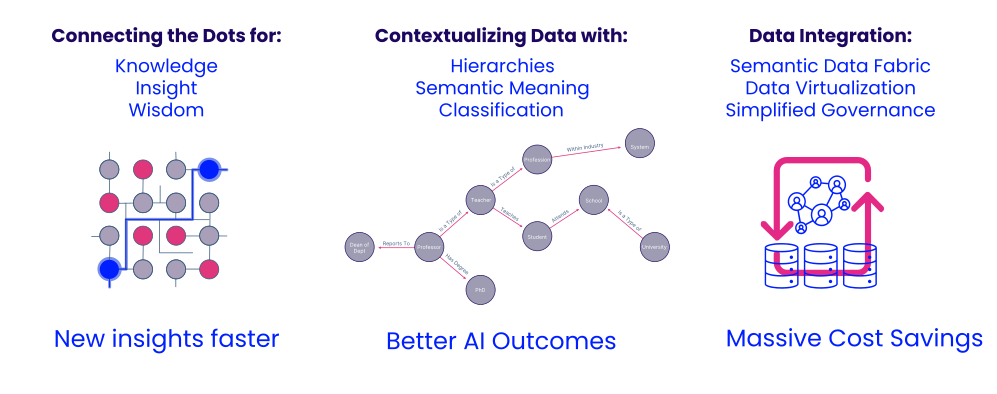
Value drivers for a knowledge graph platform in data and AI
Faster compliance cycles
Speed is a competitive advantage in regulatory adherence, and GraphRAG lets you match that speed without sacrificing accuracy. You can integrate regulatory updates into the knowledge graphs in real time within hours to ensure the AI always checks the latest requirements—far faster than traditional, manual update processes.
At the same time, continuous assurance and monitoring replace time-consuming quarterly reviews. They automatically surface compliance gaps as soon as they arise and reduce the risk of surprises during audits.
You can use knowledge graphs to analyze the impact before rolling out policy changes, preventing regressions and ensuring controls remain effective. This integrated approach accelerates regulatory response and turns agility into a source of confidence and reduced audit risk.
Improved decision quality
GraphRAG delivers substantially improved decision quality by enabling context-rich insights from knowledge graphs that provide a complete view of the regulatory space. It also allows gap detection and early identification of requirements, even when controls are not mapped or evidence is missing.
GraphRAG also supports shared control optimization to help teams identify controls that satisfy multiple frameworks in parallel — ISO 27001, SOC 2, PCI DSS, and GDPR.
Build trust and ROI with Graphwise
Building AI systems in legal and compliance that deliver trustworthy, accurate, and explainable results requires expertise and capital, too. This is where Graphwise stands apart: its purpose-built Graph AI platform offers a robust suite of capabilities tailored for trust and efficiency.
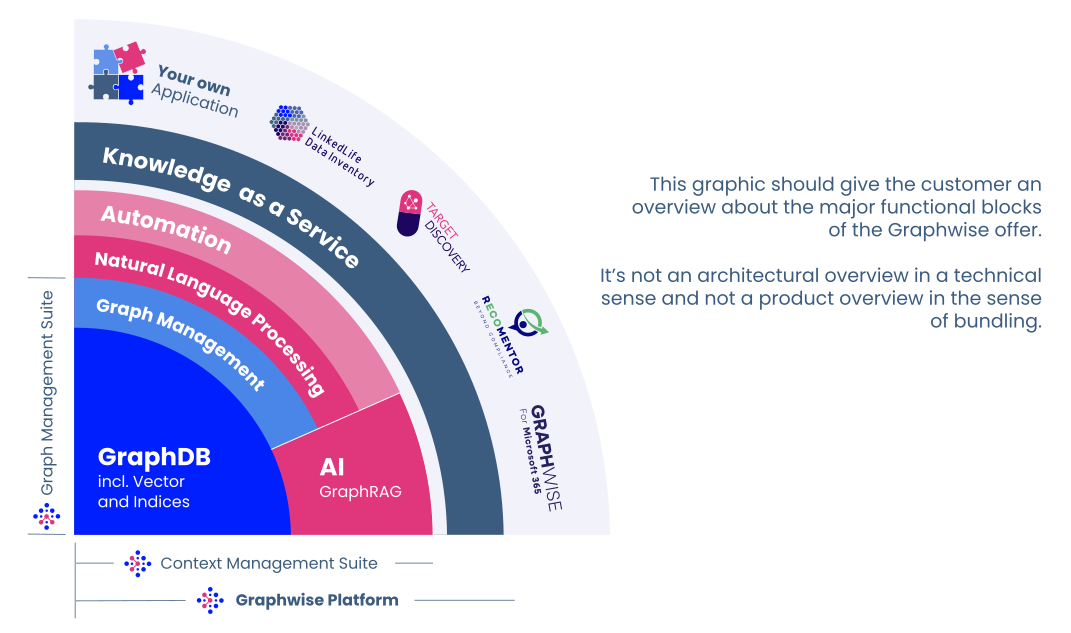
Graphwise platform overview
Key features of the Graphwise platform include:
GraphDB
GraphDB is Graphwise’s scalable and highly reliable semantic graph database stores and manages your compliance knowledge in a structured, interconnected format. GraphDB forms the single source of truth to enable semantic grounding that dramatically reduces hallucinations and supports precise fact-based reasoning.
GraphDB introduces streamlined integration with leading large language models (LLMs) and supports natural language search (Talk to Your Graph) for fast, precise AI-driven decision-making.
Knowledge graph
Graphwise helps organizations convert vast legal texts, regulatory documents, and internal policies into rich, semantically linked knowledge graphs. These graphs capture entities and regulations, define relationships and context, and enable LLMs to perform multi-hop reasoning for complex compliance queries.
Graph AI Suite
The Graph AI Suite brings modeling tools, knowledge graph management, advanced connectors, and a model context protocol (MCP) server under one roof for smooth integration with third-party AI solutions. It lowers complexity and eases end-user adoption for building customized AI applications.
Moreover, the suite models and maps raw documents into structured knowledge graphs, automates taxonomy creation, and enriches metadata through semantic analysis. It also delivers GraphRAG, which uses semantic graphs to boost LLM accuracy in legal and compliance workflows.
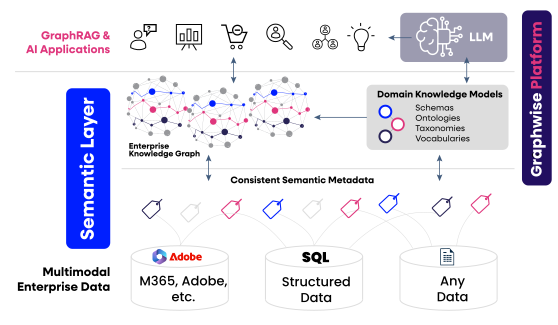
Make your data AI-ready with the Graphwise platform
Through these and many other tools, Graphwise helps enterprises reduce risk and rework, resulting in strong business returns. For instance, the Avalara vector-based RAG model lacked the accuracy needed for mission-critical tax applications. This resulted in a “Precision Paradox” in which improved accuracy led to user dissatisfaction due to errors.
Avalara implemented a DOM GraphRAG proof-of-concept model using Graphwise’s Graph AI Suite to leverage their existing DITA-structured content. They built a reliable knowledge graph base for trustworthy AI solutions.
Similarly, Healthdirect’s fragmented content from hundreds of partners and siloed data systems made it difficult to deliver unified, user-friendly health services at scale. To address this, they used Graphwise’s Graph AI Suite to build a semantic knowledge graph that automated content classification, enabled dynamic content generation, and powered smart search.
Wrapping up
GraphRAG resolves AI’s legal pitfalls, grounding outputs for reliability and ROI. It helps teams save time, reduce costs, lower risk, and make better decisions.
With Graphwise, you gain a proven partner. The company has helped global financial institutions, pharmaceutical companies, and professional services firms transform scattered regulations and policies into a single, trustworthy source of truth.
Teams finally spend their time on strategy rather than second-guessing AI, auditors receive transparent trails on demand, and organizations stay ahead of regulatory change rather than react to it.
Want to learn more about GraphRAG?
