
In an era of information overload, organizations are no longer struggling to find data, they are struggling to understand it. Most of an organization’s knowledge is trapped in “unstructured” formats such as PDFs, news feeds, emails, and reports.
Semantic text intelligence is the specialized field that bridges the gap between human language and machine understanding. It is not a single technology, but rather a synergistic combination of machine learning, text analysis, information extraction, and event extraction. Together, these tools transform raw text into a structured, queryable knowledge graph that allows machines to reason about the world much like humans do.
The four pillars of semantic text intelligence
To understand semantic text intelligence, we must look at the four core components that power it:
- Machine learning
- Text analysis
- Information extraction
- Event extraction
What is Machine Learning?
Machine learning (ML) is about teaching AI systems and programs to recognize patterns by giving them a lot of examples to learn from.
In other words, by creating ML algorithms, we aim to make a computer “see”, “hear” and “read”. For a computer to acquire such cognitive abilities, which are natural for our brain, it needs to be programmed to identify the patterns in various types of data and to compute what these patterns are about.
Once developed and trained, ML algorithms create systems that don’t just process data, they interpret and anticipate it.
Consider how we interact with technology daily. When you open Spotify, the ‘Discover Weekly’ playlist isn’t a random selection of songs; it is the result of ML algorithms analyzing your unique listening habits against millions of other users to predict your next favorite track. Similarly, Netflix uses sophisticated ML to analyze your viewing patterns and curate a personalized homepage.
In the world of semantic intelligence, we apply this same predictive power to text. Just as Netflix predicts what you want to watch, ML in text analysis predicts the meaning and intent behind words, allowing systems to serve up the exact information a user needs before they even finish their search.
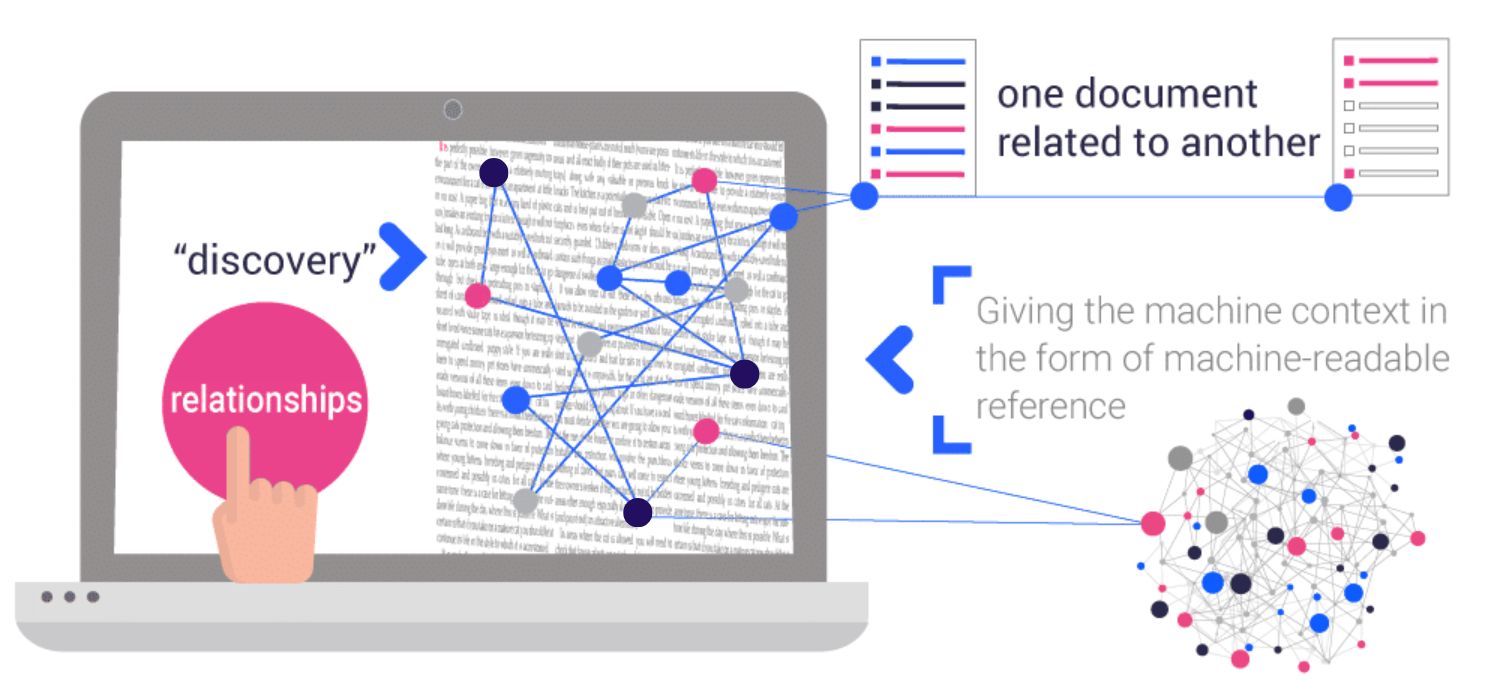
When it comes to text and its understanding, , ML is used to automate and scale 3 core processes:
- Relationship discovery: Connecting people, events, or documents across different sources.
- Semantic annotation: Identifying and tagging the specific entities and locations mentioned in a text.
- Document classification: Sorting vast amounts of information into categories based on topic and intent.
To achieve this, the machine follows a two-step learning approach: first, it is fed massive datasets and documents to identify patterns; second, it is provided with machine-readable context and references (such as Wikidata or another knowledge base) to link entities to real-world relationships.
What is text analysis?
Text analysis is the process of transforming unstructured text into a machine-readable format. Because human language is naturally messy (filled with slang, ambiguous meanings, and complex grammar), computers cannot simply “read” it like a spreadsheet.
The process of text analysis can be thought of as slicing and dicing pieces of unstructured, heterogeneous documents into easy-to-manage and interpret data pieces.
The main challenge this process solves is ambiguity. For instance, a simple headline like “Red Sox Tame Bulls” is easily understood by a sports fan, but a machine might interpret it literally as an event involving animals. Text analysis uses background knowledge and concept awareness to ensure the machine interprets the intended meaning rather than just the literal words.

To achieve high accuracy for a specific domain, text analysis requires the development of customized text mining pipelines.
Often used interchangeably with text mining, text analysis is the process of translating unstructured text into structured data, essentially “preparing” content so that text analytics can then mine it for insights. It relies on information extraction to retrieve specific facts efficiently, balancing computational performance with accuracy (precision and recall) rather than attempting full linguistic understanding.
What is information extraction?
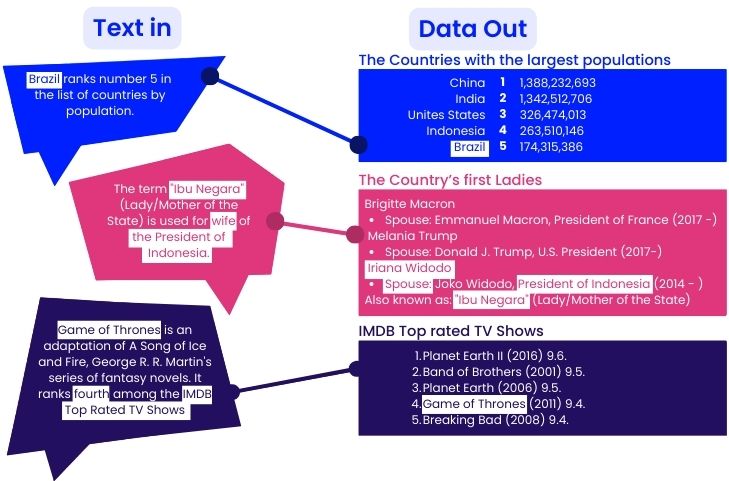
Once the text is analyzed, we need to pull out the “facts.” Information extraction is the process of pulling specific, pre-defined information from unstructured textual sources to enable finding, classifying and storing entities in a document such as people, organizations, locations, and dates.
Unlike full natural language understanding, which tries to “read” like a human, information extraction transforms a “blob of text” into structured data that can be stored in a database or a knowledge graph.
Typically, for structured information to be extracted from unstructured texts, the following main subtasks are involved:
- Pre-processing of the text – this is where the text is prepared for processing with the help of computational linguistics tools such as tokenization, sentence splitting, and morphological analysis.
- Finding and classifying concepts – this is where mentions of people, things, locations, events, and other pre-specified types of concepts are detected and classified.
- Connecting the concepts – this is the task of identifying relationships between the extracted concepts.
- Unifying – this subtask is about presenting the extracted data into a standard form.
- Getting rid of the noise – this subtask involves eliminating duplicate data.
- Enriching your knowledge base – this is where the extracted knowledge is ingested in our database for further use.
Information extraction can be entirely automated or performed with the help of human input.
Typically, the best information extraction solutions are a combination of automated methods and human processing.
While information extraction helps for finding entities, classifying and storing them in a database, semantically enhanced information extraction couples those entities with their semantic descriptions and connections from a knowledge graph. The latter is also known as semantic annotation. Technically, semantic annotation adds metadata to the extracted concepts, providing both class and instance information about them.
Semantic annotation is applicable for any sort of text – web pages, regular (non-web) documents, text fields in databases, and so on. Further knowledge acquisition can be performed on the basis of extracting more complex dependencies – analysis of relationships between entities, event and situation descriptions and more.
Extending the existing practices of information extraction, semantic information extraction enables new types of applications such as:
- Highlighting, indexingq and retrieval
- Categorization and generation of more advanced metadata
- Smooth traversal between unstructured text and available relevant knowledge
What is event extraction?
If information extraction identifies the entities (characters in a story), event extraction identifies the relationships and actions between them (the plot). It is a specialized branch of information extraction that recognizes specific occurrences such as mergers, terrorist attacks, or product launches and the roles that different entities play within them.
From raw text to a knowledge graph
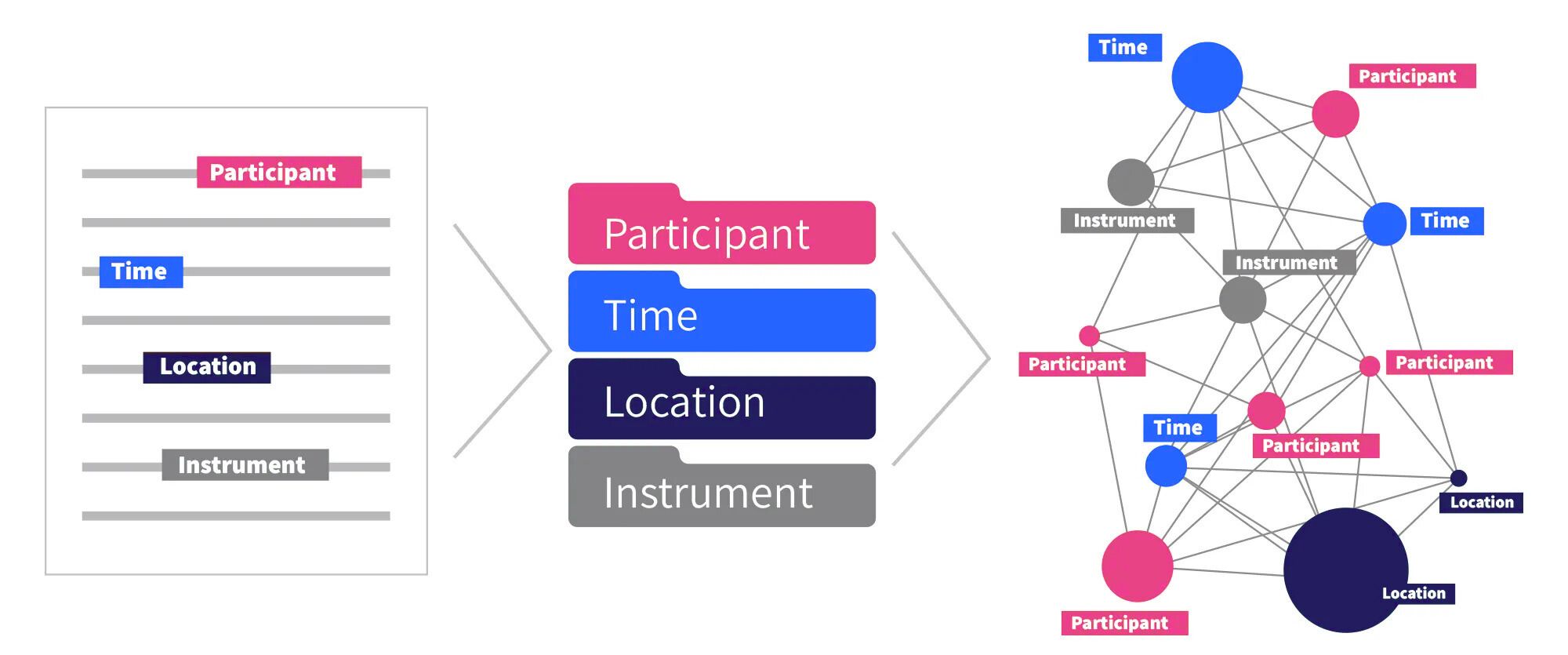
The ultimate goal of semantic text intelligence is to fuel a knowledge graph.
Imagine your company’s data as a massive, interconnected web. Information extraction provides the “nodes” (the people and companies), and event extraction provides the “edges” (the deals, hirings, and lawsuits connecting them). ML ensures this map grows and learns over time, while text analysis ensures every new document is processed accurately.
Why it matters
By combining these four topics into a single semantic text intelligence strategy, organizations can:
- Automate research: Scan thousands of news articles to find emerging risks in a supply chain.
- Improve discovery: Link internal R&D documents with external scientific papers to speed up drug discovery.
- Enhance search: Move beyond keyword matching to “Semantic Search,” where the system understands the intent behind a query.
Conclusion
Semantic text intelligence is more than just “reading” text; it is about extracting the meaning and context that makes data valuable. By leveraging ML to power advanced extraction techniques, businesses can finally unlock the 80% of their data that was previously “hidden” in text.