
GraphRAG
The Trust Layer for Enterprise AI: Production-Ready GraphRAG
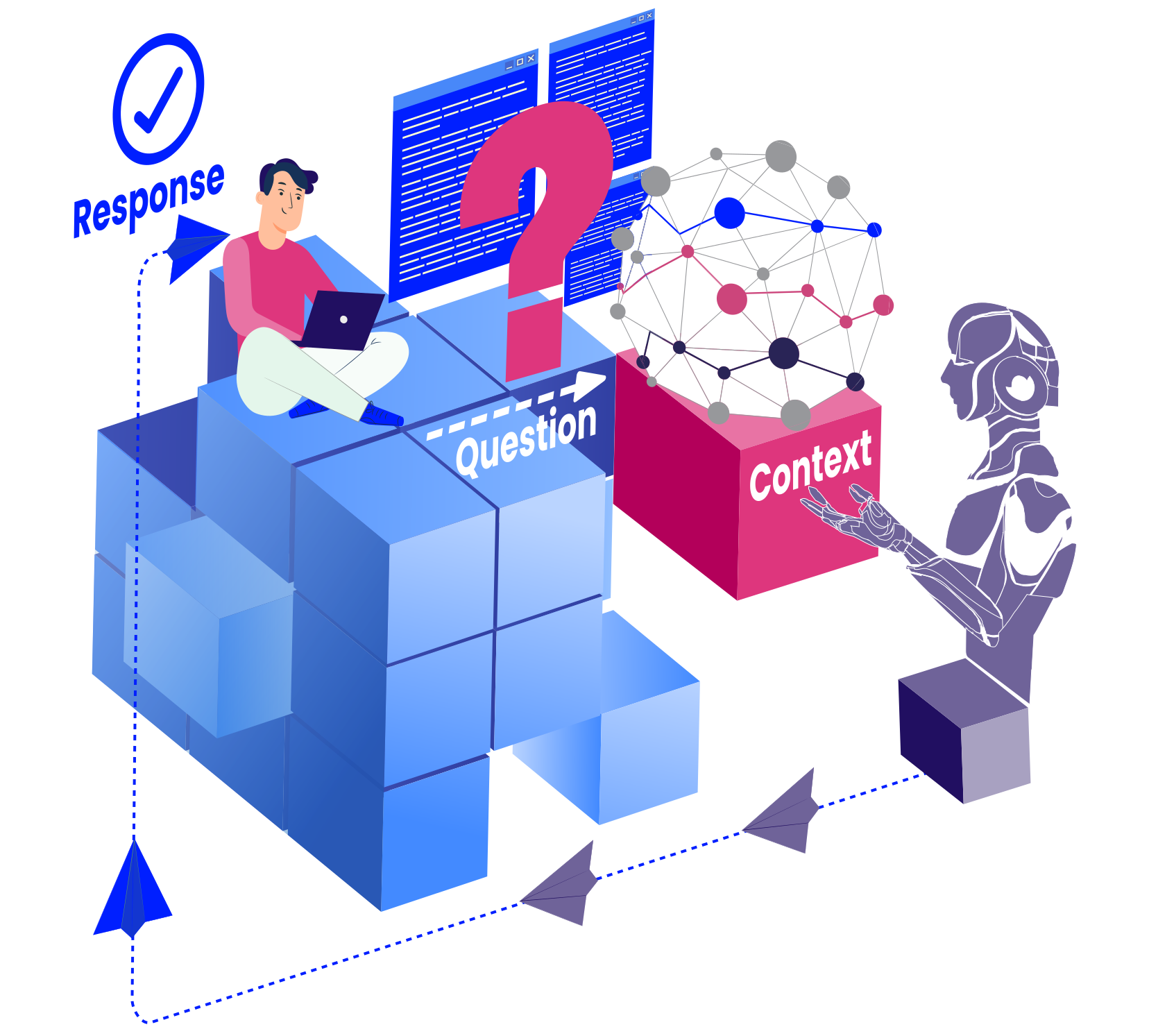
While LLMs offer a massive competitive advantage, they are inherently domain-agnostic and “frozen” in their training state. For enterprises, this creates a dangerous “Hallucination Gap” where the AI generates confident but factually incorrect or nonsensical answers.
To turn AI into a reliable business tool, you must ground it in your proprietary, real-time data. This is the goal of Retrieval-Augmented Generation (RAG).
What is RAG?
Retrieval Augmented Generation (RAG) is a framework designed to make LLMs more reliable by providing them with relevant, up-to-date knowledge from a company’s documents. This context is then fed to the LLM alongside the user’s question, ensuring the response is based on specific facts rather than generic internet data.
However, conventional RAG has a significant limitation: it treats your data as a flat list of text chunks. It can find similar words, but it cannot understand the complex relationships, hierarchies, or logic that connect your business information.
What is GraphRAG?
GraphRAG (Graph-enhanced RAG) is the evolution of AI retrieval. It replaces the flat, “vector-only” approach with an an advanced architecture that uses a Knowledge Graph to provide a “context-infused” retrieval layer.
By mapping your data into a network of entities and relationships, GraphRAG allows the LLM to navigate your enterprise knowledge like an expert, not a keyword search engine.

Relational Intelligence
Instead of treating data as isolated “chunks,” GraphRAG understands hierarchies and dependencies, following your business logic
Multi-Hop Reasoning
GraphRAG is able to connect the dots across multiple disconnected documents to answer complex, interconnected questions
Deterministic Grounding
LLMs are forced to follow the logical paths defined by Knowledge Graphs, ensuring every answer is verifiable and auditable
Overcome the Limits of Large Language Models
The possibility of hallucinations with LLMs can never be ruled out, but we can significantly limit their frequency by replacing “guessing” with “Graph-based grounding.”
Type of Hallucination
Nonsensical output. The LLM generates responses that lack logical coherence and comprehensibility.
Factual contradiction. This type of hallucination results in the generation of fictional and misleading content, yet still are presented as coherent despite their inaccuracy.
Prompt contradiction. The LLM generates a response that contradicts the prompt used to generate it, raising concerns about reliability and adherence to the intended meaning or context.
Problems With Conventional LLM
LLMs sometimes have problems with understanding context. They may not be able to distinguish between different meanings of a word and use it in the wrong context. The higher the ambiguity of a query, the higher the probability of leading the LLM down the wrong path.
The data with which the LLM was originally trained is not relevant in terms of time or context to solve the question posed. The LLM begins to fill in the data gaps with hallucinations.
LLMs have their own rules, policies and strategies set by their parent company. They prevent them from distributing unwanted content, even if it is contained in the training data. If the LLM detects a violation of these rules, possible responses are decoupled from the request.
PREMIUM
Mitigation With Semantic RAG
The Smart Query Builder injects the semantics of a word when formulating the query and thus unmistakably determines its meaning for the LLM.
The contextual and domain-specific knowledge provided in the Semantic RAG fills in data gaps and leads the LLM to meaningful answers.
The Smart Query Builder guides the formulation of the prompt and can take the rules of the LLM into account in advance. Of course, changing the LLM provider or fine-tuning can also shift the rules.
Unlocking the Business Potential: KPIs and ROI
Across all industries, there is a consensus that the use of LLM can increase productivity in almost all areas of a company. According to a study by Deloitte, 82% of managers believe that AI will improve the performance of their employees. Gartner predicts that companies will save at least 20% by using Generative AI in the coming years.
Shorten the Time to Insight
According to IDC, a knowledge worker spends around 30 % of their working day searching for information – primarily reviewing search results and processing them. Instead of long lists of documents, our GraphRAG solution delivers summarized facts.
Outcome: An increase in operational efficiency of 15-20%.



Savvy querying for the untrained
That’s a dilemma! Companies want to familiarize their employees with a topic quickly. However, in order to make successful search queries, domain knowledge (jargon and terminology) of a subject area is required.
Outcome: Our AI-guided search assistant helps inexperienced users formulate queries correctly, enabling on-the-fly exploration and faster onboarding.
Low-cost for Implementation and Maintenance
It is common knowledge that even the best pretrained LLMs might not always meet your specific needs. You need to customize the model in terms of expertise, vocabulary and timeliness. To adapt it to your specific requirements, you need to optimize it. Fine-tuning models is costly and requires significant computing power.
Outcome: By combining Prompt Engineering with GraphRAG, we cut implementation and maintenance costs by 70%, creating an ROI increase of 3x or higher.
Costs in %
Graphwise Enterprise-Ready Workflow Engine
Most companies struggle to move RAG solutions from development to production because current systems are often “black boxes” built with complex, code-heavy frameworks
Graphwise GraphRAG is the first production-ready “Trust Layer” designed to turn these prototypes into enterprise-grade systems with zero friction.
Graphwise democratizes the creation of advanced AI systems by empowering the entire technical team, and not just senior developers, to build, debug and ship AI workflows. Graphwise GraphRAG bridges the gap between complex enterprise data and reliable, trustworthy AI agents through a low-code, visual workflow engine.
Rapid Time-To-Value
Pre-loaded templates to deploy in days rather than quarters
Visual Debugging
High-control interface to trace execution paths and troubleshoot
Guardrails & Governance
Built-in filters to ensure safety, compliance, and factual consistency
Step by Step
Our GraphRAG architecture uses a cascade of context-infused methods to ensure maximum precision:
Step 1: Smart Query Builder
An assistant helps formulate targeted, domain-specific queries through auto complete and concept suggestions.

Step 2: Knowledge Retriever
The text mining implemented in the retriever extracts the semantic context of the query and provides the LLM with a list of directly identified and related concepts.
Step 3: Conversational Generation
The LLM processes the query and the graph-derived context to produce an answer enriched with background facts.
Step 4: Document Recommender
A recommendation algorithm identifies the exact source documents that match the human-machine dialog, ensuring data security and provenance.
Step 5: Explainable Conclusion
The final stage produces a summarized, easy-to-understand conclusion with clear links to the evidence.
Example applications


Conversational AI and Generative Search Experiences
The best choice if you want to harness the developments of Generative AI for your company. This option provides all the benefits explained above including recommendations and conversational generation.
Avalara Success Story
Avalara overcame the limitations of vector-based RAG by implementing a DOM GraphRAG proof of concept model. They used their existing DITA structured content to achieve 100% precision in content mapping. This established a foundation for reliable, mission-critical AI applications in tax and financial services.
Useful Resources
Component
Graphwise GraphRAG
Scale your enterprise intelligence with a GraphRAG solution from Graphwise. Move from concept to production in days, not months.
Fundamental
What Is GraphRAG?
White Paper
The Semantic Advantage: Scaling Enterprise-Ready GraphRAG and Trustworthy AI with Graphwise
By 2027, more than 40% of digital workplace operational activities will be performed using management tools that are enhanced by GenAI, dramatically reducing the labor required.
Predicts for Generative AI, Cameron Haight, Chris Matchett 2024
Get more insights in the white paper
Download this white paper to discover how Graphwise platform offers an enterprise-ready, low-code engine to operationalize explainable, governed and context-aware AI for the modern enterprise.