What Is Ontology?
An ontology is a formal, machine-readable description of knowledge as a set of concepts within a specific domain and the relationships between them (what things are, what they mean, and how they relate to each other).
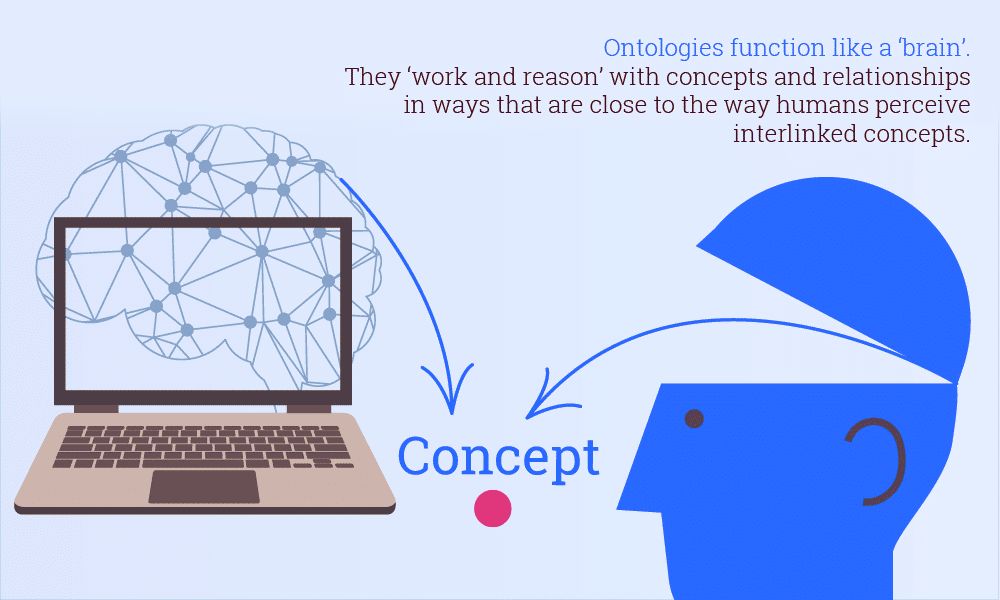
Its purpose is to create a shared and unambiguous understanding of the information within a specific area of knowledge and make explicit domain assumptions. This enables computers to “reason” about data in a way that is similar to how humans perceive interlinked concepts.
As a key component of semantic technology and the Semantic Web, an ontology acts as a framework for representing and sharing reusable knowledge. It is often represented as a knowledge graph, where concepts are nodes and relationships are edges.
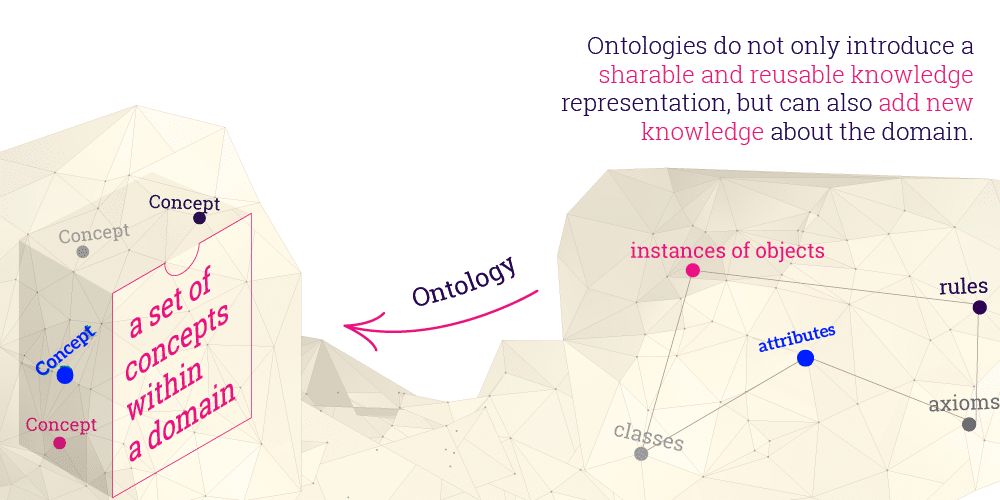
Key components of an ontology
An ontology typically includes:
- Classes: Sets or collections of objects in a domain
- Individuals: Instances of a concept or class
- Attributes: Properties describing classes and individuals
- Relations: Properties that definite the interactions or relationships between concepts and their attributes
- Axioms: Rules or statements that impose restrictions on how these concepts and relationships can be used or enable logical inferences
The OWL standard and ontology modelling
The Web Ontology Language (OWL) is a widely used language for expressing rich and complex ontologies. OWL enriches ontology modeling by providing detailed and consistent distinctions between classes, properties, and relationships.
When used with a reasoner in a semantic graph database (also known as an RDF triplestore), OWL enables consistency checks to find logical inconsistencies and ensures satisfiability checks to confirm that classes can have instances. Additionally, OWL helps in defining equivalence between instances, classes, and properties, which is vital for matching concepts from different data sources and for disambiguating between instances that share the same names.
The benefits and limitations of ontologies
Ontologies offer several significant benefits:
- Common understanding and less ambiguity: They provide a shared language for companies and departments, preventing miscommunication
- Automated reasoning: The relationships built into ontologies enable automated reasoning about data, which is easy to implement in semantic graph databases
- Flexible and extensible: Unlike simple taxonomies or rigid database schemas, ontologies can easily evolve as new relationships and concepts are added. This allows the model to grow with the data without disrupting dependent systems
- Interoperability: By providing a shared vocabulary, ontologies enable smooth data integration and cross-database search across heterogeneous systems
While ontologies provide a rich set of tools for modeling data, building and maintaining ontologies can be resource-intensive and time-consuming, requiring deep domain knowledge and consensus from various teams. Another challenge is the limited set of property constructs in OWL2, which is being addressed by languages like RDF-Star.
As a novel alternative to using ontologies for data modeling, the Shapes Constraint Language (SHACL) is a powerful tool for validating RDF graphs. Unlike OW, SHACL can be used to validate data that is already available in the triplestore, making it a flexible option for ensuring data consistency.
Since ontologies define the terms used to describe and represent an area of knowledge, they are used in many applications to capture relationships and boost knowledge management.
Do you want to test how ontologies help interpret the data in a knowledge graph?