

It’s 2026. The Web has grown into 1.2 billion websites and counting. Not only that but the architectonics of how people interact with content is being widely reshaped. The rise in AI tool adoption and the new discovery channels like AI-powered search and chatbots have changed how audiences access online information.
In that landscape, one thing has become impossible to ignore: users don’t need more content. They need better access to relevant knowledge as well as platforms that allow for meaningful, trustworthy, and traceable interaction with information sources. They need actionable results from searches across systems, retrieved quickly and accurately, in the moment of their need, tailored to their specific context.
Content for action, not consumption
In my case, as a Knowledge Steward at Graphwise, the users I work for are our Sales team people. In my role, my goal is very specific: to create content that enables them to do their job better and faster, and to be confident that the information they get is up-to-date, trustworthy, and value-oriented.
Such a job is not easy as the test for content is immediate – it either helps move the conversation forward, or it doesn’t. Case in point: when a sales rep is on a call, they don’t have time for browsing and berry-picking information. They need specific answers for a specific context, and not documents, blog posts, or webinar summaries.
That challenges our Sales Enablement team to create and maintain relevant content that can be retrieved faster, be trustworthy, and accessible in a conversational way. It also calls for a change in the mindset of ideating, planning, and publishing content. What was before a theoretical exploration of how organizational communication is increasingly moving from organization-controlled model stakeholder-centric and less message-controlling participatory communication is now a practical requirement we cannot afford to ignore.
And so we did not.
Walking the AI-ready content talk with the Graphwise Knowledge Hub
We, at the Graphwise Sales Enablement team, shifted the way we look at content ideation, creation and distribution. We stopped thinking about content as artifacts and started thinking about content from the perspective of knowledge management, knowledge graph building, and enterprise-wide coherence in communication.
It has now been almost a year since we started building the Graphwise Knowledge Hub, using Graphwise technologies, and strategically walking our own knowledge graph talk. Along the way, we learned a lot. And as I see more and more organizations trying to build their own “knowledge hub” or “single source of truth,” I want to share some of the key lessons we learned building our Graphwise Knowledge Hub.
Spoiler alert: These are three things people working in content already know but often don’t have the technology, mandate, or change-management support to truly enact.
Graphwise Knowledge Hub (At a Glance)
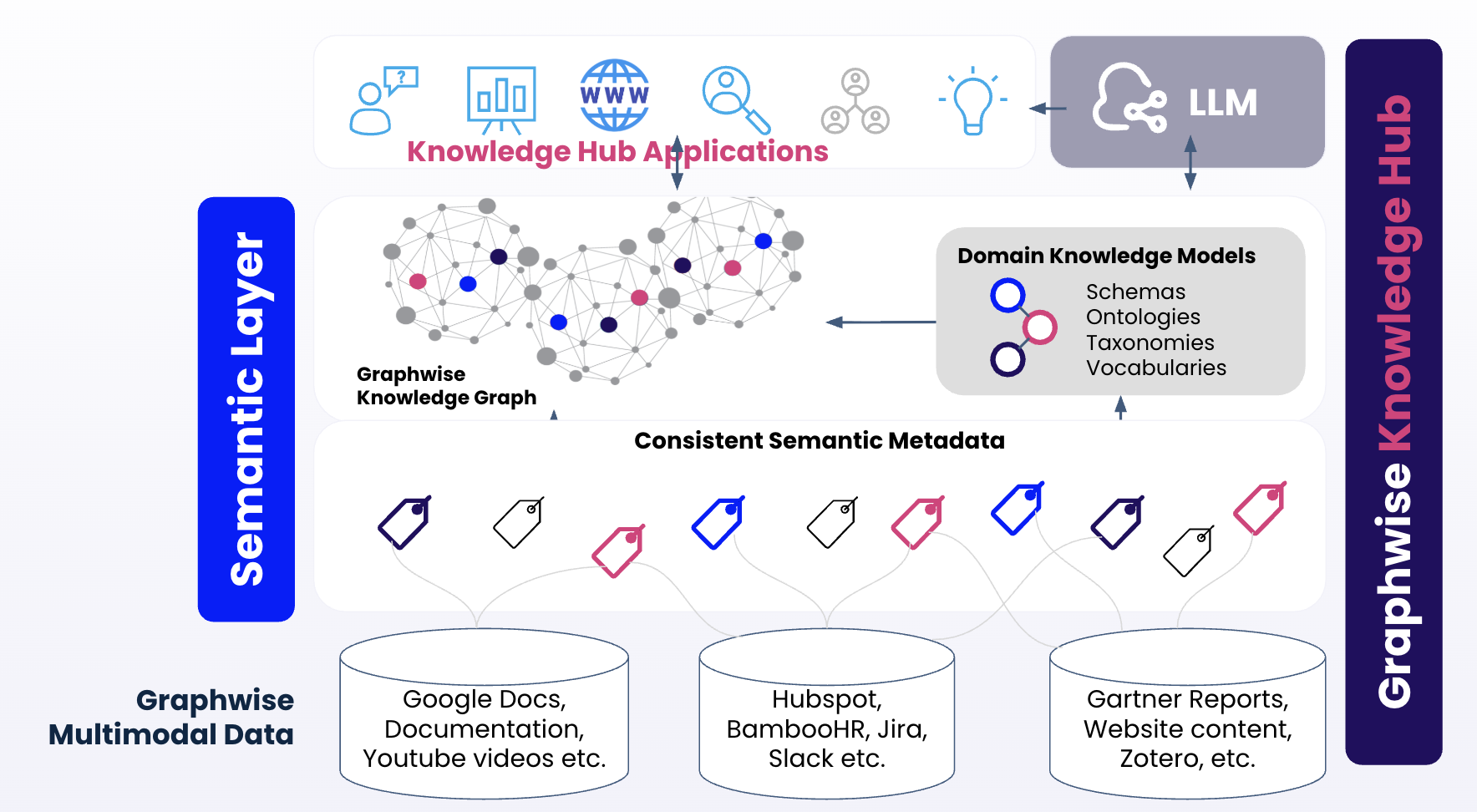
The Graphwise Knowledge Hub is an application on top of the Graphwise Knowledge Graph and is built using Graphwise Platform. It is currently powering several internal applications including a GraphRAG application, several Sales Agents and a semantic search over our technical documentation. The Graphwise Knowledge Hub is a constantly evolving infrastructure and with time will power more applications and agents e.g. a Marketing Assistant on our website, an interactive conversational application with facet filter, a Market Research Agent and more.
Lesson 1: The push-to-pull shift is real and calls for a change
You don’t need me to point you to the endless references about conversational content and the need to “talk with” audiences rather than “talk at” them. What is worth repeating though is the role that content grounded in knowledge graphs can play in making that talk a real walk along the alley of user-centric content.
In our case, building a Knowledge Hub for sales enablement meant creating content in a way that allowed sales teams to pull information and to talk to the content we had. To do that, we needed to not only create content in a way that allowed it to be composed ad hoc. We also needed to do it using agreed-upon concepts shared across systems and departments for enterprise-wide coherence in our communication.
This inevitably led to cross-department alignment around terms that organically grew into a messaging work: we needed to figure out not only the terms, but also the business logic through which they relate to each other. For example, how Graphwise GraphDB serves a given use case and what are the capabilities it has that move a specific business needle.
Only after such diligent work on knowledge management, led by Helmut Nagy (VP Sales Enablement at Graphwise), were we able to start working with and creating content that is truly pullable, modular, and composable.
In a nutshell
People don’t have time to browse, interpret, or reconcile conflicting sources. They need to pull answers, not documents, and they need to be able to set the context themselves. That said, content operations are to be centred around designing content for retrieval, not publication. They also need to be done with a view to capturing meaning in an explicit way before worrying about format. Last but not least we should be treating definitions and other cornerstone content chunks as first-class content assets.
Lesson 2: Good content is about building knowledge management scaffolding
This is a lesson I have come across in my theoretical explorations and writing work for years as a content person, but only truly learned it in practice from Helmut Nagy: How important it is to bring people together, talk, discuss concepts, agree upon terms, messaging, operational synergies, etc.
Over the past year, the Graphwise Knowledge Hub was built as an AI-driven platform bringing together CRM data, marketing materials, product documentation, website content, market research, and more. But the real transformation happened when it evolved into a shared, knowledge graph-driven platform where people could find what they need based on tags, interests, topics.
What we learned along the way is building a knowledge hub that serves reliable answers and trustworthy content meant doing some grunt work in the first place. Case in point: first we went through the processes of defining core concepts clearly and aligning and mapping terminology across teams. Next, we put a substantial amount of effort into understanding well and modelling the relationships between products, industries, and use cases. Finally, we built feedback loops so that the knowledge we added in the Graphwise Knowledge Hub would be relevant and well-tied to the ecosystem of knowledge that was growing in the organization.
This work alone brought us to creating workflows in which we ideate and write content at the level of concepts, not pages. We also work in a way that allows us to further assemble content into multiple narratives (for example, for sales, for marketing, for SEO).
In a nutshell
Lesson 3: AI is only as good as the knowledge you feed it
AI is often presented as the solution to enterprise knowledge problems, but we know from customer projects and from experience that the real story isn’t in the AI itself. The differentiator is the actionable content and contextual knowledge an organization manages to provide to the AI system.
What we didn’t know was that the Knowledge Hub would become also a focal point not only for people, but also for AI agents, as it was by default a hub for aligned meaning in the first place.
For me, from a content perspective, this not only means that content is to be used to “feed” our AI systems. It also means that it is to be created in a way that allows it to be assembled, and not simply authored. That said, what we now know is that instead of creating static assets, we can create conceptual building blocks anchored in the knowledge graph.
Thus, we can get more reliable output from an AI system, depending on who is asking, in what context, and for what purpose. To do that, we approached any AI agent or system as a consumer of structured knowledge and as an addition to our knowledge and content work, not a replacement or automatization.
In a nutshell
Instead of an epilogue: Join us for our webinar
As a Knowledge Steward, my role is not to create more content, nor to police language. Neither is the work of my colleagues who are part of the Sales Enablement team. Our work is to design and maintain the scaffolding that allows knowledge to accumulate, connect, and stay usable over time.
And when we learn our lessons and follow sustainable practices for connecting knowledge, sales enablement accelerates, communication improves, onboarding becomes easier, and content creation becomes faster.
I really hope that our approach will help you on your own knowledge graph journey towards AI-ready content and enterprise insights.
If you liked this sneak peek into the content kitchen of the Graphwise Knowledge Hub, come to see our Graphwise Knowledge Hub in action and to hear about the ecosystemic rationale and impact of the Graphwise Knowledge Hub.
In our on-demand webinar: From Silos to Shared Intelligence: Inside the Graphwise Knowledge Hub, Helmut Nagy and I share:
- What we built and why
- The lessons learned from real internal use
- How we evaluated whether the Hub truly accelerates enablement, communication, and content creation
- A live demo of the Knowledge Hub so you can explore it yourself
Because the future isn’t about creating more content. It’s about creating systems that make knowledge actionable – on demand.
