
Metadata represents data about data. It enriches data with information which makes it easier to discover, use, and manage.
Metadata is information about data like labels, tags, authors, definitions, classifications that enriches data and makes it easier for computers to discover, use, and manage.
To provide an example of metadata, think of a library card: the book is the content (data), while the card’s information such as the author, title, and publication data, is the metadata. Another example is provided by HTML tags which instruct web browsers how to layout the pages to make it easier for humans to read them and follow references to other pages.
Metadata helps computers interpret the meaning of data via references to concepts in a knowledge graph.
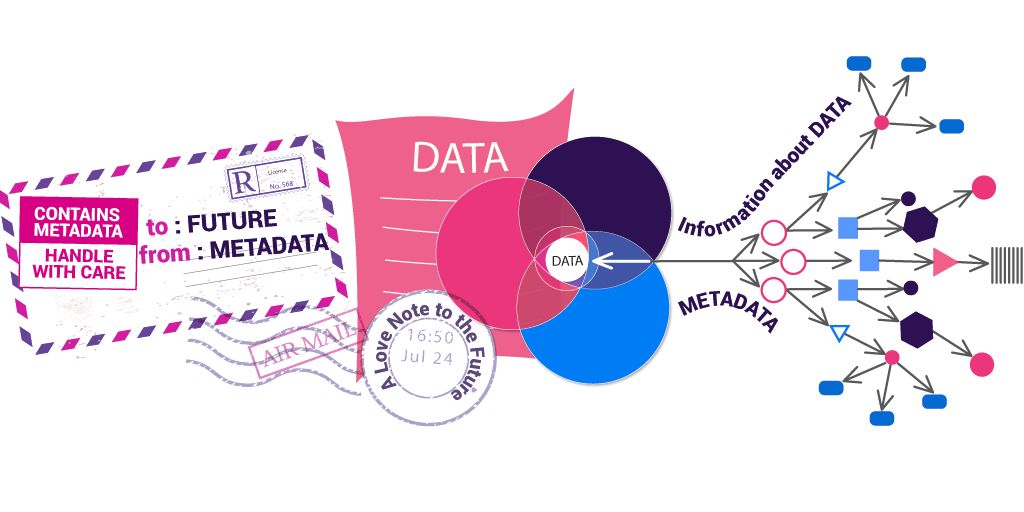
A love note to the future
The most widespread definition of metadata has it that metadata is “information about data”. Thankfully, there’s another way to look at it, apart from the dry description. “A love note to the future” is how Jason Scott refers to metadata.
Metadata, you see, is really a love note – it might be to yourself, but in fact it’s a love note to the person after you, or the machine after you, where you’ve saved someone that amount of time to find something by telling them what this thing is.
Cit. Jason Scott’s Weblog
Describing physical and digital objects is what metadata is about. It helps the classification, access and storage of digital assets of all kinds. It is with metadata that the encoding of knowledge within any data element is possible.
Types of metadata
There is a wide variety of metadata depending on its purpose, format, quality or volume. Some of the widely used categories of metadata are:
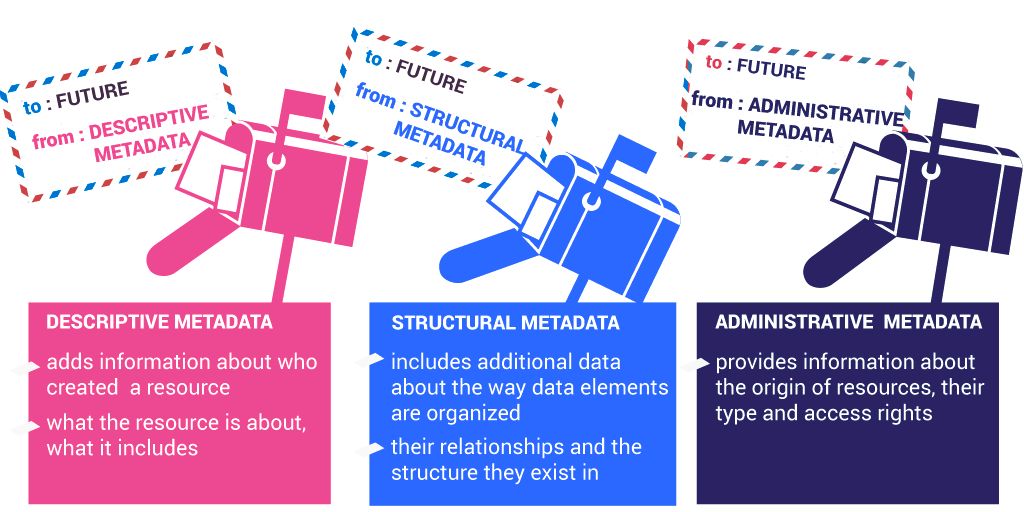
- Descriptive: Information about who created a resource, what the resource is about, what it includes
- Structural: Information about the way data elements are organized, their relationships, the structure they exist in
- Administrative: Information about the origin of resources, their type and access rights
Examples of metadata
Metadata is everywhere. Examples include:
- Emails: The sender, recipient, subject, and date.
- Files: The creation date, file size, and author.
- HTML tags: The information that tells a browser how to display a webpage.
Another, more recent, example is how RDF-star offers an alternative approach to annotating statements in RDF by allowing one to attach metadata to edges in a knowledge graph.
How does metadata help?
Metadata underlies every digital object and is critical to the way they are managed, organized and used.
When created and handled properly, metadata serves the clarity and consistency of information. Metadata facilitates the discovery of relevant information and the search and retrieval of resources. Tagged with metadata, any digital object can be automatically associated with other relevant elements and thus easy to organize and discover. This helps users make connections they would not have made otherwise.
With metadata you can:
- Search resources by all kinds of criteria;
- Identify various resources;
- Collect resources by topic;
- Trace resources.
Semantic metadata
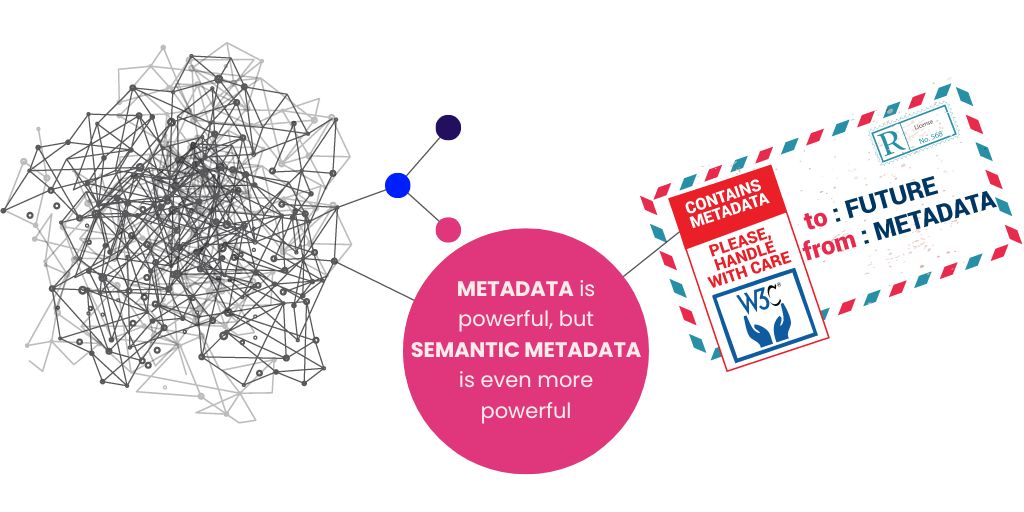
Semantic metadata goes beyond basic descriptions. It links data elements to their machine-readable definitions and to external sources, turning basic information into a richly interconnected and valuable object. This is essential for enterprise knowledge management and for enabling systems to automatically assign topics and infer context.
Want to leverage your company knowledge with metadata and knowledge graphs?