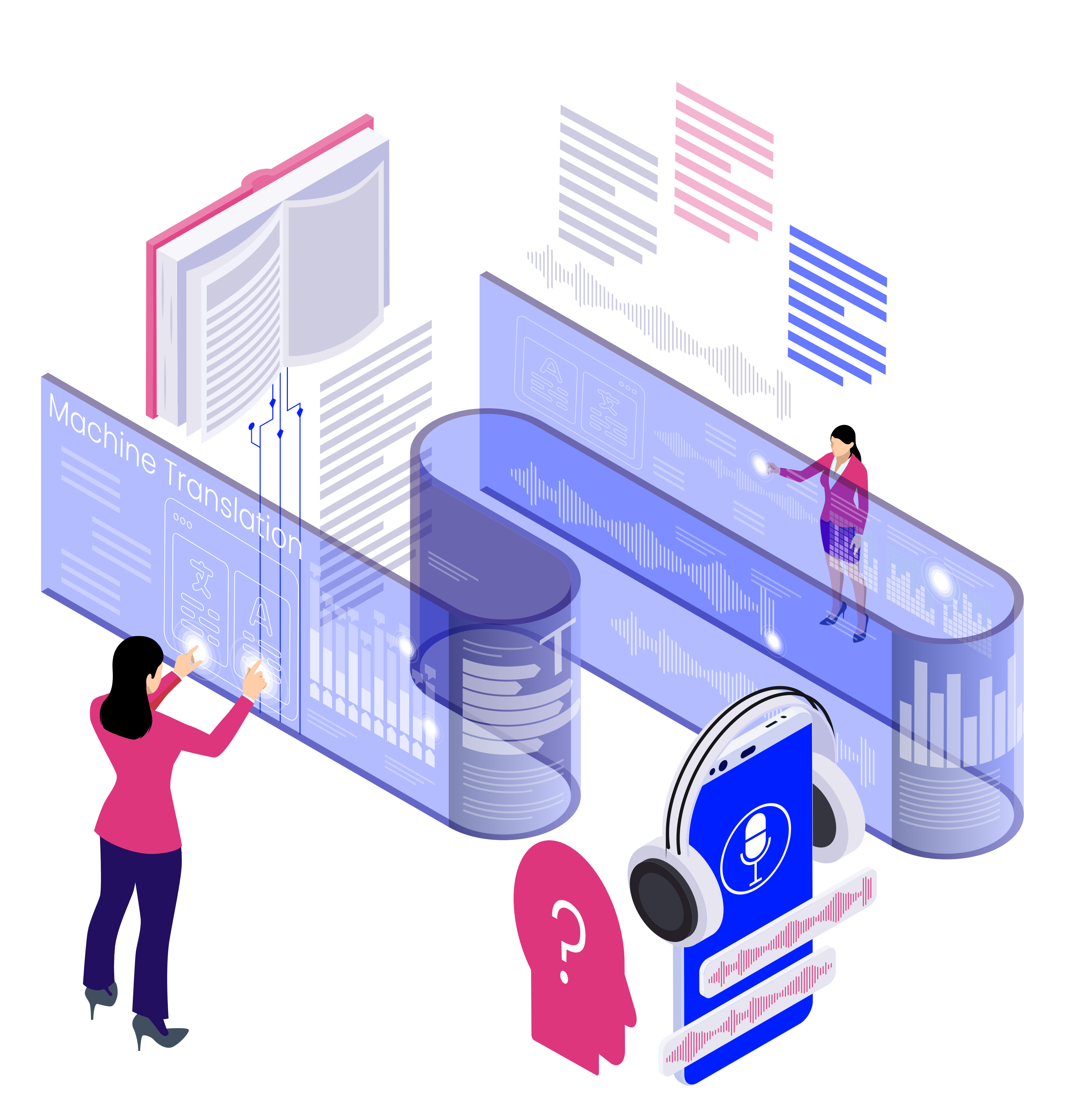
In an era where data shapes virtually all aspects of our lives, the ability to access and understand it is more critical than ever.
Natural Language Querying (NLQ) enables users to interact with complex databases – yes, including knowledge graphs – using ordinary human language, eliminating the need for specialized query languages like SQL or SPARQL, NLQ. Over the past year, NLQ has become an indispensable tool for unlocking the staggering potential of structured and unstructured data.
Why is NLQ important?
With the recent advancements in generative AI, the research field of NLQ has been dominated by approaches using large language models (LLMs) to understand human questions and provide natural language answers. LLMs and conversational interfaces have clearly demonstrated the benefits of exploring and extracting information easily from these extremely large knowledge structures.
They opened the door for a next-level user experience when it comes to how to search and consume new knowledge. Enterprise organizations possessing a lot of data hosted in various data stores, including knowledge graphs, seek to enable such interfaces for consuming the information represented there.
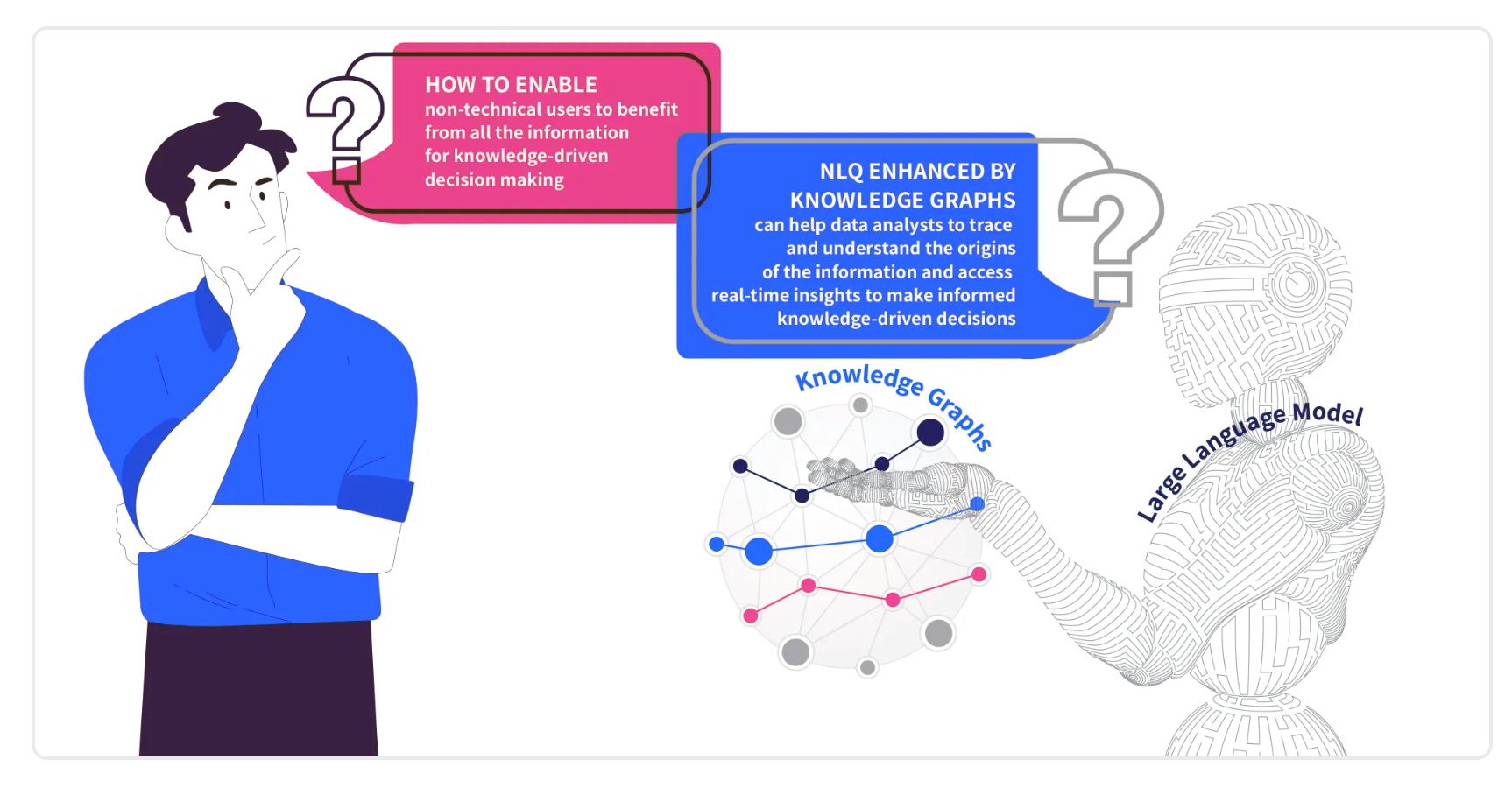
The goal is to enhance knowledge-discovery and democratize data, enabling non-technical users or employees to benefit from all the information for knowledge-driven decision-making. Additionally, organizations use LLMs and conversational interfaces to speed up the process of finding specific insights within massive, diverse data sources.
NLQ systems can be seen as a subset of Question-Answering (QA) systems, which are designed to answer questions posed by users in natural language. In particular, Extractive Question Answering aims to extract a specific segment of text from a provided document that directly answers a user question.
How can you implement NLQ?
So, how do LLMs help in tackling NLQ tasks?
Following is a list of recently emerging approaches for NLQ with the help of LLMs:
- Retrieval Augmented Generation (RAG): Enhancing grounding context of an LLM by providing domain-specific context as part of the prompt with information that could be useful for the generation of the answer. The LLM then generates an accurate, factual answer by taking into account the provided context information.
- Text-to-Query Translation: Using the skills of LLMs to translate questions into structured database queries that are then executed against an on-premise database. This very powerful technique can unlock access to knowledge encoded in various database systems without needing to reindex or transform their content. The LLM acts as a translator, converting a natural language question into a structured query (like SPARQL or SQL). Optionally, the results from the database query can be fed back to the LLM so a natural language response is returned to the user.
- Model Fine-Turning with Proprietary Data: Tailoring the LLM model to understand and process queries specific to an organization’s datasets, improving its performance on domain-specific tasks. Proper data collection and preparation are key to achieving good results, as aspects such as data diversity, consistency, accuracy, and lack of bias need to be considered.
Many libraries and tutorials are emerging with helpful tools and guidelines to speed up such development, the most fast-growing out of which is currently LangChain.
Overcoming key challenges
The field of NLQ is quickly advancing, but there are still major challenges:
- Contextual understanding – many queries depend on the context for their interpretation. This context can be immediate (based on the conversation history) or external (based on current events or user-specific knowledge).
- Complex query interpretations – users may phrase their queries in complex ways that involve nested conditions, aggregations, or comparisons. Interpreting these correctly to form accurate database queries or data retrievals requires advanced understanding and processing capabilities.
- Data modeling and storing – the data representation and schema determine the variety of questions that NLQ systems can cover. Depending on the types of questions an NLQ system needs to cover, the information to provide their answers must be indexed in an appropriate data storage. Also making an LLM aware of the structure of the data is crucial, especially for query translation.
- Transparency and trust – building systems that users trust and feel comfortable using requires not only technical accuracy but also transparency in how queries are interpreted and processed. Managing user expectations regarding the system’s capabilities and limitations is also crucial.
Knowledge graphs provide a helpful addition to these approaches thanks to the structured knowledge representation in the form of ontologies as well as the contextual richness and connectedness of the data, which enables semantic reasoning. These features can be particularly useful in domain-specific NLQ systems where understanding the specific terminology and relationships is crucial. Semantic technologies and knowledge graphs can enhance LLMs when it comes to extending the context for LLM in a rich, accurate, and transparent manner.
How Graphwise makes NLQ easier?
The Graphwise platform provides a comprehensive suite of foundational semantic technologies designed to accelerate your NLQ development and bridge the gap between AI and enterprise data.
Enterprise-grade graph foundation
Graphwise provides a powerful semantic database that complies with global standards. This makes it the perfect candidate for Text-to-Query integration, allowing LLMs to generate and execute complex queries across your entire data landscape efficiently.
Seamless AI connectors & RAG support
Graphwise enables organizations to implement RAG quickly and securely. By using built-in similarity tools and vector connectors, Graphwise can index subsets of your graph to find the “top-K” pieces of knowledge most relevant to a user’s question, ensuring AI responses are grounded in your proprietary facts.
Intuitive data modeling & annotation
To ensure LLMs understand your specific business domain, Graphwise offers tools to refine how your data is represented.
- Model Understanding: By exposing data through developer-friendly interfaces, Graphwise makes it easy for an LLM to parse and understand your data model.
- High-Quality Training Data: Graphwise simplifies the process of creating high-quality training datasets (question-answer pairs) based on your unique content, which is essential for fine-tuning specialized LLM models.
Real-world applications
NLQ is democratizing data across industries where domain experts need instant answers such as Healthcare, Financial Services, Infrastructure, and Manufacturing. In reality, few of the domain experts in each of these areas actually possess a deep technical understanding of query languages in order to take full advantage of the graph data for their day-to-day analysis. By combining semantic graph technologies with LLMs, you can make knowledge graphs easier to enrich, consume, and understand, so the value they unlock can be democratized to a wider public.
Healthcare
Semantic technologies and knowledge graphs improve personal healthcare by providing a comprehensive patient dossier for clinical decision-making and enabling access to high-quality data for clinical research. NLQ can be used to quickly retrieve patient information or research data, simply by asking questions like “What were the patient’s last lab results?” or “What are the recent studies on this disease?”. This can make data management more efficient and can help in making timely diagnosis and treatment decisions.
Financial Services
Knowledge graphs allow organizations to derive more value from their data by capturing unique relationships between data points, which is crucial for complex queries and analytics and faster risk assessment. NLQ enhanced by knowledge graphs can help data analysts trace the origins of information and access real-time insights to make informed knowledge-driven decisions.
Manufacturing
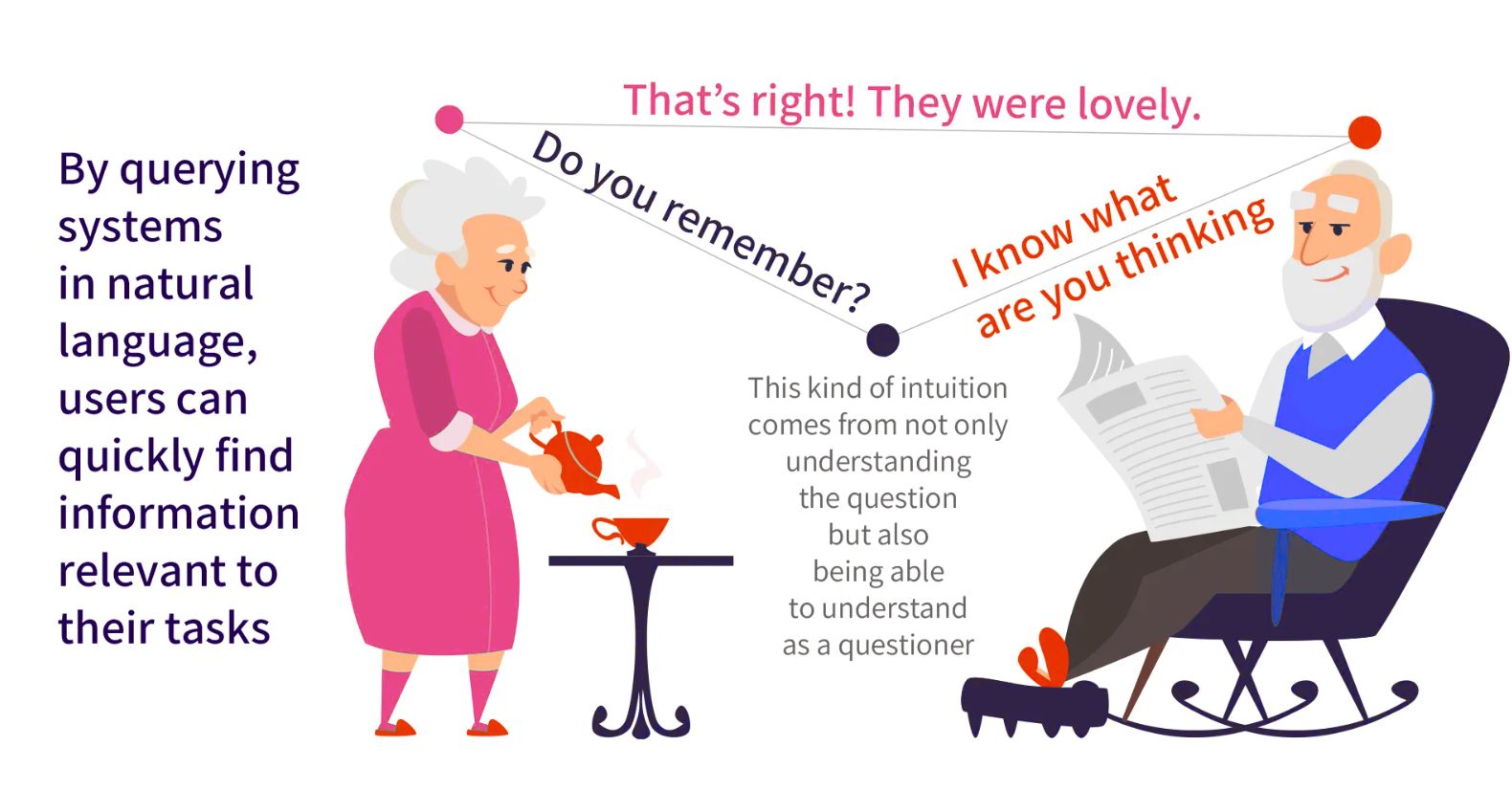
Knowledge graphs bridge the gap between different industry sectors by revolutionizing how data is structured and analyzed, leading to better knowledge management and process automation. By querying systems in natural language, users can quickly find information relevant to their tasks, be it maintenance and troubleshooting, supply chain management, or security and compliance.
In all of the areas above, the aspect of knowledge sharing and collaboration across organizations is key. NLQ can facilitate the discovery and access to relevant information, expertise, best practices, and lessons learned, thus promoting collaboration, encouraging knowledge exchange, and preventing silos of information.
Conclusion
It is no wonder why the emergence of LLMs has generated such unprecedented hype – people feel empowered by how accurately a machine can understand and meet their needs. Such a seamless experience will be expected and demanded by users of more and more applications around us. Knowledge graphs provide key features to unlock NLQ capabilities powered by data connectedness, semantic context, and inference.
Want to learn more about natural language querying?