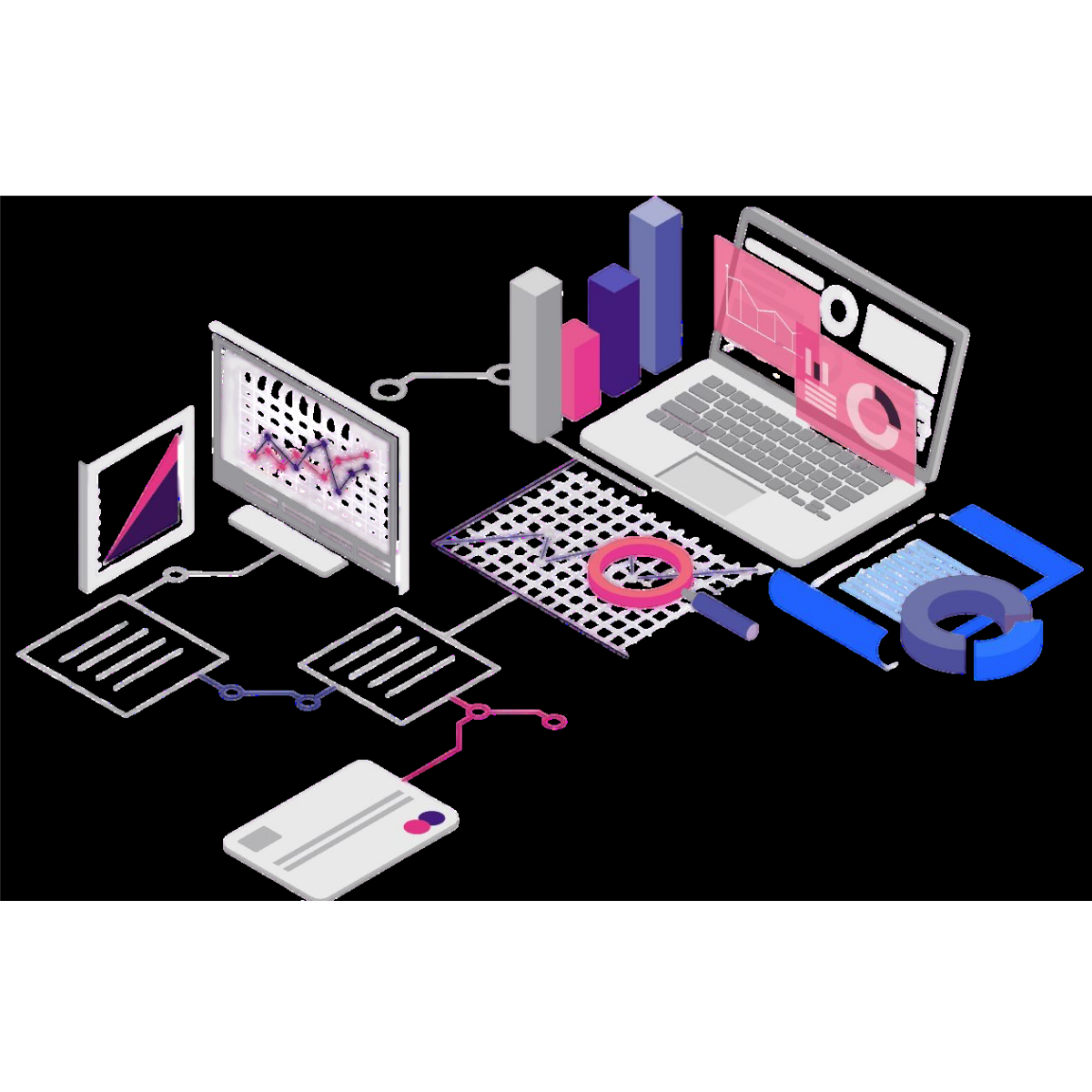
The Semantic Web is an evolution of the traditional World Wide Web. While the “classic” web was designed for people to read documents, the Semantic Web is designed for machines to understand data. To achieve this, machines are provided with machine-interpretable metadata (data descriptors) of the published information and data. As a result, computers are able to make meaningful interpretations similar to the way humans process information to achieve their goals.
Proposed by Tim Berners-Lee, this “Web of Data” allows software to navigate, interpret, and link information across different systems as easily as humans browse web pages. In this framework:
- “Semantic” means machine-processable or the ability for a system to know the definition of a piece of data
- “Web” conveys the idea of a navigable space of interconnected objects with mappings from URIs to resources
The evolving vision: from theory to data
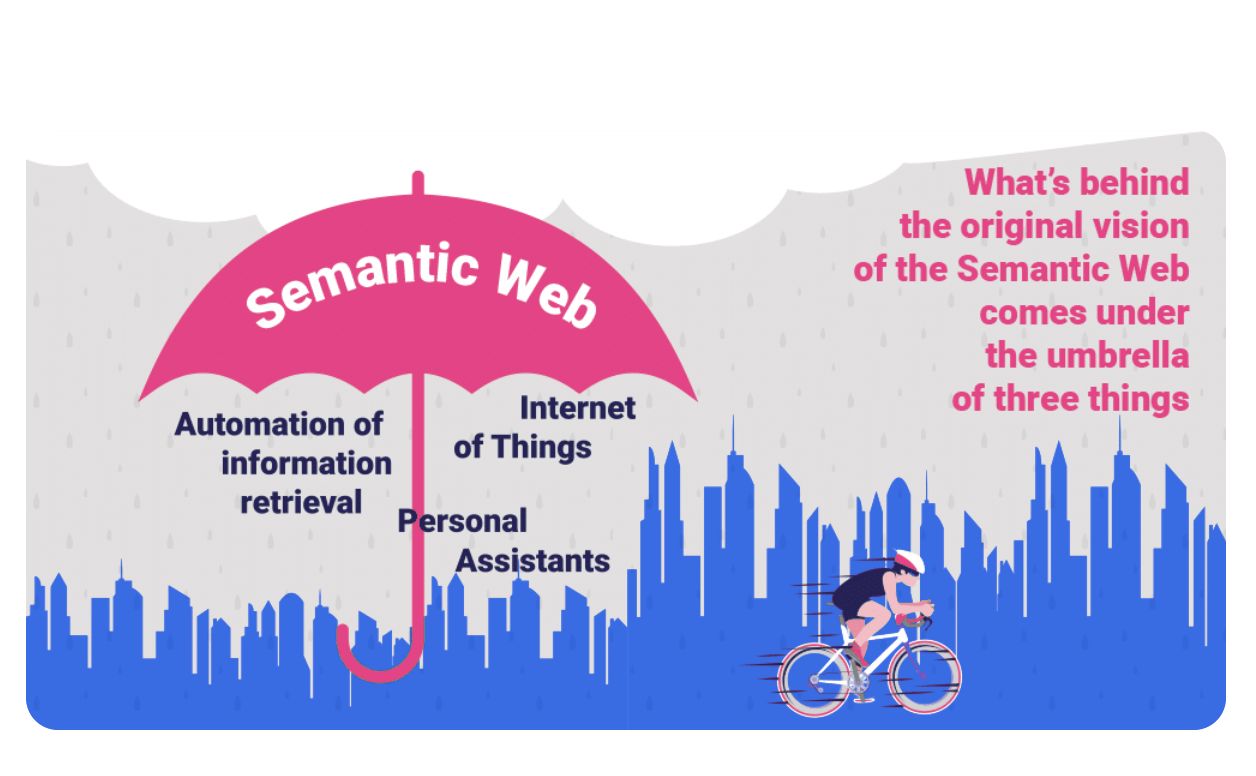
The original vision of the Semantic Web, famously outlined in Scientific American, focused on the automation of information retrieval, the Internet of Things, and Personal Assistants.
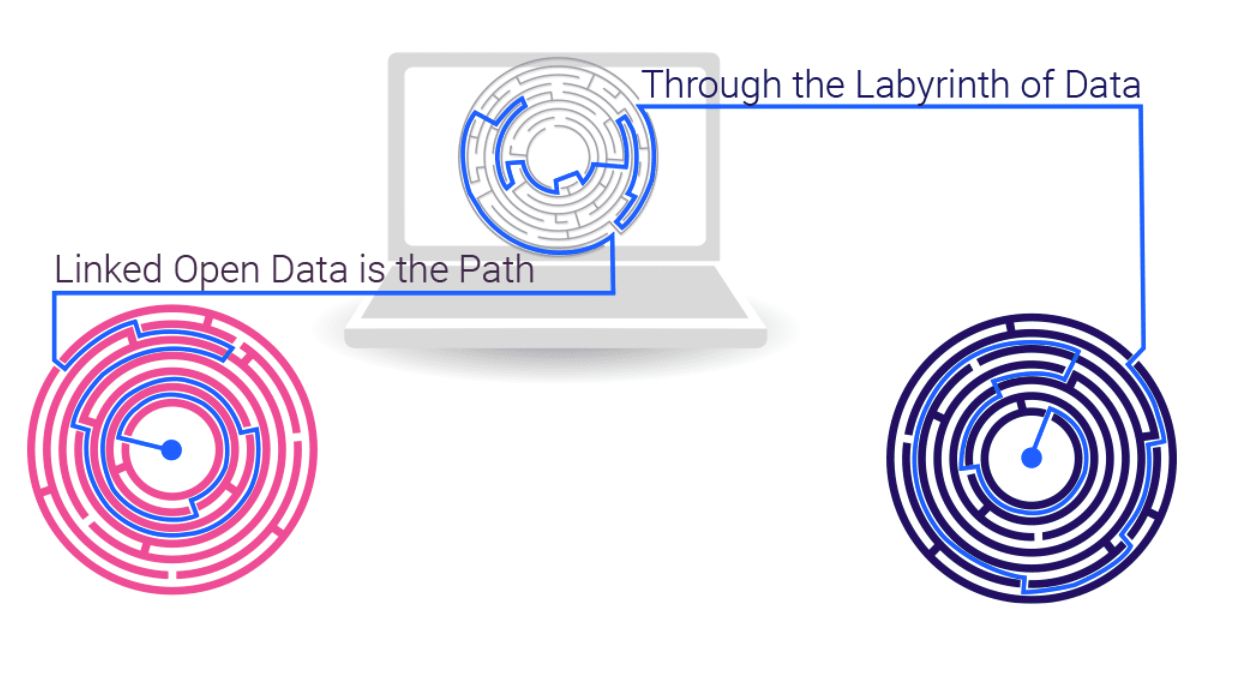
Over time, this concept evolved into two practical types of data that implement the vision today: Linked Open Data (LOD) and semantic metadata.
Linked Open Data
For the Semantic Web to function, computers must have access to structured collections of information and sets of inference rules that they can use to conduct automated reasoning.
LOD is structured data modeled as a graph and published in a way that allows interlinking across servers.
This was formalized by the 4 Rules of Linked Data:
- Use URIs (Uniform Resource Identifiers) as names for things.
- Use HTTP URIs so people and machines can look up those names.
- Provide useful information using standards like RDF and SPARQL.
- Include links to other URIs so more things can be discovered.
Today, the LOD Cloud connects billions of facts across encyclopedia data (Wikidata), government archives, and scientific databases. By interlinking these, we create a global knowledge graph that allows an AI to understand that a reference in one document is the exact same entity described in another.
Semantic metadata
While LOD creates a web of data, semantic metadata enriches the existing web of documents. These are “semantic tags” added to regular web pages to describe their meaning to machines.
For example, without metadata, a search for “Paris” is ambiguous. Semantic metadata resolves this, ensuring the system knows if the content refers to the capital of France or a person. Currently, the most popular scheme for this is Schema.org, used by over 30% of web pages to ensure they are “AI-readable.”
Why semantic technology?
If the Semantic Web is the destination and the vision, semantic technology is the engine that gets us there. It uses formal logic and mathematical models to represent the “meaning” of data rather than just its “structure.”
Unlike traditional databases that rely on rows and columns, semantic technology focuses on the relationships between entities.
As early as in 2007, Sir Berners-Lee told Bloomberg:
Semantic technology isn’t inherently complex. The semantic technology language, at its heart, is very, very simple. It’s just about the relationships between things.
Semantic technology defines and links data on the Web (or within an enterprise) by developing languages to express rich, self-describing interrelations of data in a form that machines can process. Thus, machines are not only able to process long strings of characters and index tons of data. They are also able to store, manage and retrieve information based on meaning and logical relationships. So, semantics adds another layer to the Web and is able to show related facts instead of just matching words.
Semantic technology standards
Fundamental for the adoption of the Semantic Web vision was the development of a set of standards established by the international standards body, the World Wide Web Consortium (W3C). It’s initiative states that the purpose of this technology in the context of the Semantic Web is to create a “universal medium for the exchange of data” by smoothly interconnecting the global sharing of any kind of personal, commercial, scientific and cultural data.
The Semantic Web provides a common framework that allows data to be shared and reused across application, enterprise, and community boundaries. It is a collaborative effort led by W3C with participation from a large number of researchers and industrial partners.
W3C has developed open specifications for semantic technology developers to follow and has identified, via open source development, the infrastructure parts that will be needed to scale in the Web and be applicable elsewhere.
The main standards that semantic technology builds on are:
- RDF: a simple language for describing objects and their relations in a graph
- SPARQL: The semantic query language specifically designed to query data across various systems and databases, and to retrieve and process data stored in RDF format
- Web Ontology Language (OWL): The computational logic-based language that is designed to show the data schema and that represents rich and complex knowledge about hierarchies of things and the relations between them. It is complementary to RDF and allows for formalizing a data schema/ontology in a given domain, separately from the data
- URI: A string of characters designed for unambiguous identification of resources and extensibility via the URI schemes.
By using international standards, it allows machines to:
- Integrate data: Combine information from entirely different sources without rewriting code
- Perform inference: Use “reasoning” to discover new facts (e.g., if A is a parent of B, and B is a parent of C, the system can infer A is the grandparent of C)
- Ensure accuracy: Disambiguate terms so the system knows whether “Java” refers to a programming language, a coffee bean, or an island based on the surrounding context.
Why it matters for modern AI
The relationship between Semantic Web and semantic technology is straightforward: the former is the paradigm and the latter is the implementation. When semantic technologies are applied within an organization, they create a knowledge graph. This graph acts as a “semantic layer” that sits between your raw data and your AI applications. It ensures that when an AI system (like an LLM) looks for information, it isn’t just guessing based on keywords—it is accessing a verified, logic-based network of facts.
Today, the most impactful application of these fundamentals is in GraphRAG (Retrieval-Augmented Generation). Traditional AI often “hallucinates” because it lacks a grounding in structured reality.
Graphwise builds a trusted semantic backbone. It transforms scattered, messy data into a connected knowledge hub that is “AI-ready.” By utilizing the principles of the Semantic Web, Graphwise ensures that your AI applications are grounded in precise, verifiable facts rather than just keyword patterns.
Industry applications of semantic technologies
Semantic technology helps enterprises discover smarter data, infer relationships and extract knowledge from enormous sets of raw data in various formats and from various sources. Semantic graph databases (which are based on the vision of the Semantic Web) such as Graphwise’s GraphDB platform component, make data easier for machines to integrate, process and retrieve. This, in turn, enables organizations to gain faster and more cost-effective access to meaningful and accurate data, to analyze that data and turn it into knowledge. They can further use that knowledge to gain business insights, apply predictive models and make data-driven decisions.
Various businesses are already using semantic technology and semantic graph databases to manage their content, repurpose and reuse information, cut costs and gain new revenue streams.
- Media and Publishing: the BBC, the FT, SpringerNature and many others use semantic publishing to make data integration and knowledge discovery more efficient;
- Healthcare and Life Sciences: Astra Zeneca and other big Pharma companies make use of semantic technology for early hypotheses testing, monitoring of adverse reactions, analytics in patient records and much more.
- Financial industry and insurance sector: Many companies have started adopting technologies to semantically enrich content and process complex and heterogeneous data.
- E-commerce, automotive industry, government and public sector, technology providers,energy sector, services sector and many more are employing Semantic Technology processes to extract knowledge from data by attributing meaning to various datasets.
Conclusion
It is no wonder why the emergence of LLMs has generated such unprecedented hype – people feel empowered by how accurately a machine can understand and meet their needs. Such a seamless experience will be expected and demanded by users of more and more applications around us. Knowledge graphs provide key features to unlock NLQ capabilities powered by data connectedness, semantic context, and inference.
Want to learn more about how semantics contributes to a unified layer of enterprise data?