
GraphDB
Link your business data in a semantic graph database, power semantic search, and apply real-time reasoning to build insights you can trust.
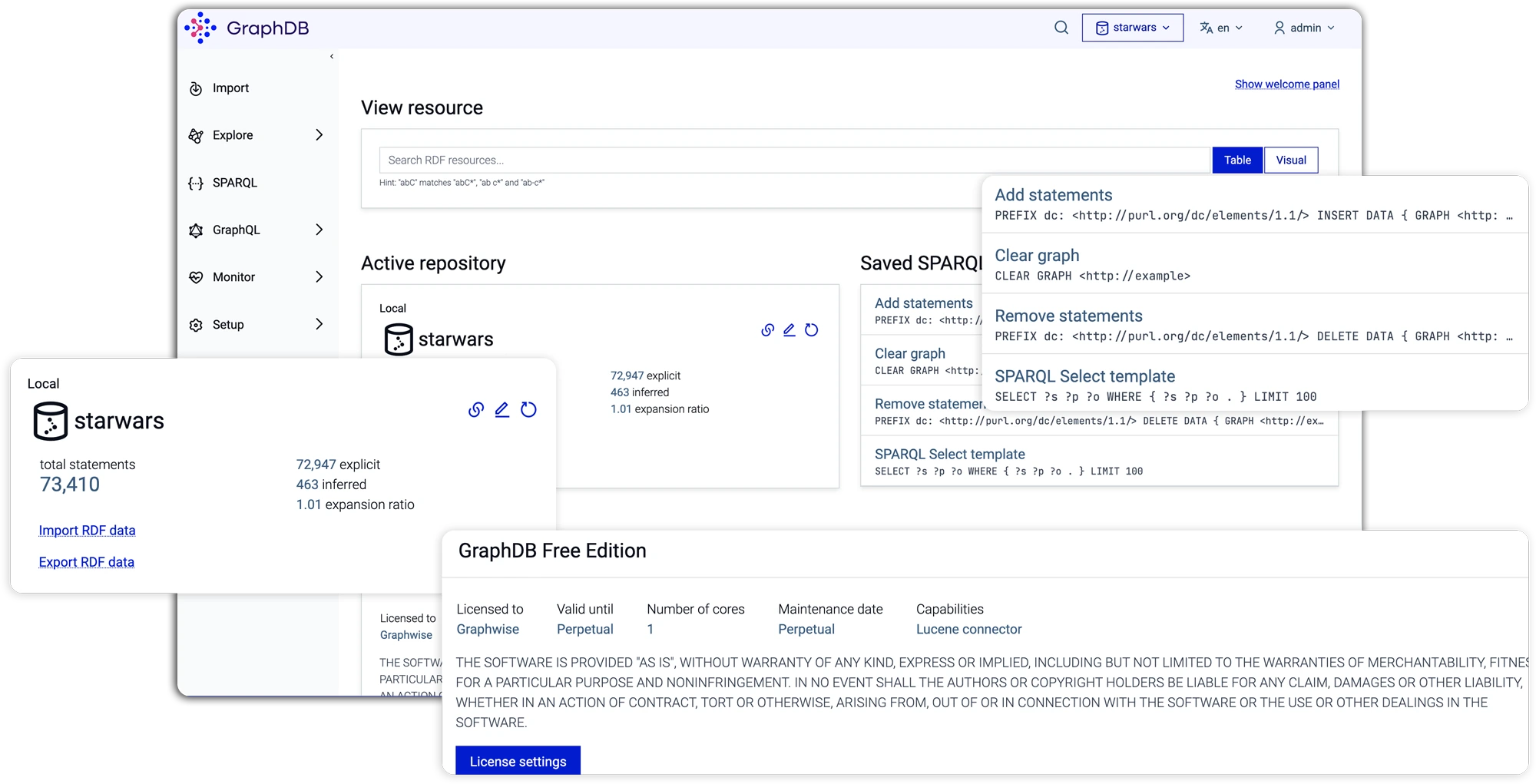
Graphwise GraphDB is an enterprise-grade semantic graph database that supports RDF and SPARQL—providing a highly scalable foundation to link fragmented business data and power real-time AI insights.
Traditional databases isolate information in rigid silos, requiring complex, manual queries to piece connections together, ultimately preventing GenAI models from seeing the full picture of corporate operations.
Graphwise breaks down these silos by mapping data based on real-world relationships rather than rigid rows and columns. This smart storage engine uses real-time inferencing and semantic search to eliminate AI hallucinations and transform raw data into trusted insights.
Unify data in a graph database with ontologies and linking to a global knowledge
Why GraphDB?
Unlock the power of AI & LLM with GraphDB
- Broad LLM compatibility & GraphRAG
- MCP support for enterprise agentic AI integration
- Talk to your graph: Use no-code RAG chat in GraphDB Workbench.
- Precision entity linking for reliable insights
- NL Query your graph from LangChain.
- Simplify knowledge graph building.


Connect the dots across your IT systems
- Implement a data fabric to gain unified access to your structured data.
- Use conceptual models to search and recommend documents.
- Ask natural language questions across multiple data sources.
Build, consume, govern enterprise knowledge graphs with GraphDB
- Unify data via a shared conceptual model.
- Avoid misinterpretation via formal semantics.
- Uncover new relationships with reasoning.
- Manage data quality and trace provenance.
- Employ standards to avoid vendor lock-in.

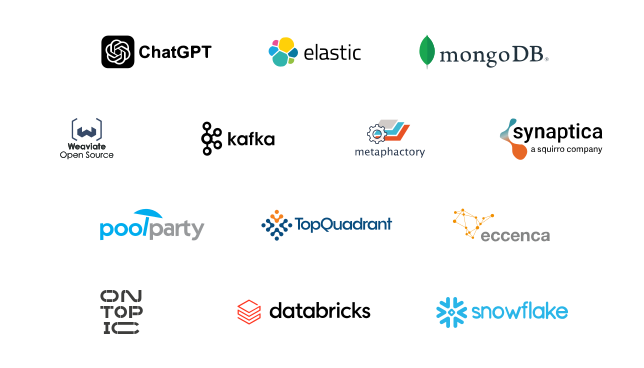
Streamline data integration
- Integrate with MongoDB to support joins across structured and semi-structured data.
- Synchronize changes in the graph database with upstream and downstream systems with Kafka.
- Access graphs over JDBC or GraphQL.
- Virtualize or transform SQL-accessible data.
GraphDB business applications
Which GraphDB Edition is right for you?
Start free or call us for custom pricing tailored to your needs
| GraphDB Free | GraphDB Enterprise | |
|---|---|---|
| Fully compliant with RDF 1.1 and SPARQL 1.1, with RDF-Star and SPARQL-Star extensions |
 |
|
| Fully compliant reasoning for the standard rulesets RDFS, OWL 2 RL and QL |
|
|
| Custom reasoning and consistency checking rulesets |
|
|
| 100% compatible with the RDF4J framework |
|
|
| Custom reasoning and consistency checking rulesets |
|
|
| GraphDB Free | GraphDB Enterprise | |
|---|---|---|
| Highly performant simultaneous load, query and inference |
|
|
| Parallelized processing of concurrent queries and inference. |
|
|
| Ultra fast forward-chaining reasoning with efficient retraction of inferred statements upon update |
|
|
| GraphDB Free | GraphDB Enterprise | |
|---|---|---|
| Plugin API for engine extensions |
|
|
| Many plugins providing additional functionality such as geo-spatial indexing, GeoSPARQL, RDF rank, etc. |
|
|
| MongoDB connector |
|
|
| Lucene connector for full-text search |
|
|
| Elasticsearch connector for full-text search |
|
|
| Solr connector for full-text search |
|
|
| Kafka connector for downstream synchronization |
|
| GraphDB Free | GraphDB Enterprise | |
|---|---|---|
| Automatic failover, synchronization and load balancing to maximize node utilization |
|
|
| Scaling out concurrent query processing, allowing query throughput to scale proportionally to the number of cluster nodes |
|
|
| Cluster elasticity remaining fully functional in the event of failing nodes |
|
| GraphDB Free | GraphDB Enterprise | |
|---|---|---|
| Workbench interface to manage repositories, data, user accounts and access roles |
|
|
| Community support |
|
|
| Commercial SLA (optional) |
|
- GraphDB Free comes with a single-core license.
- GraphDB EE can be licensed for twelve or more cores according to needs and is available on-premise from Graphwise and its partners.
- The GraphDB Enterprise Edition 12-core cluster is also available as a software as a service (SaaS) on AWS Marketplace and Microsoft Azure Marketplace.

Explore the Power of GraphDB in Minutes, just two clicks away
- Launch and explore data from anywhere, at any time
- Explore curated datasets customised for your industry
- Select ready-to-go and pre-packaged projects
Explore our Success Stories

Expanding Editorial Output for the FIFA World Cup, Delivering 800+ Pages in Weeks
The BBC used semantic technology to To power its 2010 FIFA World Cup website to cut editorial costs and improve user experience.
Read more
Enhancing Public Access and Legislative Transparency
The UK Parliament leveraged GraphDB to modernize its legislative and open data platform, enabling clearer public information & easier access.
Read more
Building a Collaborative Knowledge Hub for AI-Powered Predictive Intelligence
Sensing Clues implemented Graphwise’s Knowledge Management Suite to build vast organizational knowledge models.
Read more
Accelerating Cancer Research with AI-Powered Target Discovery
Using GraphDB & LLDI, a Queen’s University research lab accelerated cancer research streamlining candidate validation from months to days.
Read moreDownload GraphDB
Important update: Starting with GraphDB 11.0.0, all editions, including GraphDB Free, require a valid license. You can request one for free, which will be sent to your email. For desktop users, we recommend quick installation with the GraphDB Desktop application.
- Windows (.msi)
- MacOS Apple Silicon (.dmg)
- MacOS Intel (.dmg)
- Linux (.rpm)
- Linux (.deb)
For a server environment, we recommend the platform independent GraphDB distribution, which requires separate Java installation.
After you have downloaded and installed your preferred GraphDB package, it’s time to request a license. Once you have set up your license, you can check the GraphDB documentation for the basics on working with the GraphDB Workbench.