
Accelerating Discovery — How GraphRAG Drives ROI in R&D and Knowledge-Intensive Workflows
This article explains how GraphRAG, built on Graphwise’s graph-native platform, helps organizations cut search time, speed up discovery, and turn AI pilots into measurable ROI across research and knowledge-intensive workflows.

Main Takeaways
- The problem isn't missing data — it's disconnected data — researchers spend 30% of their time searching across silos, not because the information doesn't exist, but because nothing connects it.
- Vector RAG can't reason about relationships — it retrieves text that looks similar, but it has no understanding of how a drug interacts with a trial, or how a regulation links to a product; GraphRAG does.
- Institutional memory becomes a live asset — past failures, archived projects, and retired researchers' insights stop living in folders and become active, queryable knowledge.
- The ROI compounds — 15-20% efficiency gains, up to 70% lower maintenance costs, and research cycles cut from weeks to hours add up to a reported 3× return on AI investment.
Companies are competing to innovate faster, but success does not go to the company with the most data. Still, to the team that can turn data into actionable knowledge, find the right evidence, pattern, or prior decision, at exactly the moment it is needed.
Yet most researchers face challenges not because they lack information, but because they struggle to keep track of insights from different formats, systems, and disciplines. A report shows that knowledge workers spend 30% of their time searching, filtering, and revalidating information spread across disconnected tools and repositories (silos).
Many companies use retrieval-augmented generation (RAG) to search through documents and systems, but they are reaching their limit for complex problems.
To address this, GraphRAG enters the space. It turns scattered documents into connected knowledge and helps organizations cut research time, reduce busywork, and enable AI from a prototyping expense to an ROI driver.
In this article, we will cover the limitations of traditional RAG in complex R&D discovery. We will also discuss how GraphRAG connects entities and evidence to enable traceable reasoning, shorter research cycles, and faster decisions.
Why traditional RAG isn’t enough for complex discovery
Standard RAG uses vector search. It takes documents, splits them into small pieces, turns those pieces into mathematical vectors, and then retrieves the nearest neighbor (closest) when a user asks a question.
While this works for basic Q&A, it shows limitations in research-intensive workflows for two reasons.
The “chunking” blind spot
Vector search retrieves similar text chunks, but it does not understand entities (molecules, customers, chemical compounds, assets). It also does not comprehend the relationships between these entities (causes, inhibits, dependencies, or side-effects).
If a healthcare researcher asks, “How does this specific protein interact with our current pipeline of inhibitors across all trials since 2018?” The traditional RAG may grab snippets that mention the protein name. But it will not understand the logic of the trials and will not provide a synthesized answer.
Shallow context and hallucination
Traditional RAG often produces snippet collages, answers that look correct because they use the right keywords, but miss the edge cases, long-range relationships critical for discovery. And that is unacceptable in high-stakes R&D, healthcare, or regulated industries.
Without a structured understanding of the data, the LLM is likely to hallucinate (plausible-sounding) connections or miss weak signals hidden across multiple documents.
What GraphRAG changes: from documents to connected knowledge
GraphRAG reframes retrieval as a graph problem rather than a nearest-neighbor search problem.
Instead of treating content purely as text, it builds a knowledge graph that encodes entities (such as drugs, materials, customers, assets, or policies), their attributes, and the relationships between them. Language models then query and interpret that graph to retrieve the most relevant subgraphs, including chains of related experiments, supporting evidence, constraints, and precedents.
The graph approach helps entity- and relationship-aware retrieval. For example, a researcher investigating a manufacturing defect can easily identify similar cases, whether using different terminology or the same type of failure occurring under similar conditions, even across different documents and formats.
Similarly, an R&D leader can ask which projects may be impacted by a new regulatory ruling and receive a graph-grounded answer that connects regulations, products, markets, and historical assessments.
GraphRAG composes answers that preserve context, cite sources instead of a collage of snippets, and explain how different pieces of evidence fit together.
How GraphRAG drives ROI in R&D and knowledge-intensive work
The transition to GraphRAG brings a financial imperative. The return on investment is delivered across the following key pillars:
Operational efficiency gains
GraphRAG delivers 15-20% efficiency gains in everyday knowledge work. Organizations can increase their R&D capacity without hiring a single additional researcher by reducing the time spent triaging documents and searching for lost insights.
Maintenance and implementation savings
The hidden costs of AI are the “human-in-the-loop” requirement to correct errors and manage data pipelines. Because GraphRAG provides more accurate, fact-based summaries from the start, it can cut LLM implementation and maintenance costs by up to 70%. You spend less time fixing the AI and more time using it.
Shorter research cycles
Checking existing information can take weeks in traditional R&D, but with GraphRAG, it takes hours. Research teams can quickly align on what we already know, preventing duplicate work and allowing for more targeted experimentation. When you consider faster research cycles, lower maintenance costs, and faster time-to-insight, organizations using GraphRAG see up to a 3× return on their AI investment.
Leveraging institutional memory
Large organizations are facing brain drain. This is the loss of knowledge when a senior researcher leaves, or a project is mothballed. GraphRAG ensures that past failures and successes are not hidden in archived folders but are active participants in the current knowledge network.
Strategic and market intelligence
GraphRAG transforms how strategy and risk teams work by combining external information (news, patent filings, market reports) with internal documents. It helps organizations get a complete picture of their environment. They can detect weak signals (small changes), like when a competitor makes slight adjustments to their patent strategy, that might be missed by regular searches.
How Graphwise’s GraphRAG platform accelerates discovery
Turning GraphRAG from an idea to production requires a strong knowledge graph, semantic modeling expertise, and a scalable retrieval pipeline capable of handling real-world complexity.
Graphwise addresses this need through enterprise-grade graph infrastructure and semantic modeling that turn fragmented content into AI-ready knowledge, at scale.
Graphwise GraphDB manages complex, interconnected data. And its modeling tooling and services help teams design ontologies for their specific domains. These ontologies capture the concepts and relationships that matter to the business and ensure that AI understands how the organization itself thinks about its knowledge.
Graphwise then connects this semantic backbone to a GraphRAG layer that links LLMs with graph-native retrieval. This lets assistants go through millions or billions of data points, reason over entity relationships, and return context-aware, explainable answers in natural language.
Graphwise can scale to multimillion-record knowledge graphs and supports multilingual content for global organizations with research sites, customers, and regulators across regions. It reduces integration overhead and accelerates time-to-value by packaging knowledge graph infrastructure, semantic modeling, and GraphRAG pipelines together.
Real-world success story: NuMedii & accelerating drug discovery
NuMedii is a biotech company focused on AI-driven drug discovery for new therapies for complex diseases. They faced a challenge common to many R&D organizations. Critical information existed across dozens of databases, each with different schemas and terminologies. Without a unified structure, finding relevant connections and generating reliable hypotheses required extensive manual integration and expert curation.
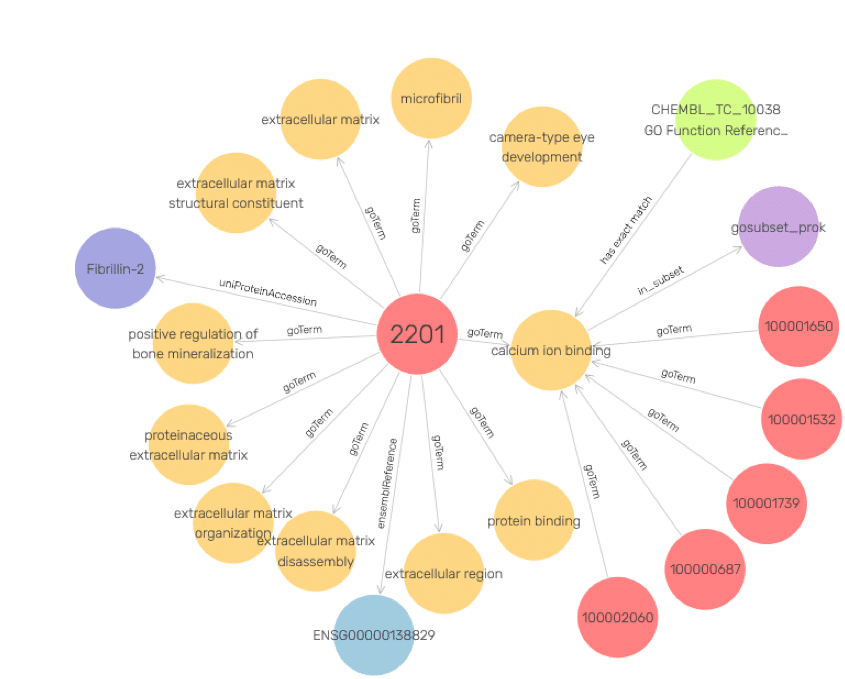
NuMedii used Graphwise’s GraphDB to build a knowledge graph comprising 7.98 billion triples (data points). This graph integrated over 20 different public and proprietary databases into a single, semantic network.
Graphwise reduced NuMedii’s months of manual work, going through each document, to days of graph-powered discovery. It helps NuMedii find hidden links between biomedical concepts and test new therapeutic hypotheses much faster and confidently.
Conclusion
When we view GraphRAG narrowly, it may look like a smarter search layer for LLMs. But it’s the innovation wheel that compounds the value of an organization’s knowledge. It eliminates the discovery tax and reduces hallucinations by connecting the dots between fragmented data sources.
Organizations that bridge the gap between “having data” and “having connected, navigable knowledge” will consistently out-innovate their peers. For research teams, it leads to fewer blind alleys, better reuse of hard-won insights, and faster movement from idea to a validated result.
Ready to see how GraphRAG can drive a 3× return on your AI investment?
Details
What Is GraphRAG
Retrieval Augmented Generation or RAG enhances LLMs with external knowledge for more accurate, contextual question answering. See how RAG can evolve into GraphRAG, which uses knowledge graphs as a source of context or factual information.
Learn moreRecommended Content
Building Smarter, Faster — How GraphRAG Cuts AI Development Costs and Complexity
Read about why traditional RAG systems become costly at scale and how GraphRAG reduces complexity and improves cost predictability.
Read more
From Data to Decisions — How GraphRAG Accelerates Time to Insight and Boosts ROI
Read about how GraphRAG connects data, context, and meaning to deliver faster and verifiable insights that accelerate decision-making and boosts ROI
Read more
AI-ready Graph Environments: The Key to Scaling AI with Graphwise’s Knowledge Graphs
Read about why most enterprise AI fails and how Graphwise creates graph environments using knowledge graphs and semantics.
Read more
Bring Your Enterprise Information Security Management System with GraphRAG to the Next Level
Read abou how GraphRAG systems enhance enterprise information security management by using knowledge graphs
Read more
GeoAI: How GraphRAG Unlocks Complex Geospatial Knowledge
Read about how LLMs struggle with spatial queries, but connecting them to structured geographic knowledge graphs through GraphRAG improves accuracy.
Read more
From Retrieval to Reasoning: Enhancing HippoRAG with Graph-Based Semantics
Read about how an ontology-based knowledge graph boosts the multi-hop Q&A accuracy of one of the leading schemaless GraphRAG systems
Read moreFAQ
Any Questions? Look Here
To reduce time spent searching for information in R&D, organizations can implement semantic technologies and knowledge graphs that unify dispersed data repositories into an interconnected network. By leveraging tools like GraphDB and PoolParty for automated metadata tagging and semantic search, researchers can retrieve contextualized answers and summarized facts instead of sifting through vast document lists, effectively cutting search time by up to 50% and accelerating the discovery process.
Standard RAG fails on complex multi-hop research questions because it relies on vector similarity search, which suffers from "tunnel vision" and a lack of semantic understanding. Since traditional systems retrieve disjointed data chunks based only on proximity to the user's query, they are architecturally unequipped to trace relationships across multiple documents or follow logical paths between entities. Consequently, they treat information as isolated facts rather than connected knowledge, preventing the multi-hop reasoning required to reconcile scattered evidence and accurately answer complex, interconnected questions.
GraphRAG significantly outperforms traditional RAG by delivering up to a 3x return on investment through enhanced accuracy and operational efficiency. Key financial and performance benefits include up to 70% lower maintenance and implementation costs, an 80% reduction in token usage, and nearly threefold faster time-to-action. By leveraging structured knowledge graphs, GraphRAG increases AI response accuracy from roughly 60% to over 90%, enabling organizations to reclaim 60–80% of processing time in knowledge-intensive workflows like R&D and compliance.
To stop AI from hallucinating in scientific research, you ground Large Language Models in a Knowledge Graph using Graph Retrieval-Augmented Generation. This technique anchors AI responses to structured, verified domain facts rather than relying on probabilistic predictions, effectively providing a reliable "source of truth" and semantic guardrails. By ensuring every output is traceable to a validated scientific source, this approach provides the high precision and explainability necessary for critical research and medical contexts.
External patent and market data are connected with internal research knowledge through a semantic knowledge graph that harmonizes disparate sources into a unified data model using standards like RDF. By mapping internal R&D documents and external intelligence to common ontologies, organizations can utilize technologies like GraphRAG to automatically link related concepts and uncover hidden strategic relationships. This integration creates a contextualized "360-degree view" that breaks down data silos and transforms fragmented information into actionable insights for tracking innovation and market trends.
Large biotech companies manage billions of data points by implementing enterprise knowledge graphs and a semantic layer to integrate fragmented, heterogeneous datasets from diverse sources like genomic, molecular, and clinical records. By leveraging highly scalable graph databases and semantic middleware, they unify structured and unstructured information using RDF standards and specialized biomedical ontologies. This approach facilitates a FAIRification process — making data Findable, Accessible, Interoperable, and Reusable — which allows researchers to discover hidden relationships and perform complex analytical queries across disparate databases without the need for labor-intensive data migrations.