
GraphDB 11.3: Safer Backups, Smarter AI Integrations, and a Workbench That Feels at Home in Graphwise
The latest GraphDB release introduces safer data management, cutting-edge Model Context Protocol (MCP) support, and a new Python client for easier administration and integration.

The transition from “experimental AI” to “enterprise-grade AI” requires more than just a large language model; it requires a data foundation that is both indestructible and highly accessible. With the release of GraphDB 11.3, we are doubling down on these requirements by introducing smarter backup safeguards, expanded Model Context Protocol (MCP) support, a new Python client built into RDFLib, and a refreshed interface that aligns with our new identity as Graphwise.
Here is a closer look at how GraphDB 11.3 helps DevOps teams and AI developers move faster and with greater confidence.
Bulletproof data operations: smarter backups
For DevOps engineers managing large-scale knowledge graphs, a backup is only as good as its ability to be restored. Traditionally, verifying the success of a backup in a distributed or cloud environment (like S3) could be a “fingers-crossed” moment.
GraphDB 11.3 introduces a success checksum system to eliminate this uncertainty.
- Automated validation: Upon completion, GraphDB now tags backups with a checksum and generates a
.successfile. This provides an immediate, machine-readable confirmation that the backup is healthy. - Corruption guardrails: The engine now includes “guard code” that prevents the system from even attempting to apply a corrupt or incomplete backup.
By automating the work of the guard code, GraphDB 11.3 removes the manual overhead of validating data integrity, ensuring that your recovery point objective (RPO) is backed by reality, not just a log entry.
Building the future of AI with enhanced MCP support
As the industry moves toward agentic AI, MCP has emerged as the standard for connecting AI models to data sources. GraphDB 11.3 significantly expands its MCP capabilities, making it easier for developers to use GraphDB as a robust knowledge backend for AI agents.
- Latest protocol support: This release adds support for multiple MCP versions, including the latest 2025-11-25 standard.
- Flexible transport modes: Developers can now choose between legacy SSE and the new Streamable HTTP transport. This flexibility allows you to optimize for high-concurrency environments and gracefully handle resource exhaustion.
- Rich metadata: With support for prompt and tool metadata via spring-ai-mcp, developers gain better tooling, easier debugging, and more granular analytics for their AI-driven applications.
Whether you are building a simple retrieval system or a complex autonomous agent, GraphDB 11.3 provides the stable, high-performance bridge needed to feed your models the right context.
Faster automation with the new GraphDB Python client
For many DevOps engineers and developers, Python is the default way to script, automate, and integrate data systems. With GraphDB 11.3, working with GraphDB from Python becomes easier and more robust thanks to the new GraphDB Python client, contributed to the RDFLib library.
Instead of writing custom wrappers around the REST API, you can now rely on an officially supported, industry-standard library to:
- Monitor and administer GraphDB instances and clusters
- Manage repositories, access control, authentication, and security
- Import data and integrate GraphDB tasks into your existing Python tooling and CI/CD pipelines
Because the client is part of RDFLib, it fits naturally into existing Python data and semantic workflows. You can standardize on a single library for RDF handling and GraphDB administration, reducing custom code and making your operational scripts more portable and maintainable. Future releases will extend coverage to even more administrative endpoints, but 11.3 already delivers a fast, resilient way to get real work done with GraphDB using the skills and tools your team already has.
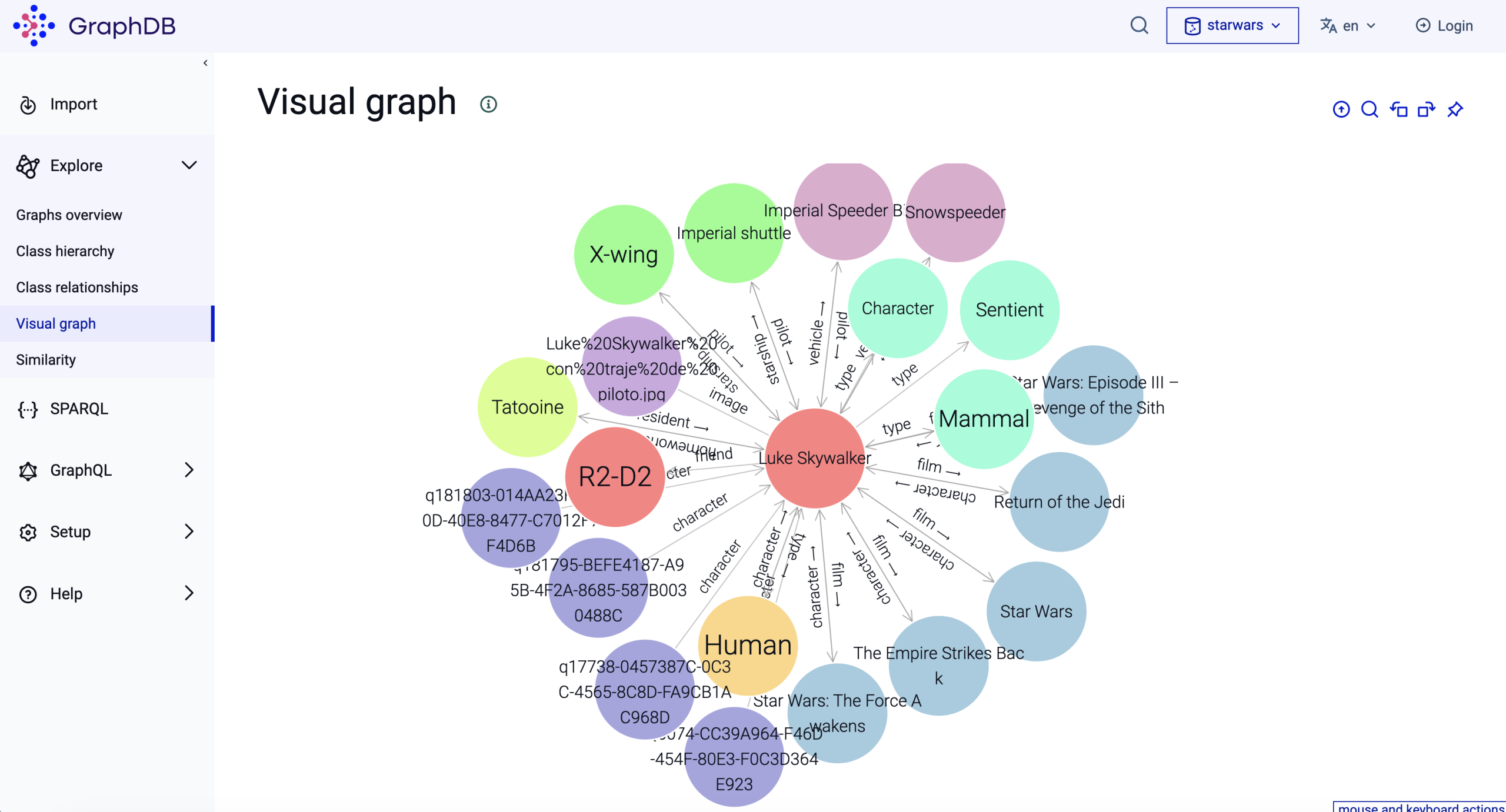
A Fresh look: Graphwise Workbench
You may have noticed things look a bit different. Following our rebranding to Graphwise, the GraphDB Workbench has been updated with our new brand colors and design guidelines.
While the powerful functionality you rely on remains the same, the updated look and feel represents our commitment to a unified, modern ecosystem. It’s a cleaner, more intuitive environment designed to help you focus on what matters: the data.
Notable performance improvements
In addition to the headline features, GraphDB 11.3 includes several requested enhancements:
- Advanced vector search: You can now create vector fields out of nested object fields, allowing for more nuanced and complex similarity searches within your knowledge graph.
- GraphDB-Ontop integration: We’ve added support for all Ontop configuration keys, giving you total control over how you virtualize relational databases as RDF.
Ready to explore GraphDB?
GraphDB 11.3 is designed to make your knowledge graph operations more resilient and your AI integrations more powerful.
Want to experience these new features firsthand without any setup?