
Select Page

Semantic Digital Twins

Empowering organizations and partners to build an intelligent, context-aware ecosystem that predicts impact and automates reasoning

Fragmented infrastructure and the expert bottleneck

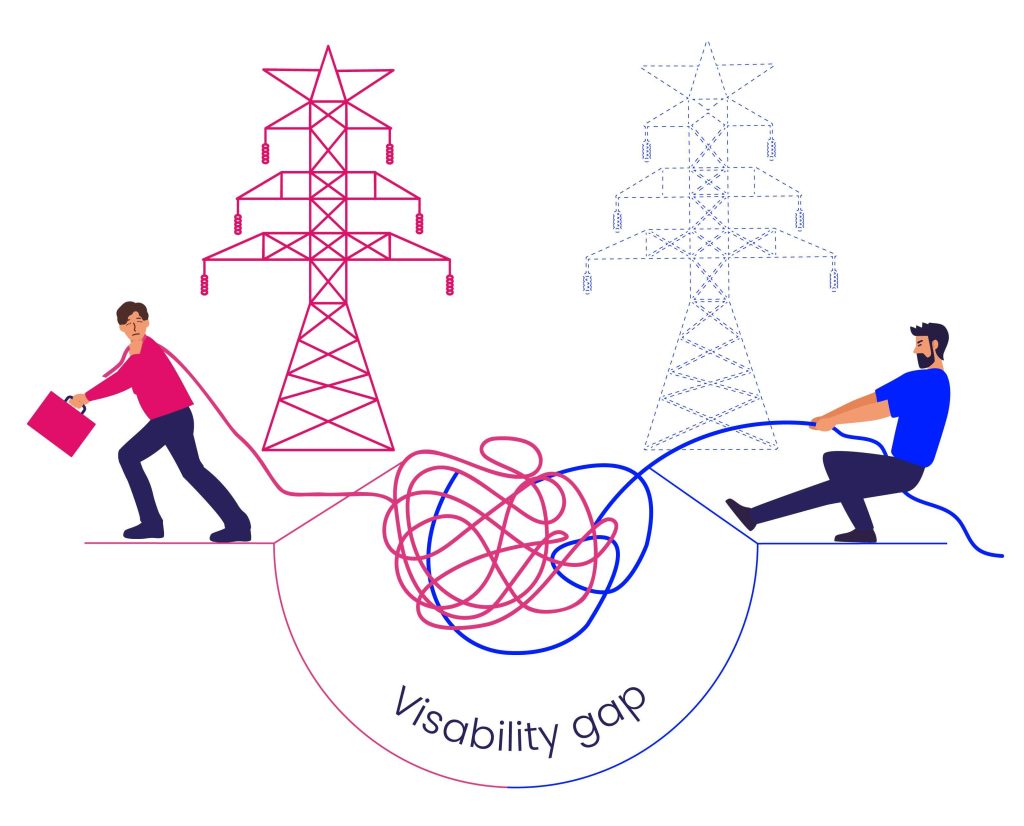
Modern organizations manage thousands of interdependent assets, yet their digital twin data remains trapped in vendor-specific silos (CMDBs, repositories, tools, wikis). This creates a massive visibility gap: you can see that a component exists, but you can’t see the hidden threads connecting it to your customers and services.

This leads to:

  • Complex integration: Merging proprietary vendor formats is time-consuming and expert-dependent
  • Brittle, hard-coded logic: Traditional digital twin models lack inherent intelligence, they rely on built-in code chains that cannot automatically infer failure modes
  • The expert bottleneck: Technical staff and business leaders must rely on a handful of overworked experts to write complex queries and get basic answers
  • Blind impact analysis: Manually tracing the dynamic dependencies of parts of a system and how they will be affected by a change or detected failure, is manual, slow and prone to errors
Focus Traditional Twin Semantic Digital Twin
Data model

Rigid schemas & data models
Inflexible

Flexible Knowledge Graph
Increased agility & adaptability

Visibility

Fragmented
Across Wikis/CMDB

360° real-time connectivity
Dependencies

Manual tracing
Error-prone

Faster impact analysis
Accessibility

Expert-dependent
Expertise gap

Democratized access to insights

From observation to understanding

While a traditional digital twin creates a virtual replica that mirrors the data and behavior of a physical system, a Semantic Digital Twin “understands” it within a broader context. By replacing rigid tables with a dynamic Knowledge Graph, you move from a static replica to an intelligent, context-aware ecosystem: 

  • Contextual intelligence & reasoning: Ontologies enable the system to reason close to the source without brittle, hard-coded logic
  • 360° real-time visibility: The single, unified view of your infrastructure enables to trace the effects of any change or failure in milliseconds
  • Agility & adaptability: The flexible model evolves over time by incorporating new technologies (e.g. DTDL, CIM, AAS) without costly re-engineering
  • Democratized insights: Anyone can query the Digital Twin by using natural language and get immediate answers

Our Strategic Moat

The Graphwise advantage

We provide the semantic engine that turns fragmented infrastructure data into a resilient, machine-interpretable source of truth.

Graph power

Enrich existing CMDBs and tables with a flexible graph, modeling complex, many-to-many relationships that tables can’t capture

Semantic Layer Unification

Harmonize data from disparate systems with a single source of truth, allowing you to instantly resolve ambiguities and failures

Modeling ontologies

Define the assets, relationships, and logic of your digital twin in an expandable, future-proof framework

GraphRAG for contextual answers

Allows operators to “Talk to the Graph” for context-aware, hallucination-free answers about system status

Success Stories

See what Our Customers and Partners do with Graphwise

customer success story

Statnett – Talk to Your Power System

See the full story

Problem

As the green transition accelerates, Statnett needed to perform rapid power system analyses. However, their data was locked behind complex CIM standards (IEC 61970/61968), requiring highly specialized knowledge and hours of manual extraction just to answer basic questions.

Solution

Graphwise developed a “Talk to your Power System”, a semantic interface allowing engineers to query the grid’s digital twin using natural language instead of complex code.

Results

They achieved a total transformation of their analytical workflow. Complex grid queries that once took hours of expert labor are now resolved in seconds, allowing engineers to focus on grid resilience rather than data hunting.

tietoevry partner success story

Tietoevry – Verifiable AI for IoT and nutrition

See the full story

Problem

Tietoevry’s enterprise clients struggled with Gen AI models that produced fluent but unreliable text because they lacked the deep domain context needed to interpret complex IoT sensor data and specialized culinary constraints.

Solution

Tietoevry integrated Graphwise’s GraphRAG and Knowledge Graph technology to build a “trusted semantic backbone” for their clients, ensuring AI outputs are grounded in industry-specific facts and logic.

Results

By grounding AI in structured knowledge, Tietoevry enabled its clients to automate high-stakes decisions in maintenance and nutrition with total confidence and domain-aware accuracy.

customer success story

Leading BAS Manufacturers – Precision asset management

See the full story

Problem

Two leading Building Automation Systems (BAS) manufacturers struggled with fragmented, siloed data models for HVAC, lighting, and security that required manual, redundant updates.

Solution

The manufacturers integrated Graphwise’s GraphDB with the Brick metadata schema, creating a unified semantic digital twin that centralizes all building assets into a single, standardized graph model.

Results

By replacing isolated silos with a “semantic backbone,” the manufacturers slashed implementation time for integrators and drastically reduced maintenance costs through centralized, enterprise-wide asset visibility.