
From Data Silos to a Single Source of Truth – Introducing the Graphwise Platform
The Graphwise Platform is an end-to-end framework that automates the transition from raw, disconnected enterprise data to highly intelligent, autonomous AI.

Main Takeaways
- Graphwise is launching Graphwise Platform Pulse, a quarterly initiative and webinar series dedicated to help companies maximize ROI during their AI journey - starting live on July 2, 2026
- The Graphwise Platform delivers the Semantic Backbone for enterprise AI to merge all our components into a single, end-to-end secure framework. Each one builds on the output of the one before it, turning fragmented data into governed, AI-ready knowledge your organization can actually trust.
- Organizations that build on the Semantic Backbone get 100% deterministic, explainable AI responses grounded in verified enterprise facts, with multi-hop reasoning across every data source and zero tolerance for hallucination.
GenAI is smart. But it has no idea what your business knows, how your data is connected, or which answers it should trust. This results in uncertainty in AI due to the constant hallucinations it responds with. And yet, enterprise investment in AI has never been higher. McKinsey reports that over 88% of organizations have deployed AI in at least one business function — but only 11% have managed to scale it successfully.
The core issue is that most single AI tools have no corporate memory. They don’t know your business data, your processes, or your priorities. When they hit a gap in their knowledge, they confidently hallucinate, making up facts that sound authoritative but have no grounding in reality. If you add to that their inability to connect information across data silos, you have an AI that is simultaneously overconfident and underinformed. For most enterprises, that combination plummets ROI before a project ever reaches production.
What Actually Fixes AI Hallucinations?
Graphwise’s Platform is the solution to AI hallucinations. Think of it as giving GenAI a “business brain” that completely understands your business POV. Instead of letting an AI guess based on general information, Graphwise builds a solid semantic layer that connects your siloed data, documents, and unique business logic into one.
By grounding the AI in this verified source of truth, we eliminate those unpredictable hallucinations and replace uncertainty with reliable facts. It guarantees 100% deterministic, explainable AI responses with multi-hop reasoning (the ability to connect pieces of information across entirely different systems) while automatically generating the data pipelines via AI-assisted modeling.
This blog post introduces the Graphwise Platform and explores how it provides a trustworthy, scalable foundation for enterprise AI.
If you’d rather see it in action, you can join our Platform Pulse webinar on July 2 for a live end-to-end demonstration.
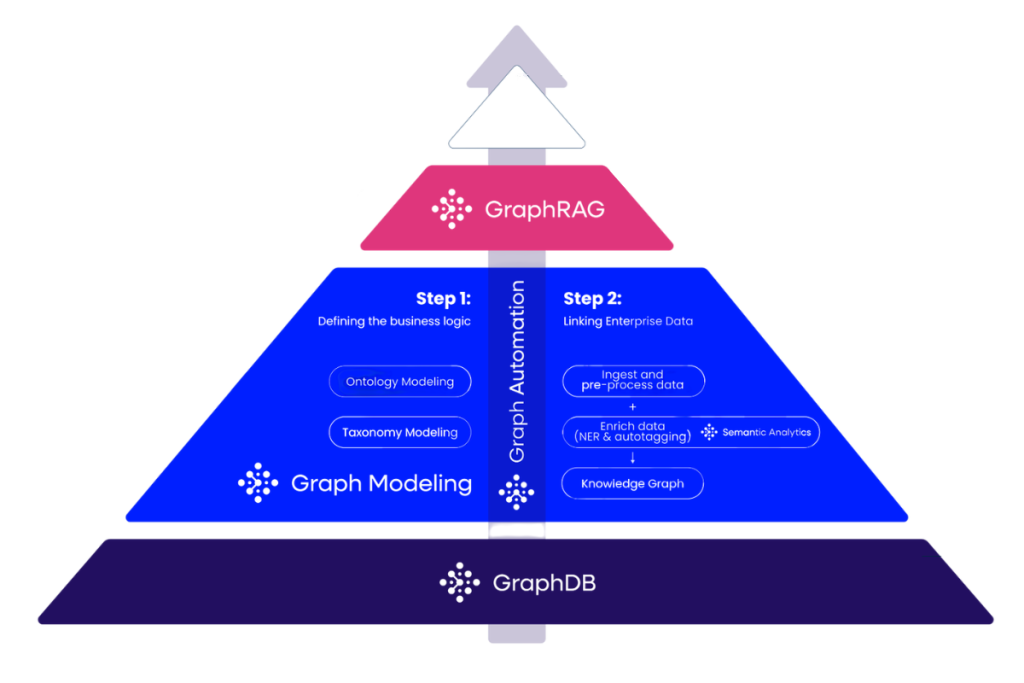
How the Graphwise Platform works as one framework
Most enterprises stitch together their AI infrastructure from separate tools using a database here, a modeling layer there. Graphwise platform provides the complete end-to-end framework that maps, transforms, stores, and connects your enterprise data to AI, without the integration overhead of managing multiple vendors.
Instead of a company having to buy, stitch together, and maintain different software vendors to build a secure AI data pipeline, Graphwise does it all in a unified environment, dividing the journey into two distinct, manageable business phases.
Phase 1: Establishing the structural foundation
Step one starts with a simple question: what kind of enterprise knowledge are you trying to make AI understand?
For some organizations, the most valuable knowledge is hidden in unstructured content — PDFs, policy documents, manuals, emails, research papers, contracts, reports, and internal knowledge bases. For others, it lives in structured systems — SQL databases, MongoDB, CRM platforms, IoT systems, digital twins, or operational applications. Most enterprises, of course, have both.
What you need to know before you start?
Graphwise starts by helping you map the logic behind your knowledge.
- If your data is unstructured, the platform helps you build and manage taxonomies. This gives your organization a controlled vocabulary, so different documents, teams, and systems stop using different words for the same thing. It reduces ambiguity and helps AI understand the language of your business more consistently.
- If your data is structured, Graphwise uses ontologies to map out the real-world relationships behind it. This is where the platform defines how products connect to suppliers, how assets connect to locations, or how employees connect to processes. In other words, it does not just describe your data. It describes how your business works contextually.
Step 1: Modeling business logic
This step is powered by Graph Modeling. Instead of asking teams to manually build complex models from scratch, Graph Modeling uses LLMs to suggest concepts, synonyms, relationships, and business rules. But the human expert stays in control. Users can accept, edit, or reject every recommendation, so the final model reflects real business knowledge rather than a generic AI guess.
Step 2: Linking enterprise data
Once the rules are defined, Graph Automation turns them into something operational.
This is where the platform starts connecting your actual enterprise data. Graph Automation coordinates repeatable data and transformation pipelines across systems like SharePoint, SQL databases, content repositories, etc. Instead of leaving your data scattered across separate tools, it brings those sources into one governed flow.
Inside that, Semantic Analytics enriches the content. It identifies entities, extracts concepts, applies metadata, and automatically tags information so that previously hidden knowledge becomes visible to the system. Each piece of information thus becomes part of a larger network of meaning and context.
That enriched knowledge is then stored in GraphDB, Graphwise’s enterprise-grade semantic graph database. GraphDB holds your data as an interconnected web of facts, where relationships are explicit, governed, and queryable. It also supports native reasoning, which means the platform can infer new insights from the relationships already present in the graph.
This is the moment where disconnected data becomes a single source of truth. Not because everything has been copied into one giant repository, but because everything has been connected through shared meaning.
Phase 2: Deploying the semantic layer and powering intelligence
Once the knowledge graph is built and securely stored, the platform is ready to power AI applications with GraphRAG.
Traditional retrieval approaches often rely on finding text that looks similar to a user’s question. In enterprise environments, that is rarely enough. Important answers are usually spread across multiple systems, documents, and business relationships.
Step 3: GraphRAG implementation
GraphRAG uses the knowledge graph to assemble verified business context before generation happens. Instead of relying on disconnected fragments, the AI works from governed enterprise facts, enabling traceable responses and multi-hop reasoning across different data sources.
That is what makes the Graphwise Platform different from a collection of AI tools. The value is not only in each component, but in how they work together:
- Graph Modeling defines the business meaning
- Graph Automation activates it across enterprise systems
- Semantic Analytics enriches unstructured content
- GraphDB stores it as a governed web of facts
- GraphRAG retrieves from that trusted foundation.
Step 4: Agentic horizon
Once that foundation exists, it becomes reusable across search and recommendation, analytics, AI assistants (like Graphwise for M365), and future agentic workflows instead of requiring a new pipeline for every use case.
It also prepares organizations for what comes next: autonomous AI agents. Because the platform creates a unified model of the business, future agents can operate with the context, memory, and governance needed to support complex enterprise workflows safely and reliably.
Wanna see how this works in action?
On July 2nd, we’re launching Graphwise Platform Pulse, our new quarterly webinar series where we’ll recap our comprehensive Graphwise Platform architecture, showcase real-world enterprise workflows, and deep-dive into our evolving components.
Join us for our inaugural session this July, where we will lay out the complete blueprint of the platform, demonstrate how the layers interact, and feature a live end-to-end demonstration of the Semantic Backbone in action.

Details
What is a Semantic Backbone
A semantic backbone leverages knowledge graphs and unified data models to connect enterprise information, rather than just linking traditional databases. It establishes a shared understanding of the business concepts across the organization and delivers highly integrated, consistent, and secure AI and data solutions.
Learn moreRecommended Content
AI-ready Graph Environments: The Key to Scaling AI with Graphwise’s Knowledge Graphs
Read about why most enterprise AI fails and how Graphwise creates graph environments using knowledge graphs and semantics.
Read more
What Is a Semantic Backbone?
The Semantic Backbone serves as a source of truth, unifying data silos & providing contextual grounding for scalable and trustworthy Agentic AI.
Read more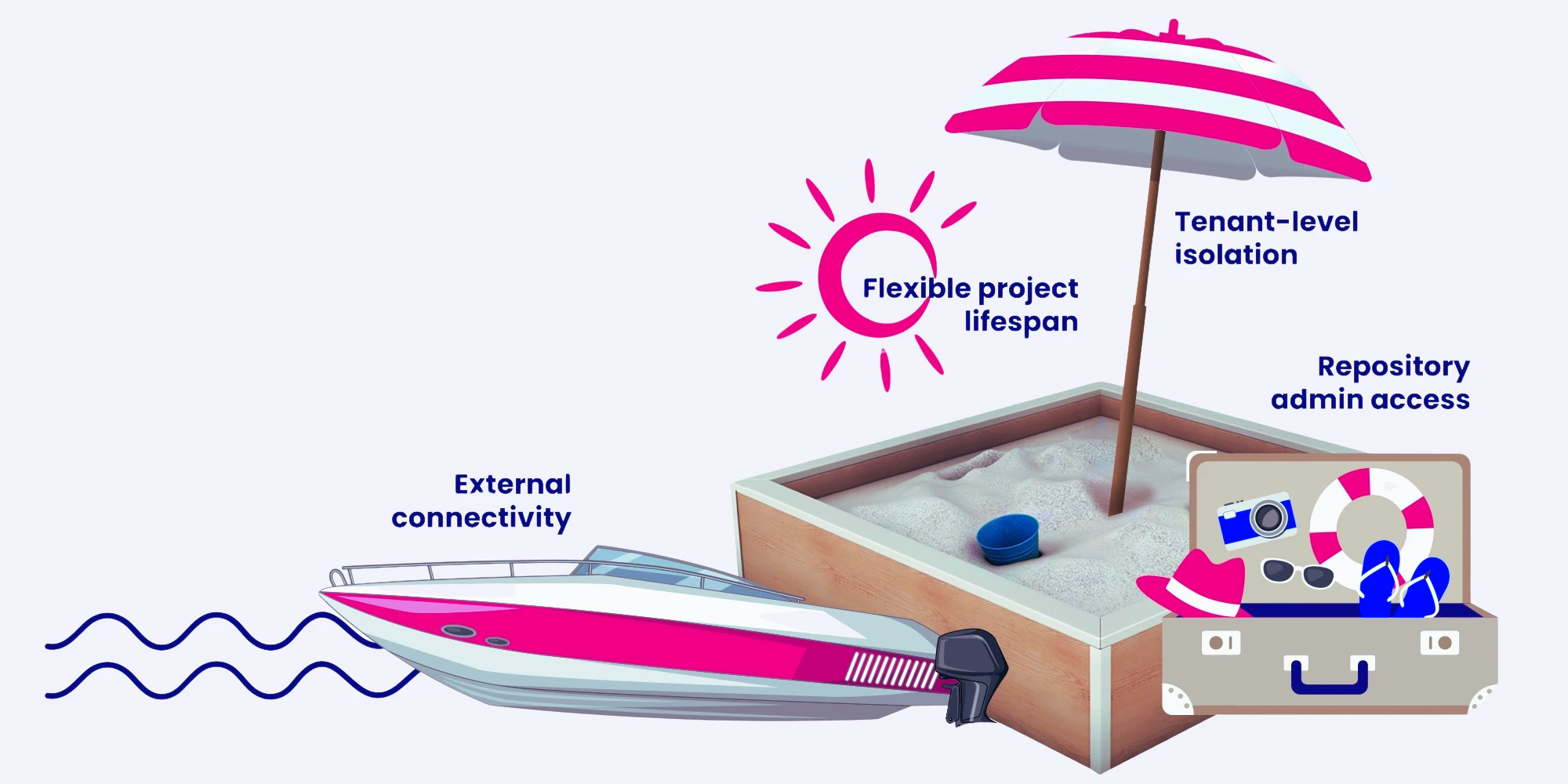
Graphwise Sandbox
Try Graphwise Sandbox—a secure, self-service platform to explore GraphDB. Run queries, use curated datasets, and test graph tech with no setup needed.
Read moreFAQ
Any Questions? Look Here
The timeline depends on your organization's scale and data complexity, but it typically follows three stages. Discovery and assessment takes 2–4 weeks to identify high-value use cases, define core business logic, and map essential data sources. A functional pilot then runs 2–3 months, building the foundational taxonomies and ontologies needed to link specific datasets. Usually this results in a working prototype like a semantic search or GraphRAG application. Enterprise-wide scaling then continues over 6+ months, expanding the backbone across departments into your organization's universal source of truth.
No. Graphwise works on top of your existing infrastructure, not instead of it. The platform connects to your current systems - SQL databases, MongoDB, Elasticsearch, Kafka, Microsoft 365 - through open APIs and native connectors. It can even query legacy databases in real time without moving or duplicating data. You can start with a single use case and expand incrementally. The goal is to make the knowledge already inside your systems AI-ready, not to force a migration.
A knowledge graph can connect virtually any type of enterprise data. This includes structured sources like ERP, CRM, and SQL databases, IoT sensor feeds, and spreadsheets. It also covers unstructured content — PDFs, emails, meeting transcripts, contracts, and multimedia files — which can be enriched through semantic analytics and entity extraction. Lastly, semi-structured data from content management systems like SharePoint as well. Beyond internal data, knowledge graphs can incorporate external knowledge bases, industry standards, and linked open data to add broader context to your proprietary information.
Knowledge graph-powered AI delivers the most value in data-intensive industries where complex relationships between entities matter. Pharmaceuticals and life sciences use them to accelerate drug discovery and navigate regulatory complexity. Financial services rely on them for fraud detection and risk management. Manufacturing applies them to semantic digital twins and supply chain optimization. Media organizations use them to tag, link, and recommend content across large archives. Government institutions use them to automate policy enforcement across agencies. The common thread is that knowledge graphs ground AI in governed facts reducing hallucinations and making outputs explainable enough to trust in regulated environments.
A collection of AI tools means separate, standalone products like a database from one vendor, a retrieval engine from another, a modeling layer from a third but each one working in isolation. An AI platform integrates all of those into one unified system where data flows consistently from one layer to the next. The practical difference is that a toolset requires significant effort to connect and maintain, while a platform handles that integration by design. A platform reduces the complexity, ensuring data consistency, and lowering the total cost of ownership.