
When Regulators Want Proof, Not More Paperwork: Meeting DORA with a Semantic Digital Twin
The Semantic Digital Twin enables financial Institutions to have a standardized framework for identifying critical problems within their IT infrastructure.

Main Takeaways
- DORA doesn't ask for documentation, it asks for actionable evidence of your ICT resilience, not policies buried in spreadsheets and slide decks.
- Companies are full of fragmented data across databases, wikis, and CMDBs. This creates a "data fog" problem where hidden dependencies become audit failures.
- A Semantic Digital Twin maps every disconnected system together. Instead of weeks rebuilding architecture diagrams for auditors, you answer "what-if" scenarios on demand in seconds.
Financial institutions have always managed complex IT infrastructure. What changed in January 2025 is who gets to ask questions about it — and what counts as an answer. DORA, the EU’s Digital Operational Resilience Act, doesn’t just require financial entities to have robust and well-documented Information and Communication Technology (ICT) systems. It requires them to prove that resilience on demand — not with policies and spreadsheets, but with verifiable evidence regulators can actually test. For most institutions, that’s where the problem starts.
DORA is special because it treats the IT structure of financial institutions as a “core-critical-structure” for the whole EU. Therefore, it imposes stricter requirements that go far beyond those of a regular business. This means companies need to find, assess, and regularly test different critical scenarios. Because DORA audits exactly for this, and ongoing testing is what keeps companies compliant with the Act.
What are the DORA’s requirements?
For financial institutions, paperwork is no longer enough because regulators don’t just want to know your policies. They want precise, machine-executable evidence of your operational resilience during “what-if” scenarios.
DORA’s aim is narrow but quite demanding. It requires financial institutions to have resilient ICT systems. For example, what if there’s an outage, a cyber security incident, or a failed 3rd party provider. Then they must keep running or recover fast enough as if the problem didn’t occur.
To achieve this level of resilience, DORA requires financial institutions to:
- Identify every critical element of their ICT infrastructure
- Assess the exact criticality and business domain dependencies of those assets
- Perform detailed impact assessments of “what-If” failure scenarios
- Execute comprehensive, continuous resiliency testing programs
How DORA structures compliance: four stages
DORA organizes these requirements around five pillars: ICT Risk Management, ICT-related Incident Reporting, Digital Operational Resilience Testing, ICT Third-Party Risk, and Information Sharing. Meeting them follows a sequential logic, where each stage building on the last:
Identify and Classify ICT Functions — map and inventory all ICT functions and dependencies across your environment, identify unmanaged or unknown systems, and document interconnections to third parties.
Map Scope and Dependencies — define the scope of critical ICT functions, map their dependencies by business domain, and track any material changes.
Assess Impact of Failure — test recovery annually or following any substantive change, identify inconsistencies in recovery time objectives across mapped business functions, and conduct scenario testing.
Analyze Risks — perform risk assessments prior to major changes, continuously identify sources of ICT risk, track legacy assets, and promptly identify anomalous activity and single points of failure.
Each stage requires evidence — not documentation, but live, queryable proof that your infrastructure map reflects reality. That’s where most institutions hit the wall.
What if you fail to comply?
DORA’s penalties reflect its underlying logic: if the ICT infrastructure of financial institutions fails, the stability of the EU’s entire financial system is at stake. The consequences are, therefore, designed to be felt at every level of an organization, not just its compliance department.
Non-compliance carries real teeth. National Competent Authorities can issue fines of up to 10% of annual global turnover and personal fines of up to €1 million for individual executives. They can also temporarily ban senior executives from their roles, restrict or suspend operations entirely, and publish formal censure notices that do lasting reputational damage. The accountability is both corporate and personal, which is why DORA has made boards of directors and senior executives pay close attention. Now they can be held personally accountable, not just the company.
Where do companies struggle?
Most institutions don’t fail DORA because they don’t understand their own infrastructure. They fail because that understanding lives everywhere and nowhere at once — split across CMDBs, configuration repositories, wikis, and the memories of a few senior engineers, with no single place that holds the whole picture. This scattered, unqueryable state of knowledge is what we call data fog.
What makes the fog so dangerous is the part you can’t see. You can confirm that a component exists, but the hidden threads connecting it to downstream services and critical business functions stay invisible. And, ironically, those threads are exactly what DORA asks you to trace.
The issue also compounds: every new system, vendor, and integration adds dependencies no one fully maps, so the gap between what you can prove and what actually runs widens with each passing quarter. Traditional digital twins don’t fix it either. They mirror data but lean on hard-coded logic that can’t infer failure modes on its own, and only a handful of specialists can query them meaningfully.
So when an audit lands or a system fails, risk teams spend weeks manually chasing information across fragmented systems, trying to guess how a single technical failure became a critical business problem. Under DORA, guessing is a compliance violation meaning that institutions need a system that can answer those questions on demand.
The solution is the Semantic Digital Twin
The Semantic Digital Twin enables financial institutions to have a standardized framework for identifying critical problems within their IT infrastructure. While a traditional digital twin might mirror the basic data of a system, a Semantic Digital Twin understands the data within its broader business context. It acts as a trusted semantic backbone, turning fragmented infrastructure data into a single, machine-interpretable network of knowledge.
To capture the full complexity of a financial institution without reinventing the wheel, you can lean on open industry frameworks that already exist. The strongest of these is BIAN (the Banking Industry Architecture Network) and when you convert it into a knowledge graph, you can get a working digital twin of a bank.
BIAN as a digital twin of a bank
What makes BIAN such a good fit is how completely it maps out an institution. It doesn’t stop at high-level structure — it runs all the way down. From the broadest business areas to the granular data records underneath them:
- Business Area — the broadest grouping, organizing related domains around overall goals: channels, resource management, business management, and the finance and risk management area where DORA lives
- Business Domain — the more familiar level: credit risk, compliance, advisory services, market risk, trade banking. Every function you’d expect to find inside a financial institution sits here
- Service Domain — the specific services and capabilities that support each business domain, each one responsible for one or more control records
- Service Operation — a precise functional action a service domain performs, with its own defined inputs and outputs
- Control Record — the key entity that manages and tracks the operational side of a service domain
The BIAN knowledge graph in action
On their own, these are just layers in a document. But convert BIAN into a knowledge graph and they become a context-rich network, serving you as a Semantic Digital Twin.
You can trace how a single API or endpoint actually behaves in the real world, which business domain it serves, and what fails downstream if it goes dark. This is exactly the dependency chain DORA expects you to trace on demand.
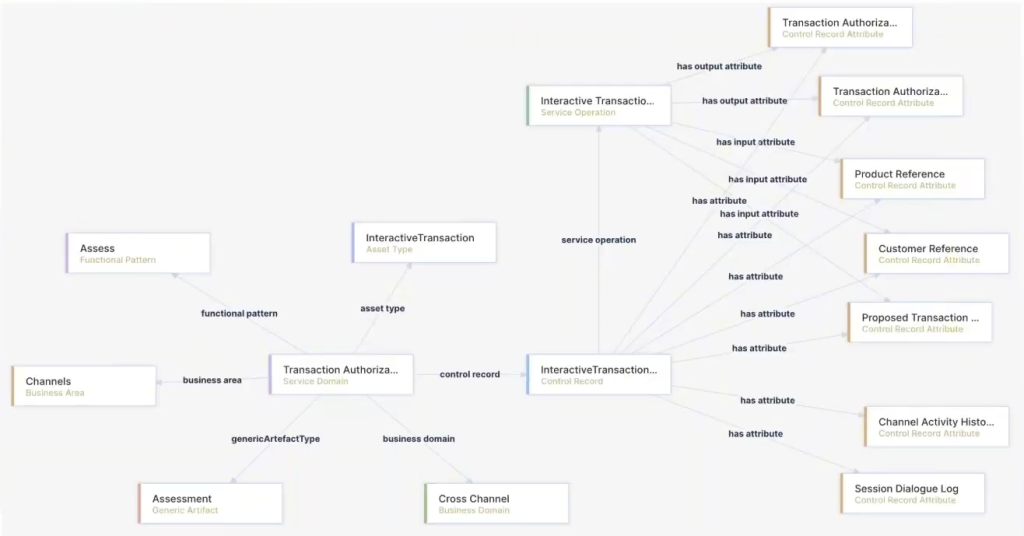
This is a queryable, descriptive graph and not just a static diagram.
Take a look at the BIAN ontology mapped above. You can see exactly how a single Transaction Authorization service domain is structurally linked to its broader business area (Channels). More importantly for DORA, look at how it expands into its operational reality. It connects directly to its active control records, tracking everything from product and customer references to specific session dialogue logs and channel activity histories.
See it in practice. Watch the full technical walkthrough of BIAN as a knowledge graph below.
What does this mean for your team?
Transitioning your infrastructure into a Semantic Digital Twin turns DORA compliance into a streamlined, everyday activity. Because the knowledge graph maps every server, database, and third-party dependency directly to your core business functions, you can run resilience tests and track any “what-if” scenarios via on-demand queries that execute in seconds.
Questions like: “What are the most reused business domains?”, “What are the top dependencies?”, and “What are the top five asset types by business area?” become queries rather than investigations. Which eliminates weeks of manual spreadsheet work.
When auditors ask for proof, you hand them a live, machine-executable trail that serves as a verifiable source of truth. This allows your engineers to stop constantly reconstructing architecture diagrams and focus entirely on operational uptime. The knowledge graph doesn’t need to be rebuilt for every audit because it evolves alongside your infrastructure, so the evidence is always current.
To wrap it up
DORA is a recurring obligation – you must prove, on demand, that you can survive an ICT failure. The institutions that handle it must be able to answer any critical “what-if” questions and scenarios the moment an auditor asks.
A Semantic Digital Twin built on a framework like BIAN is how you get there. That is because it clears the data fog, turning your fragmented systems into a single queryable model. This makes the audit just a demonstration of your operational capability. The regulation isn’t going away but the weeks of manual work it demands can.

Details
What Is a Semantic Digital Twin?
The Semantic Digital Twin empowers organizations and partners to create context-aware ecosystems, predict impact, and automate reasoning
Learn moreRecommended Content

The Advantages of GraphRAG for Enhanced Regulatory Compliance and Understanding
Read about how knowledge graphs combined with LLMs address regulatory compliance challenges.
Read more
Bridging Legal Data and AI: Our Experience with Talk to Your Graph and GraphDB
Read about Cognizone's collaborative experience with Graphwise GraphDB and its Talk to Your Graph interface.
Read more
Automating Data Privacy Compliance: Knowledge Graphs, Generative AI, and Real-Time Risk
Read about how How to use knowledge graphs and GenAI to automate data privacy compliance and govern emerging AI use cases effectively.
Read moreFAQ
Any Questions? Look Here
A functional pilot can typically be built in 2 to 3 months, giving the team a working prototype and early insight into real pain points. Full-scale implementation, however, usually takes several months to a year, depending on the complexity and heterogeneity of the institution's data sources and the scope of the twin. Semantic technology speeds up integration and modeling, but the main bottleneck remains accurately mapping and connecting diverse data sources. In short - expect a pilot in a quarter, and a full deployment within 6–12 months.
Yes, a Semantic Digital Twin can integrate with your existing CMDB and ITSM tools. It uses semantic technology and knowledge graphs to pull data from these systems together into a unified, interoperable layer, even when the sources are legacy or fragmented. This creates a live, contextualized view of your IT assets and how they relate, without requiring you to rip and replace what's already in place. Your CMDB and ITSM data become the foundation the twin builds on, enabling richer analytics, predictive maintenance, and better-informed IT decisions.
Ownership of a Semantic Digital Twin is typically a cross-functional responsibility rather than sitting with a single team. It usually involves data governance professionals, IT specialists, semantic technology experts, and domain-specific business stakeholders working together to keep the data feeding the twin accurate and interoperable. Maintenance also includes evolving the underlying semantic models and ontologies as the organization's assets and processes change. This work often sits within a broader digital transformation or data management office, ensuring the twin stays aligned with business goals and compliance needs.
You do not need to adopt the full BIAN framework to get started. A focused subset that aligns with your project scope is a practical and common starting point. Semantic technology makes this easier by allowing you to model just the domains you need now while keeping the structure open to expand later. Starting narrow lets you map and connect the data points that matter most without taking on unnecessary complexity upfront. As the digital twin matures and proves value, you can broaden BIAN adoption in phases, scaling coverage alongside your actual needs.
Yes, a Semantic Digital Twin can help you prepare for multiple audits at once. It pulls together data from disparate systems into a single, unified model. The same underlying information can support different audit requirements without duplicating effort. Because it maintains a live, traceable record of assets and their relationships, teams can query compliance readiness directly rather than manually chasing down evidence for each audit separately. This cuts down on repetitive data-gathering work, improves the accuracy and traceability of what's reported, and gives the organization a clearer, more consistent view of compliance across multiple audits at the same time.
When third-party providers won't share their architecture data, a Semantic Digital Twin works around the gap rather than depending on complete access from every source. Its flexible ontologies and data models can accommodate missing information, connecting whatever data points are available while leaving room to incorporate more detail later if it becomes accessible. A unified semantic layer and knowledge graph then tie this partial data together with everything else in the model, making the available information's meaning and relationships explicit even without full visibility into the third party's systems.