
Graph Modeling
Leverage our award-winning taxonomy and ontology management tool to transform siloed content into an integrated architectural layer ready for AI agents
Without a centralized semantic backbone and taxonomy and ontology management tool, companies get stuck fixing data problems inside siloed CMS and applications. This is a “data tax” on your time and money. Graphwise automates this architectural layer, ensuring your data is clean and ready for AI agents without manual effort.
Graphwise’s Graph Modeling (previously PoolParty – recognized by KMWorld and Gartner) is a taxonomy and ontology management tool, integrating LLMs to automate specific building and management tasks, allowing for AI-driven efficiency.
Create, link and manage your taxonomies in a centralized tool
Traditional taxonomy modeling has long been a manual bottleneck, requiring months of human effort to build and maintain. Graphwise Graph Modeling removes this barrier by integrating LLMs into the taxonomy modelling process.
- Create the logical structure of your business, including hierarchical and faceted taxonomies, thesauri, and controlled metadata term lists
- Build on global W3C standards (SKOS/RDF) to ensure your data is never locked in a proprietary silo
- Link multiple vocabularies across the enterprise and implement APIs for seamless system integration
- Customize quality settings, with built-in data validators and guidelines, ensuring high-quality inputs for your AI models


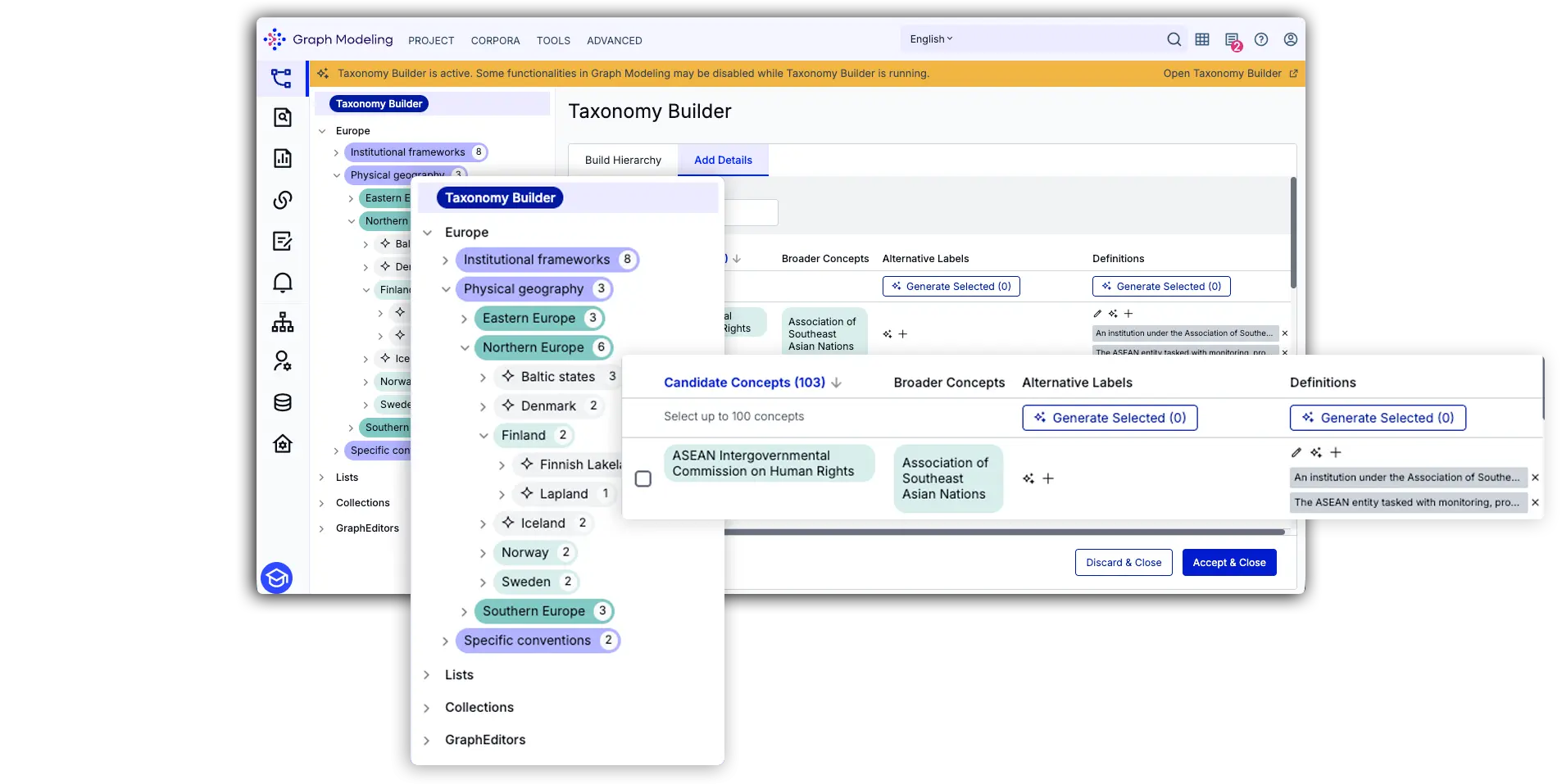
Automate the taxonomy modeling process with our Taxonomy Builder
The Taxonomy Builder feature uses LLMs (incl. OpenAI, Google Gemini, and Anthropic) and GenAI to streamline the process of creating taxonomies, eliminating the bottleneck of manual modeling and ensuring domain-specific facts instead of generic AI guesses.
- Precise, domain-specific recommendations: The LLM is grounded in your own company documents and data
- Human-in-the loop control: The AI-suggested concepts can be accepted, edited or rejected by the user
- Contextual intelligence & hierarchy expansion: By understanding where a concepts sits in your hierarchy, the tool provides more accurate results than ChatGPT
- Comprehensive vocabulary control: The tool suggests narrower concepts, alternative labels or definitions that a user might overlook, enabling auto-tagging and search
Move beyond simple hierarchies with ontology management
Don’t just organize your terms – define how your business actually operates. Our ontology management tool helps you transform static lists into dynamic, machine-readable semantic layers:
- Connect the dots: Link custom schemas and rich, real-world relationships directly to your existing taxonomies
- Standardized & scalable: Built on global W3C standards (SKOS/RDF) to eliminate proprietary data silos
- AI-Ready foundation: Turn fragmented content into an integrated architectural layer optimized for precise GraphRAG and autonomous AI agents
Maintain control with human-in-the-loop and strategic governance
While Graphwise reduces the manual burden of modeling, it is designed to augment, not replace, taxonomists and SMEs. The human expert remains essential at three key decision points:
- Selective adoption: Choose which AI suggestions to accept
- Structural refinement: Organize hierarchies for end-user navigation or machine tagging
- Label governance: Ensure synonyms match brand standards
We recommend a governance plan that defines the purpose, maximum depth, and specific use cases for each scheme before triggering automation.
Key features you’ll love:

Take a deep dive with an expert.
Please fill out the form to get connected with a Graphwise Team Member. Get ready for your guided walkthrough and full-access account!