
What Is an Agentic Enterprise?
Learn what the enterprise ai agents are and how those autonomous ai agents can do for an enterprise to improve company's results
What Is an Agentic Enterprise?
An agentic enterprise is an organization where AI agents execute bounded, multi-step processes across business systems. In contrast to a copilot, which generates information for a user to then act on, enterprise AI agents can select approved tools, validate results, retry permitted operations, and escalate decisions. Agents can make bounded decisions within a workflow, while higher-impact decisions can require further human authorization.
Importantly, agents are bounded. Alongside defined context, they also have defined permissions, budgets, approval gates, and audit trails.
Agentic enterprise is therefore an operating model for managing agents. Agents become business functions that are appropriately owned and controlled.
Main Takeaways
- Agents execute processes within defined limits. They can also select and execute approved tools, validate information, and escalate where necessary.
- Processes should be divided between agents where different functions, permissions, tools, and validation are needed. Alternatively, processes can be executed by a single agent (or in a deterministic process) if they are simple, consistent, and easily testable.
- By default, functions such as payment release, production code changes, contractual commitments, and credential updates should require human authorization.
- Ensure that agents use consistent, governed semantic definitions, while receiving only the context appropriate to their role and task. A knowledge graph can provide this shared semantic foundation.
- Start with a frequent, bounded, and reversible process, and execute it in shadow mode first. Only increase agent autonomy when metrics demonstrate that it is executing reliably.
What makes an enterprise agentic?
Copilots generate information, whereas agents execute processes within enterprise systems. For example, to resolve a supplier invoice, an agent can split the task into sub-tasks, retrieve the purchase order and payment policy, and execute the relevant tools. It then validates the results and retries or escalates where necessary.
It is helpful to distinguish between three levels:
- Single agent: one agent plans and executes a process.
- Multi-agent system: a coordinated system in which a supervisor agent delegates tasks to specialist agents, while agents, tools, enterprise systems, and human reviewers work together toward a common business objective.
- Agentic enterprise: the organization manages these systems as business functions, which are appropriately owned and controlled.
The third level is an important business decision as well as a technical one, so it should be considered within your enterprise AI strategy.
Agents, copilots, and automation: what is the difference?
The table below details the distinctions between rules-based automation, copilots, and multi-agent systems.
| Attribute | Rules-based automation | Copilot | Multi-agent system |
| Trigger | Schedule, webhook, or event | User prompt | Business objective, state change, event, schedule, or API call within a bounded policy |
| Logic | Rules | Single response generation | Planning, validation, and retrying |
| Action | Fixed | Suggested | Appropriate and authorized action |
| Process state | Explicit workflow state | Usually session or conversation state | Working, episodic, and semantic state, subject to policy |
| Error handling | Stop the process or store in the error queue | Await user correction | Validate, retry, or escalate |
| Human involvement | Operator | Reviewer and executor | Supervisor, policy owner, and exception reviewer |
Agents do not replace rules-based automation. Rigid rules (such as never paying an invoice twice) should be enforced deterministically in code or a policy engine so they cannot be overridden by model output. Agents should use their logic for processes that require judgment, for example analyzing an unstructured invoice.
Why multi-agent systems, and when not to use them
Extended context can lead to a loss of direction
If an entire process is included in one prompt, the model has to analyze a very long context (potentially thousands of tokens). Liu et al. (Transactions of the ACL, 2024) found that models make better use of information at the start and end of long contexts than in the middle. Performance can also decline as the amount of context increases, depending on the task and model. Consequently, it is not advisable to rely on an extended prompt alone for policy and escalation rules within an agent process. Instead, enforce these via the tool layer and policy engine, and provide agents with relevant context near to where decisions are made.
Isolated errors in specialist agents
Within a supervisor agent process, the supervisor agent defines objectives and delegates functions such as ingestion, validation, and exception management to other agents. As a result, each agent has reduced context and permissions. This means that errors can easily be analyzed, tested, and corrected. Humans manage exceptions and refine policies.
Within structured processes, the number and complexity of human-managed exceptions are often a greater driver of human-review capacity than transaction volume alone.
While specialization can be advantageous, it also adds overhead. Information can be lost when agents hand off work to each other, and both latency and cost increase. Processes should be separated between agents where differing functions, permissions, tools, and/or validation are required. Processes can alternatively be executed by one agent (or in a deterministic process) if they are simple, consistent, and easily testable.
How do you restrict agent autonomy?
In enterprise agentic AI, agents can only access approved data. They can also only use authorized tools and spend up to a defined budget. If an agent requests an action outside these restrictions, the control layer should block the request and route the case for escalation where appropriate.
While prompts can describe policy, they must not be used to enforce it. Permissions, approval gates, budgets, data access, and tools must be controlled outside the model and verified again at execution.
How do you manage and monitor agents?
Human authorization
Human-in-the-loop (HITL) oversight is most effective if different levels of human involvement are established. These should be determined by factors such as the impact, reversibility, data sensitivity, and regulatory exposure of the action. Human involvement should not be based on agent confidence.
- Level 1: Full autonomy. Read-only actions, summaries, internal drafts, and routine data cleansing.
- Level 2: Monitored. Customer communication drafting, non-critical data amendments, ticket allocation, and payment staging (within policy). Actions are logged and can be undone within a set window.
- Level 3: Requires prior human authorization. Payment release, production code changes, contractual commitments, and credential changes.
These levels constitute a default enterprise policy. However, for each action, the degree of human involvement will vary depending on risk, reversibility, and regulatory considerations, as well as your enterprise policy.
Autonomy should be managed at a tool and action level, not at an agent level.
Within accounts payable (AP), for example, one agent could execute Level 1 invoice matching. Payment staging could then be undertaken at Level 2. Finally, payment release could be passed to a human at Level 3. This is why levels of human involvement are controlled within the tool layer, where prompts cannot alter them. Governing an agentic enterprise therefore relies on permissioned agent actions rather than on instructions in prompts.
AgentOps and auditing
AgentOps measures tool-call failure rates, tracks process and delegation flows, and monitors token expenditure and latency. It also monitors semantic drift, which refers to shifts in meaning. This may occur, for example, if the definition of an approved supplier changes or a policy is superseded. Semantic drift differs from model drift (changes in model behavior) and data drift (changes in the data).
An immutable log should be created for each process execution. This should include the defined objective, context retrieved, actions executed, policy validation and authorization, and output. Auditors can therefore reconstruct the decision-making process and, where the relevant inputs and versions have been retained, replay it in a controlled environment. In addition, this information shows the extent of human involvement in different processes. This is a genuine cost to consider when evaluating ROI on enterprise AI investments.
Enterprise AI agent architecture
When designing agentic AI systems for enterprise use cases, these elements can be implemented in different ways and combined into a composable agent framework. They operate within an enterprise architecture that includes compute, model-gateway, and retrieval layers (see our guide to enterprise AI platform architecture for more information).
Process planning
Within an enterprise automation framework, many autonomous AI agents implement some version of the following planning loop:
- Plan: Divide an objective into sub-objectives.
- Select: Choose an approved tool/function or agent.
- Validate: Assess whether the selected function is moving you toward your objective.
- Recover: Retry, re-route, or escalate.
- Output: Present results and associated audit information.
Published planning approaches include ReAct, Plan-and-Solve, and Reflexion. None of these approaches, by itself, knows an organization’s approval limits, enterprise policies, or tool permissions. Those controls must therefore be applied outside the model and at tool-execution time.
Memory
Working memory
This relates to the current process and associated restrictions. It should be scoped to the process in question and discarded, or retained only under a defined retention policy, when the execution ends.
Episodic memory
This includes records of previous process executions, including errors and successful recoveries. Access should be controlled, and selective retention should be implemented.
Semantic memory
This encompasses enduring factual, definitional, procedural, and regulatory information. Semantic memory should be appropriately owned and have provenance, version control, and an update process in place.
Semantic context and GraphRAG
Semantic memory is frequently a source of error within multi-agent environments. Should agents differ in their understanding of what constitutes an approved supplier, for example, then they will behave in different ways. A knowledge graph allows semantic information to be held centrally and makes the relationships between data items explicit. It can also associate semantic information with sources and provenance metadata.
Graphwise’s GraphRAG enables grounded, semantically aware querying of enterprise information and can provide provenance for the context supplied to agents. However, it does not make the data complete, and validation is still essential. GraphDB can expose LLM and graph-querying tools through an MCP server, so that compatible agents or orchestrators can query graph context using the Model Context Protocol (MCP) rather than relying only on information embedded in prompts.
Gartner’s ‘Market Overview for AI Context Platforms’ (August 2026) names Graphwise as a representative vendor, so weigh our view accordingly. The report includes a strategic planning assumption that by 2027, organizations that prioritize semantics in their AI-ready data will increase agentic AI accuracy by up to 80% while reducing costs by up to 60%. This is a Gartner planning assumption, not a guaranteed outcome or a Graphwise performance claim. A knowledge graph should also not be viewed as a substitute for orchestration, identity management, and workflow design.
Tool execution control
On an enterprise agentic AI platform, only tools exposed through the enterprise application integration layer can be executed. Each tool must conform to a strict JSON Schema. Parameters supplied by the model must be validated server-side. Short-lived, least-privilege credentials should be issued. Idempotency keys should be used so that retries are safe. Rate limits and timeouts should also be implemented. Approval gates should be in place for irreversible actions.
Below is an illustrative schema that limits the parameters an agent can send to a payment staging tool:
{
  "$schema": "https://json-schema.org/draft/2020-12/schema",
  "name": "stage_payment",
  "description": "Stage a verified invoice for payment. Does not release funds.",
  "parameters": {
    "type": "object",
    "properties": {
      "invoice_id": {
        "type": "string",
        "pattern": "^INV-[0-9]{8}$"
      },
      "amount": {
        "type": "number",
        "exclusiveMinimum": 0
      },
      "currency": {
        "type": "string",
        "enum": ["EUR", "USD", "GBP"]
      },
      "approval_status": {
        "type": "string",
        "enum": ["within_policy", "pending_human"]
      }
    },
    "required": [
      "invoice_id",
      "amount",
      "currency",
      "approval_status"
    ],
    "additionalProperties": false
  }
}
The schema validates the shape of the request, not whether the invoice, amount, or approval status is correct. Irrespective of the agent’s stated approval status, the invoice will first be re-retrieved from the enterprise resource planning (ERP) system. The approval policy will then be rechecked. Only then will the payment be staged.
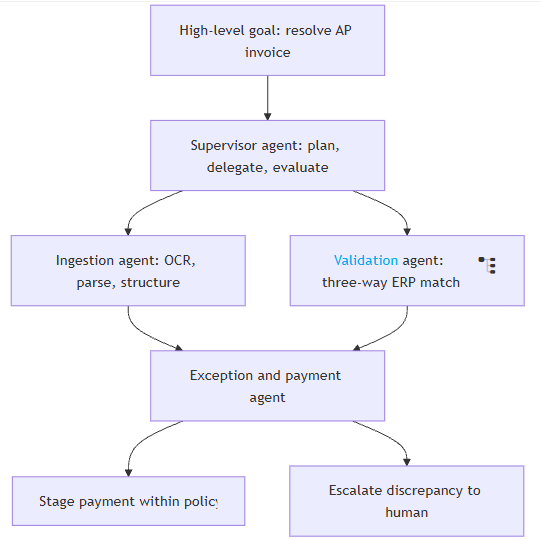
AP example: supervisor-worker process
The diagram below shows the AP process above as a supervisor-worker setup. Agents are never permitted to determine their own approval status. Instead, the payment tool independently validates policy compliance before the payment is staged.
Example architecture
Within policy, payment can be staged. Where discrepancies exceed a predefined threshold, the case is escalated for human review.
Where can agentic processes add value?
The following enterprise AI agent use cases show how agentic AI works in business operations. These processes suit agents because they typically feature clear triggers, policies, and verifiable outputs.
Finance/AP
Invoice data can be extracted. This information can then be cross-referenced against purchase orders and delivery notes. Should all data match, payment can be staged. Payment release is, however, subject to thresholds, segregation of duties, and approval policy.
IT service management (ITSM) without tickets
Issues are classified. Appropriate runbook information is retrieved. Potential causes are analyzed and an approved resolution is implemented. The agent then confirms that service has been restored. If this cannot be confirmed, the issue is escalated to the engineers. For routine issues, this is how agentic AI supports a ticketless enterprise.
Supply chain exceptions
Shipments, weather, and supplier status can be monitored. Where reorders are needed, these can be placed within a pre-approved budget. Should reorders go beyond this budget or require a change involving a strategic supplier, they are escalated to a person.
Are you ready to move beyond copilots?
Agentic AI readiness in enterprises depends on systems, data, and ownership. You are ready to deploy your first AI agents for enterprise processes if you can answer yes to most of the following:
- Are systems of record accessible via secure, well-documented APIs?
- Are data ownership, access rights, and business definitions well understood?
- Can every action be attributed to the initiating user or event, the agent, the applicable policy, and the tool that executed it?
- Are escalation thresholds clearly defined and measurable?
- Is there an identified owner for AgentOps, model risk, and business outcomes?
Start with a frequent, bounded, quantifiable, and reversible process. A highly regulated process is usually not the best first choice, as rectifying errors would prove costly, unless its controls, evidence requirements, and escalation paths are already well defined.
90-day plan
- Days 1–30: Analyze the decision-making and exception management within a process. Define tool schemas, plus authorization and escalation policies. Execute one agent within a sandbox environment.
- Days 31–60: Introduce further agents and an orchestration function. Link to secure APIs. Build authorization controls and audit mechanisms.
- Days 61–90: Execute processes in shadow mode. Compare agent recommendations with expert decision-making. Gradually deploy the process as task success, cost, latency, and policy compliance reach predefined targets.
Before giving agents further autonomy, analyze:
- Process execution success rate in relation to expert performance.
- Policy non-compliance rate.
- Escalation frequency and the time taken by humans to manage exceptions.
- Tool-call failure and retry rate.
- Cost and latency of process execution.
Autonomy can then be incrementally introduced for individual functions, again using the above analysis.
- What makes an enterprise agentic?
- Agents, copilots, and automation: what is the difference?
- Why multi-agent systems, and when not to use them
- How do you restrict agent autonomy?
- How do you manage and monitor agents?
- Enterprise AI agent architecture
- Where can agentic processes add value?
- Are you ready to move beyond copilots?
FAQ
Any Questions? Look Here
Enterprises can use agentic AI to execute processes such as invoice matching and IT issue resolution. Agents can reduce the manual work required at routine stages of a process, so human-review capacity may depend more on the number and complexity of exceptions than on transaction volume alone. The business impact of agentic AI will depend on how well-defined processes are and on the richness of the semantic context provided to agents.
A permanent record should be kept of every process execution. This should include the objective, context retrieved, actions taken, policy checks, authorization, and output. Auditors can then reconstruct each decision and, where possible, replay it. AgentOps should also log tool-call failures, re-routing, and semantic drift, so that changes in agent behavior can be identified.
If an enterprise intends to deploy agentic AI, the 90-day plan above can take a first process from analysis through to a limited launch. Moving beyond pilots to enterprise-wide impact takes longer. Only one function should be given increased autonomy at a time, and only after metrics confirm that agents are executing reliably.