
Beyond the Chatbot: Why Marta is the Smarter Way to Navigate Graphwise
Marta is Graphwise’s AI assistant built on our own knowledge graph technology and designed to give instant, contextually accurate answers about Graphwise products, use cases, and business value.

Main Takeaways
- Marta is a working proof of concept, not a demo — built on Graphwise's own knowledge graph, she's a live example of what the technology actually delivers, not a slide deck promise.
- Keyword search vs. relationship navigation — a standard chatbot matches words; Marta traverses the connections between products, use cases, and ROI data to return a contextually accurate answer.
- No more hunting through documentation — clients, partners, and employees get direct answers instead of digging through PDFs, manuals, and landing pages.
- A first step toward multi-agent systems — Marta is designed to eventually coordinate with other specialized agents, reflecting where enterprise AI is actively heading in 2026.
Graphwise is proud to introduce Marta, a cutting-edge digital assistant designed to revolutionize how our users, clients, partners, and employees interact with and learn about the Graphwise ecosystem. Marta provides an efficient, personalized, and comprehensive learning experience, detailing our products and illustrating how they generate substantial business value across a multitude of industries.
Marta isn’t just another chatbot. She represents a fundamental shift in how we interact with complex data, built on a principle we at Graphwise hold dear: Drinking our own champagne.
The knowledge graph advantage
Marta’s capabilities are rooted in the core technologies of Graphwise:
- The Graphwise Platform: Providing Marta with the necessary processing power, data integration capabilities, and advanced graph algorithms to analyze complex product information and business outcomes.
- The Graphwise Knowledge Hub: A centralized repository of product documentation, case studies, value propositions, and industry-specific data, all interconnected via a knowledge graph, serving as Marta’s brain.
The difference between standard chatbots and Marta?
Contextual Intelligence. If you ask a standard AI about a complex business solution, it scans for keywords. If you ask Marta, she consults the Graphwise Knowledge Hub and sees the relationships between our products, industry-specific ROI, and real-world case studies.
A living demonstration of our technology
Marta is more than an assistant or informational tool. She is a living demonstration of the scalability and intelligence of the Graphwise Platform:
- No data silos: She integrates product documentation and business value propositions into a single, fluid conversation.
- Accuracy: Because she sits on top of a Knowledge Graph, her responses are grounded in the specific architecture of our ecosystem.
- Multi-agentic system: Marta is the first step toward a multi-agentic system, where she will eventually work together with other specialized agents to tackle diverse and complex informational queries, setting a new standard for intelligent digital assistance
Marta draws on a set of integrated tools to answer queries: it can query GraphDB using SPARQL, generate Mermaid diagrams, search the web, and more. She selects the appropriate tool — or combination of tools — depending on the nature of the query. A human-in-the-loop mechanism allows her to ask for clarification when uncertain. What this means for you
Marta provides a shortcut to expertise, whether you are:
- A client looking for a specific ROI calculation or deeper insights into strategic use cases
- A partner gaining comprehensive knowledge for effective solution selling
- A Graphwise user aiming to master Graphwise features and functionalities
You no longer have to dig through PDFs, technical manuals, or infinite landing pages. You simply ask, and Marta navigates the graph to find the exact intersection of information you need.

Details
What Is a Knowledge Graph?
Knowledge graphs are a collection of interlinked descriptions of entities that put data into context and enable data analytics & sharing.
Learn moreRecommended Content
AI-ready Graph Environments: The Key to Scaling AI with Graphwise’s Knowledge Graphs
Read about why most enterprise AI fails and how Graphwise creates graph environments using knowledge graphs and semantics.
Read more
AstraZeneca: Enabling New Medicines Through Semantic Knowledge Graphs
Read this abbreviated & updated version of a talk from the Graph AI Summit 2025 by Ben Gardner, AstraZeneca
Read more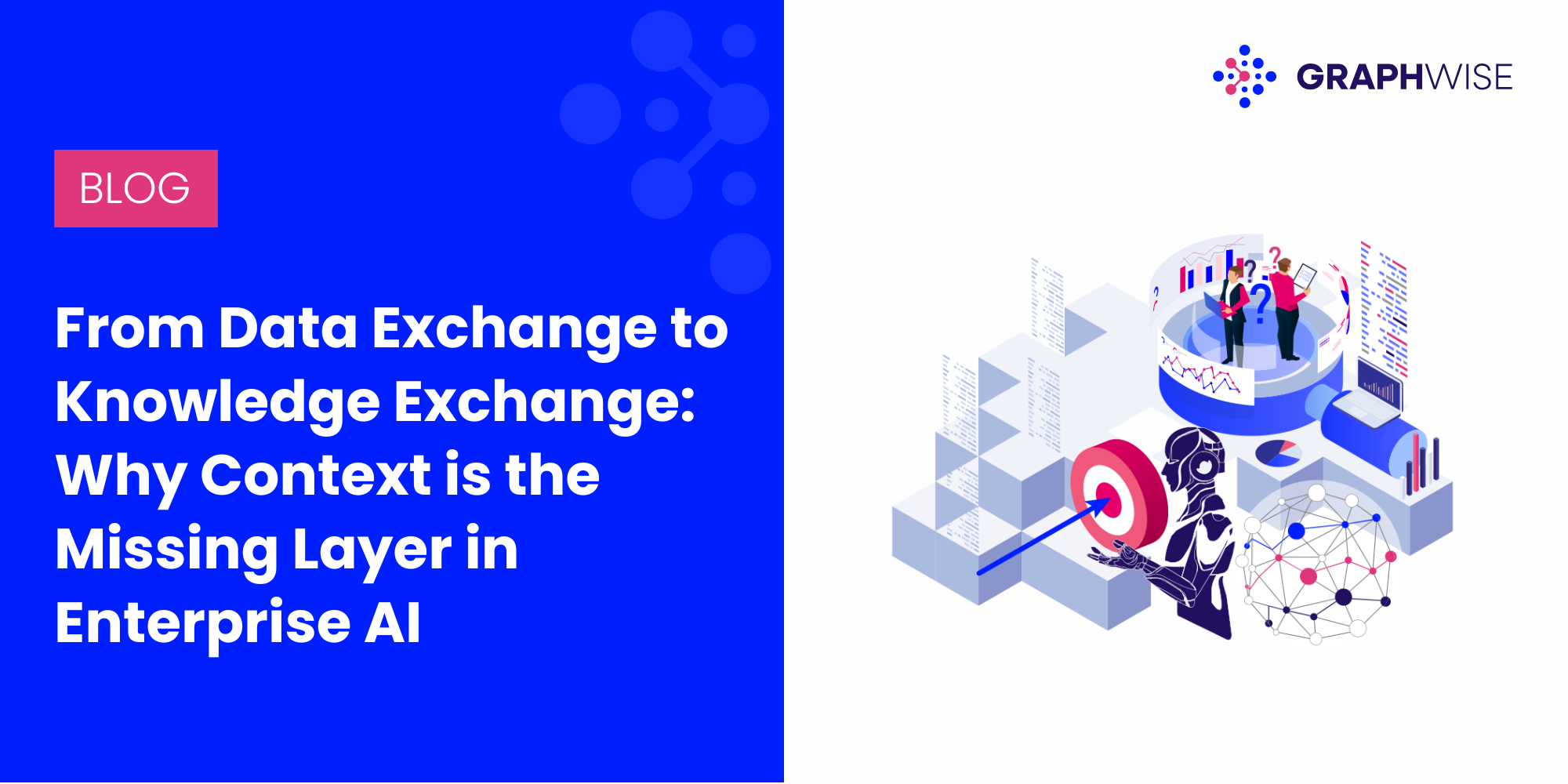
From Data Exchange to Knowledge Exchange: Why Context is the Missing Layer in Enterprise AI
Read about the origins of the semantic web, the rise of enterprise knowledge graphs, their relationship to AI, and what it actually takes to get started.
Read more
Lessons Learned from Building an AI-ready Knowledge Hub
Read about how we reimagined content to deliver actionable, context-aware knowledge through the Graphwise Knowledge Hub.
Read more
Beyond the Search Box: Transforming M365 into a Smart Knowledge Hub
Read about how the Graphwise for M365 integration transforms Microsoft 365 into a knowledge hub.
Read more
Accelerating Discovery — How GraphRAG Drives ROI in R&D and Knowledge-Intensive Workflows
Read about how GraphRAG helps organizations cut search time, speed up discovery, and turn AI pilots into measurable ROI.
Read moreFAQ
Any Questions? Look Here
The primary difference lies in their underlying intelligence: standard AI chatbots typically rely on natural language patterns and keyword matching, whereas a knowledge graph assistant leverages a structured network of interlinked entities to provide "contextual intelligence." By grounding Large Language Models in a knowledge graph—a method often called Graph RAG—these assistants offer superior accuracy, traceable reasoning, and the ability to answer complex questions by understanding the relationships between data points rather than just identifying text patterns.
Companies build AI assistants on their own data primarily through Retrieval-Augmented Generation (RAG), which grounds Large Language Models in proprietary datasets to ensure accuracy and relevance. By unifying siloed information into a knowledge graph, organizations can implement "Graph RAG" to provide the assistant with structured context and relationship-based reasoning. This architecture enables the AI to retrieve precise, domain-specific facts from internal sources before generating responses, significantly reducing hallucinations and making the assistant's output more trustworthy and actionable.
Enterprise AI assistants often provide wrong or generic answers because they primarily rely on probabilistic large language models trained on general internet data rather than specialized organizational knowledge. Without a semantic layer or knowledge graph to ground them in a company’s unique domain, these systems struggle to understand internal terminology, complex business logic, and the nuanced relationships hidden within fragmented data silos. Consequently, the AI frequently resorts to statistical "best guesses" or hallucinations that lack the precision and factual grounding required for reliable, business-critical decision-making.
AI agents decide which tool to use by employing orchestration logic and decision-making frameworks, such as Markov decision processes or behavior selection algorithms, to analyze a user's intent and match it against the specific capabilities of available tools. By leveraging an "Agentic Graph RAG" architecture, agents evaluate whether a question requires structured data retrieval, unstructured document scanning, or semantic analysis, ultimately selecting the tool that maximizes the expected utility and accuracy of the final answer.
A multi-agent AI system is a collaborative framework composed of multiple autonomous intelligent agents that interact to solve complex problems beyond the capacity of a single entity. It works by assigning specialized tasks to individual agents—such as data retrieval, analysis, or decision-making—which then coordinate their actions through a shared environment or "Semantic Backbone." This shared world model provides a unified context and long-term memory, allowing diverse agents to communicate effectively, avoid operational silos, and achieve collective goals through orchestration and multi-hop reasoning.
For a company to use its own AI technology internally—a practice often called "dogfooding"—means applying its proprietary software to solve its own business challenges, such as Graphwise building its own Knowledge Hub using GraphDB and GraphRAG. This strategy allows the firm to validate product efficacy, refine features in a real-world environment, and drive operational efficiency, ultimately serving as a live demonstration of the technology's value to prospective customers.