
Analyzing Four Strategic Use Cases in Enterprise AI
The semantic backbone isn't optional infrastructure for enterprise AI — it's what separates systems that work in demos from systems that hold up in production. Let’s see what that looks like across four concrete use cases.

Main Takeaways
- AI fails in production because context is missing, not because the model is weak — fragmented data without a semantic layer leaves even powerful LLMs guessing.
- One backbone, four use cases — the same knowledge graph powers technical knowledge management, compliance, digital twins, and scientific research, making each new use case cheaper than the last.
- The four use cases share one fix — siloed data, eroding expertise, information overload, and compounding inaccuracies all require a layer that encodes meaning, not just data.
- Start light, go deep — most organizations begin with simpler graph formats for early wins, then migrate to RDF as use cases demand greater complexity and cross-application reuse.
Most AI projects in companies — which work in principle during demos — fail the actual real-world test, primarily because specific business knowledge cannot be sufficiently integrated into the AI workflows. Corporate data is fragmented, inconsistently structured, and available only without the domain-specific context that makes AI results trustworthy. Without a layer that encodes not only the data but also its meaning, even the most powerful AI model can only make guesses.
That layer is what we call a semantic backbone. At its core is a knowledge graph — an infrastructure that goes beyond storing and connecting data. It captures what this data actually means: domain knowledge, business rules, and process knowledge, all made reusable across every AI application built on top. For industries where the questions are complex and the answers have to be accurate, that’s a prerequisite, not just a nice-to-have.
Rather than developing applications in isolation, this methodology achieves maximum cost-efficiency by leveraging a unified semantic infrastructure across multiple use cases. Domain-specific knowledge remains the primary differentiator. While linking data silos is a necessary first step, generic AI systems lacking contextual understanding will inevitably fail to meet expectations. By establishing governance from the outset, organizations benefit from compounding network effects: AI performance scales upward while the cost per application steadily decreases.
What is a Semantic Backbone and why does it matter?
The semantic backbone does three things. It links data across silos into a consistent, connected structure. It enriches that data with domain knowledge encoded in ontologies and taxonomies. And it provides a deterministic reasoning layer that keeps AI outputs grounded in verifiable facts. That last point is what separates a production-grade AI system from a demo. Without a semantic knowledge graph as a foundation, AI systems can rely only on probabilistic LLMs, vectorized data and content chunks, inflexible agent skills, and isolated databases. Enterprise-wide, interconnected knowledge, business rules, deterministic process knowledge, and all that implicit “tribal knowledge” are completely left out of the equation. In a nutshell: data without context and a layer of semantic meaning is insufficient for LLMs to draw meaningful conclusions, especially in autonomous multi-agent systems.
It is important to differentiate a “semantic backbone” from the “semantic layer” concept common in the BI community, which typically refers to thin abstractions over individual data silos. By contrast, a semantic backbone integrates metadata systems from across the entire organization into a unified knowledge model. This structure captures deep domain expertise, ensuring that every application developed on the platform utilizes the same consistent foundation.
The backbone is a journey, not a switch. Most organizations start with targeted productivity use cases and earn early ROI before the full infrastructure is in place. Lighter graph formats like LPG work well at that stage. But as more strategic use cases are added to the same infrastructure, the case for RDF (Resource Description Framework) strengthens. RDF covers more ground, handles greater domain complexity, and makes each subsequent use case cheaper and more capable than the last.
The four strategic use cases
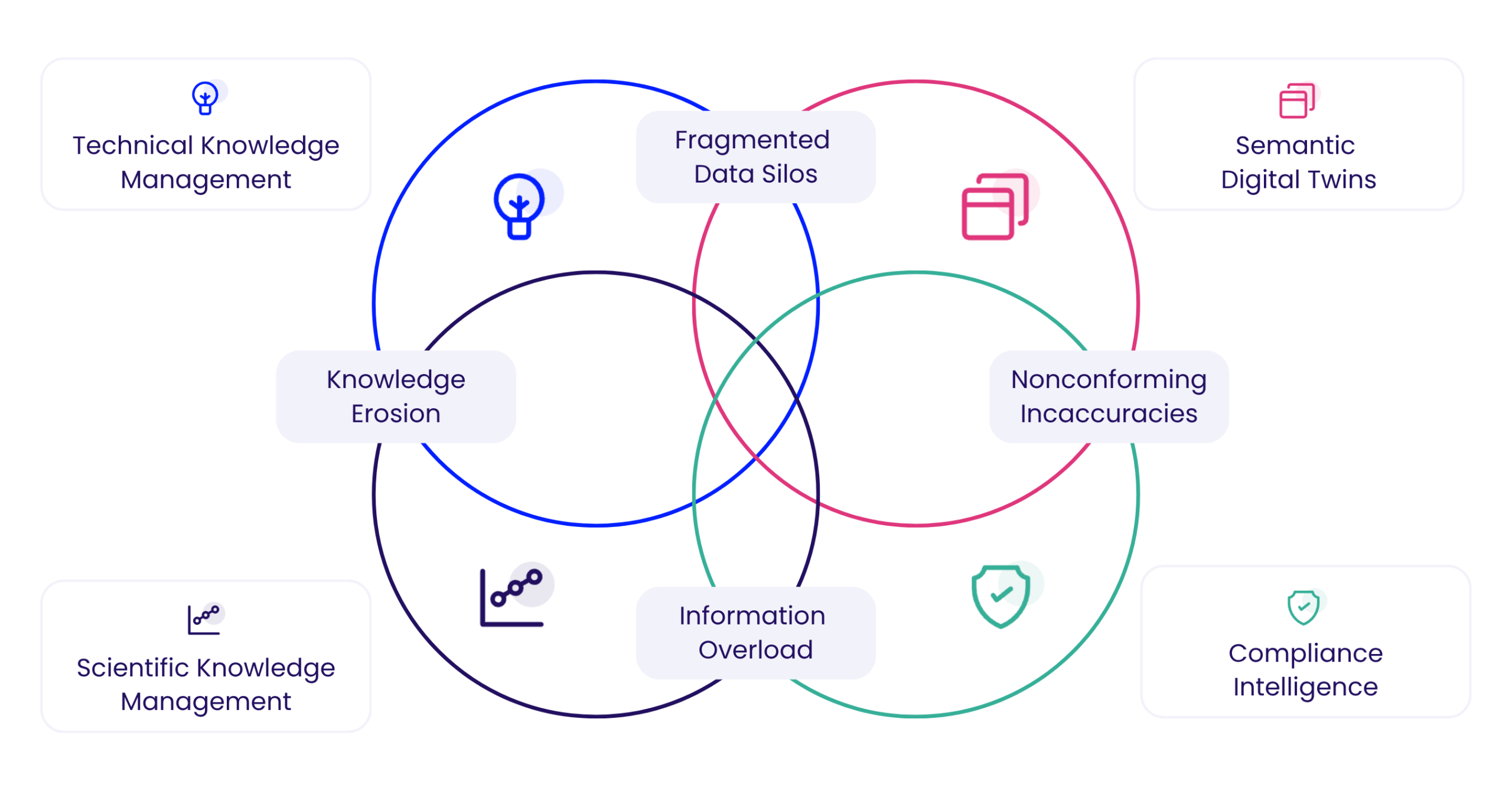
That journey — from early productivity use cases to a full enterprise backbone — is typically driven by one or more of four strategic challenges. These are the four areas where we see some of the greatest and most consistent demand across industries:
- Technical knowledge management — preventing collective expertise from eroding and making it findable, reusable, and integrated across the full product and support lifecycle. You can check our webinar on the topic HERE
- Semantic digital twin — augmenting existing digital twin infrastructure with context. Not just what is happening, but why and what the downstream implications are. This is the foundation for multi-agentic systems on top of physical infrastructure. Our webinar on the topic can be found HERE
- Compliance intelligence — mapping the complexity of regulation directly to internal policies and controls. Moving organizations from reactive, manual processes to proactive, automated risk management. Learn more from our webinar on the topic HERE
- Scientific knowledge management — making dense, specialized knowledge navigable in research-intensive domains, connecting evidence, surfacing hidden relationships, and freeing experts to focus on insight rather than search. Check our webinar on this topic HERE
All four deliver measurable outcomes. The advantages are consistent: better AI governance, explainability, and the kind of precision that high-stakes decisions require. These are not abstract benefits, but ones that show up in the numbers.
Technical Knowledge Management: Stop reinventing the wheel
Information silos, fragmented knowledge, and a workforce that’s retiring faster than it can pass on what it knows — that’s the everyday reality of Technical Knowledge Management. In large organizations, the left hand often doesn’t know what the right hand is doing and the same problems get solved from scratch. Most critically, a lot of people who carry decades of knowledge are retiring right now and that loss of expertise leads to a downward spiral.
The knowledge needs to be secured before it’s gone. Otherwise, organizations will keep chasing a level of AI performance they can never quite reach. A semantic backbone changes this: knowledge assets become essential components of the enterprise information infrastructure and culture. When different sources are connected and enriched with domain-specific knowledge, the result is knowledge hubs, meaning-based search that understands intent, and AI answers grounded in facts rather than guesses.
Manufacturing: No more hunting for answers
In industrial manufacturing, field technicians waste time hunting for answers scattered across standard operating procedures, maintenance manuals, and product catalogs. Together with our partners RWS and NINEFEB, for example, we built a solution for our customer Sandvik where semantically enriched content became a genuine turning point. Discovery, reuse, and consumption of technical information are now possible in a far more intelligent way, and technicians can stop reinventing the wheel every time a familiar problem resurfaces.
IT and software: A unified knowledge layer for the support desk
Help desks face similar hurdles: version sprawl and mergers create inconsistent customer experiences. Graphwise solves this by cross-linking repositories so support teams provide accurate, unified answers. For instance, Avalara utilized a knowledge graph and advanced RAG-System to improve support reliability, aiming to boost satisfaction, deflection, and retention.
Our own Enterprise AI Assistant, Ask Marta, is a live example of what this looks like in practice. It’s a knowledge hub consolidating the help desk, internal documentation, and CRM data from HubSpot, all linked into a single knowledge graph. Every answer is queryable in natural language, with full source attribution.
Professional services: The right answer at the moment it matters
Professional services companies like EY leverage the Graphwise Platform to eliminate fragmented knowledge experiences by establishing a unified semantic backbone. At EY, the “Discover Reimagined” initiative utilized Graphwise to automate content tagging and maintain global taxonomies, transforming knowledge management from a cost center into a strategic asset.
This infrastructure centralizes decades of proprietary expertise, making it navigable for client-serving practitioners and significantly improving search performance by 50-60%. Such a unified layer is particularly critical for onboarding new employees into knowledge-intensive environments and for enabling trusted, agentic AI applications that require deep business context to function accurately across platforms like Microsoft Dynamics and Adobe Experience Manager.
Healthcare: When errors are fatal
In Healthcare and medical devices, inconsistencies in metadata across silos slow workflows at exactly the wrong moment. Field engineers fixing expensive equipment can’t afford hallucinated answers and accuracy is a requirement.
Semantic Digital Twin: Adding context to physical systems
The Semantic Digital Twin is the second use case seen across industries, again and again. It’s an augmented version of the digital twin systems industry has built over recent years. The added context means organizations can not only monitor what’s happening, but explain why, and trace the downstream implications.
That opens the door to natural language querying of highly sophisticated infrastructure, and ultimately to multi-agentic systems built on top of it. It’s no surprise the approach works so well here. The human body, the grid, and any knowledge-driven business are all, at their core, webs of connected parts — people, assets, components — and a graph-based approach models that kind of structure better than any other technology.
Power grids: Querying critical infrastructure in plain language
The typical starting point is an existing industry ontology — CIM (Common Information Model) for electricity. It gives a project an immediate head start. Domain knowledge is already encoded and teams are connecting existing digital twins rather than building from scratch. The result is also a step toward genuine data sovereignty, avoiding vendor lock-in on infrastructure operators run themselves.
Accessing grid data through complex queries was previously limited to a small group of specialists. Given that the CIM ontology encompasses thousands of properties across hundreds of classes, even skilled engineers often require hours to construct accurate queries..
Talk to Power System changes that entirely: ask a question in plain language, get a precise structured answer in seconds, with full explainability built in. Engineers can trace equipment failures and their cascading impacts, retrieve standards-compliant single-line diagrams, and open, inspect, or modify the automatically generated SPARQL query directly. Every step is visible, every result is traceable.
Buildings, data centers, and railways: Context at every scale of infrastructure
Smart buildings are a sophisticated domain in their own right. Different devices generate spatial and sensor data that often isn’t connected at all. Facility management depends on resolving that ambiguity and improving interoperability and just as CIM gives power grids an advantage, the Brick schema does the same for buildings. Leading multinational Building Automation Systems (BAS) manufacturers such as Johnson Controls use this approach for exactly that purpose.
Large banks apply the same method to data center management. They use it to understand risk profiles across service downtimes, configure networks more effectively, analyze uptime, and run accurate automated impact analysis.
Railway networks tell a more human story. European rail isn’t always as interoperable as it should be. Travelers going from Austria to Italy may still need to get off the train at the border and board another. Together with the European Railway Association, Graphwise built a semantic digital twin aimed at solving exactly that kind of friction.
Compliance Intelligence: Treating regulation as a graph
Regulatory complexity is exploding. Data is fragmented, and compliance teams are drowning in manual work. The fear of missing a critical gap is real enough to keep people awake at night and spreadsheet-based mapping isn’t going to catch it. Our semantic backbone addresses this by creating a dynamic layer that links external regulations directly to internal policies and controls. The mapping is no longer manual and now the AI understands the law and the framework, not just the words.
Banking and finance: 360-degree visibility into risk
Trade surveillance has long relied on rigid, siloed databases. That produces an exponential number of false alerts and makes it nearly impossible to detect complex market manipulation. Integrating fragmented trading data into a single knowledge graph changes that and gives compliance teams 360-degree visibility into risk, preventing fines and generating real operational savings.
A global bank struggling with DORA implementation gives a concrete example. The regulation runs to hundreds of pages of dense legal text. We treated the law as a graph, mapping its exact hierarchy, structure, and definitions directly to the bank’s operations. The impact was immediate: less research time, fewer errors, and the confidence to answer regulators with precision.
Life sciences and manufacturing: Turning static archives into live intelligence
In the life sciences sector, for example at Takeda, regulatory tasks previously required experts to spend days manually scouring static archives. This process was transformed by implementing a semantic Q&A repository on our platform, which slashed response times to under an hour by automatically aligning new queries with validated historical data.
In manufacturing, the same approach replaced manual control mapping entirely, cutting that effort by over 80%. What used to live in spreadsheets — an endless, exposure-prone task — is now handled dynamically. Teams have stopped mapping manually and have started managing their real risks.
IT and data infrastructure: Audit trails that prove compliance in real time
Static, backward-looking audit reports leave auditors with little they can trust. Continuous, natural-language-queryable compliance monitoring replaces them, with every answer backed by a live audit trail. There are no black boxes — just transparent monitoring that proves compliance without a doubt.
Built to be extended
We provide infrastructure, not a finished product. Recomentor, a demo application focused on ESG reporting, shows what partners and enterprises can build on top of it. Look closely at the engine underneath: it ingests multiple reporting frameworks simultaneously, identifies gaps across coverage, specificity, ambition, and risk, benchmarks performance against peers, and traces every finding back to its source. That same engine powers compliance intelligence across multiple industries and frameworks we serve.
Scientific Knowledge Management: Accelerating discovery
In research-intensive domains, the bottleneck isn’t a lack of knowledge — it’s the inability to navigate it. Researchers face thousands of genes, complex molecular pathways, scattered publications, and hidden relationships across diseases. Drug discovery, regulatory workflows, hypothesis generation: all of it can move faster when the right connections surface automatically instead of through manual searching.
Biomedical research: Reasoning across thousands of connections at once
The Linked Live Data Inventory, our biomedical knowledge graph, demonstrates this directly. A researcher can ask, for example, which genes are involved in Pompe disease and will get back a structured, fully sourced answer in seconds. From there, the query can expand naturally: which biological processes involve those genes? Which are located in the plasma membrane, making them accessible to drug modulation as potential therapeutic targets? Each answer builds on the last, with full provenance throughout as demonstrated by our demo application.
What makes this powerful isn’t just retrieval — it’s reasoning. Because the knowledge graph encodes taxonomies, causal relations, and transitive properties, the system can infer hidden connections and prioritize genes based on multi-disease involvement. What used to require hours of cross-referencing multiple databases becomes a guided conversation.
Together with the Oxford Drug Discovery Institute, we applied this to Alzheimer’s research, enabling researchers to build hypotheses ten times faster and with results they could trust. What once took months of screening and ranking gene targets now takes weeks, sometimes days, with a fraction of the team involved.
Agriculture, chemicals, and aerospace: Deep expertise made navigable at scale
The same infrastructure extends well beyond Pharma. At CABI, a global non-profit focused on agriculture and the environment, an outdated, single-user thesaurus had become a bottleneck rather than a resource. It was too rigid for faceted search, data integration, or AI readiness.
We helped restructure it into a dynamic knowledge graph, cleaning and classifying over 160,000 concepts and connecting more than 80,000 datasheets across CABI’s Digital Library. The result is a thesaurus that’s no longer a static legacy tool, but a living asset that powers smarter search and discovery at scale.
In chemicals, materials science, and aerospace engineering, the same pattern holds: deep, specialized expertise that’s hard to navigate and easy to lose becomes structured, searchable, and reusable.
A platform built for the long game
All four use cases run on the same Graphwise Platform, built around a set of core components:
- Graphwise GraphRAG powers the retrieval layer, automating AI agents and making them highly precise by grounding them in the knowledge graph rather than in probability.
- GraphDB provides the RDF triplestore — enterprise-grade, capable of handling billions of data points.
- Graph Modeling provides visual tooling for building and curating taxonomies and ontologies, accessible to subject matter experts, not just engineers.
- Graph Automation handles the unglamorous but essential work of ingestion, turning scattered, structured and unstructured data into unified knowledge graphs through visual, drag-and-drop pipelines instead of custom engineering.
- Semantic analytics structures unstructured data and builds consistent metadata across formats.
This is the ecosystem in which we work alongside our partners and customers, not a closed system they have to work around. A growing library of connectors extends the backbone even further, including Graphwise for Microsoft 365, bringing the Graphwise Platform directly into the systems organizations already use.
The common fix
At the core of all four use cases are the same fundamental problems: fragmented data silos, knowledge erosion, information overload, and inaccuracies that compound as AI systems scale. What we’ve seen across industries and domains is that these aren’t separate challenges requiring separate solutions — they share a common fix.
Rather than treating it as an afterthought, adopting a semantic backbone strategy early on proves increasingly valuable as an enterprise scales its AI initiatives. This foundational approach is precisely what distinguishes AI that merely performs well in a demonstration from systems that remain robust and reliable in a production environment.

- What is a Semantic Backbone and why does it matter?
- The four strategic use cases
- Technical Knowledge Management: Stop reinventing the wheel
- Semantic Digital Twin: Adding context to physical systems
- Compliance Intelligence: Treating regulation as a graph
- Scientific Knowledge Management: Accelerating discovery
- A platform built for the long game
- The common fix
Details
What is a Semantic Backbone
The Semantic Backbone serves as a source of truth, unifying data silos & providing contextual grounding for scalable and trustworthy Agentic AI.
Learn moreRecommended Content
When Regulators Want Proof, Not More Paperwork: Meeting DORA with a Semantic Digital Twin
Read about how a Semantic Digital Twin helps financial institutions meet DORA compliance with searchable proof instead of manual paperwork.
Read more
Automated Compliance Checks in AECO by Leveraging Semantic Technologies
Read about how semantic technologies enable automation of compliance checks in the AECO domain.
Read more
Graph Technologies and Graph RAG: Shaping the Future of Corporate Knowledge Management
Read about how recent studies reveal the potential of graph technologies and GraphRAG to enable organizations to manage data more effectively
Read moreFAQ
Any Questions? Look Here
Enterprise AI projects frequently fail to transition from pilot to production due to a fundamental lack of data readiness, where fragmented silos and "context-poor" foundations prevent AI models from grounding their outputs in actual business reality. While small-scale pilots may succeed in isolation, scaling them to an enterprise level often reveals integration bottlenecks and leads to unreliable results, such as hallucinations, which erode leadership trust. Furthermore, many organizations fall into the "proof-of-concept trap," where lengthy development cycles and shifting business priorities cause projects to lose momentum or fail to deliver a clear return on investment before they can be operationalized.
A semantic layer is a business-friendly abstraction that translates technical data into understandable terms for specific use cases like Business Intelligence, often acting as a thin "wrapper" or "afterthought" for single-purpose applications. In contrast, a semantic backbone is a comprehensive, enterprise-wide knowledge graph infrastructure that serves as the organization's "semantic nervous system" and authoritative source of truth. Unlike a traditional semantic layer, the backbone is developed as critical, tool-agnostic infrastructure that simultaneously powers multiple applications — including analytics, search, and Agentic AI — by unifying fragmented data silos through a shared framework of taxonomies and ontologies to ensure consistent reasoning across the enterprise.
To prevent institutional knowledge loss when senior employees retire, organizations should implement a semantic knowledge management strategy that moves beyond manual documentation methods like wikis or exit interviews, which are often incomplete and time-consuming. By leveraging enterprise knowledge graphs and text analysis, companies can passively capture a "semantic footprint" of an employee's expertise, interactions, and reasoning from both structured and unstructured data sources. This approach transforms individual know-how into a machine-interpretable and searchable network of organizational memory that remains discoverable for future teams, ensuring that critical insights and expert decision-making patterns are preserved and accessible long after the individual has departed.
Automating regulatory compliance mapping with AI involves utilizing Knowledge Graphs and Semantic Backbones to create a dynamic, machine-readable link between external regulations and internal controls. By applying Intelligent Document Processing and semantic tagging, AI can automatically decompose dense legal texts into structured entities, allowing organizations to instantly map regulatory requirements to internal policies and detect compliance gaps in real-time. This approach is further reinforced by GraphRAG (Graph Retrieval-Augmented Generation), which grounds AI-generated insights in a verified knowledge graph to ensure accuracy and provide a transparent, live audit trail. Ultimately, this semantic framework eliminates the need for manual mapping, significantly reducing administrative overhead while ensuring continuous, evidence-based compliance monitoring.
Scaling AI applications across departments is achieved by implementing a shared knowledge layer, typically an Enterprise Knowledge Graph, which unifies disparate data silos into a single, machine-readable semantic foundation. This layer acts as a "single source of truth" by providing consistent context and business logic, ensuring that AI agents across different business units operate on the same governed information rather than conflicting interpretations of data. By decoupling knowledge from specific departmental tools and grounding it in a shared ontology, organizations can reuse this core infrastructure to rapidly deploy reliable, traceable, and interconnected AI solutions, such as GraphRAG, that maintain accuracy and reliability as they scale.
Building an enterprise knowledge graph without rebuilding existing data systems is achieved by implementing a semantic backbone or virtual data layer that sits on top of your current databases and content repositories. Instead of physically migrating or transforming all your data, this approach uses ontologies and taxonomies to map heterogeneous sources — both structured and unstructured — into a unified, interlinked conceptual model. This non-intrusive method breaks down data silos and creates a "single source of truth" incrementally, avoiding the high cost and risk of enterprise-wide system overhauls.