
Search Documentation Smarter, Not Harder: Meet Theo, The Graphwise Help Search Agent
In this post, you will learn about Theo, the Graphwise’s AI-assisted help search agent. Read about why we built it, how it enables natural-language interaction with documentation through the Graphwise Knowledge Hub, and how it fits the newly emerging patterns of interacting with documentation.

Main Takeaways
- Theo combines an LLM with the Graphwise Knowledge Graph to answer documentation questions conversationally, instead of returning generic keyword-matched search results.
- Every answer Theo generates is grounded in and traceable to source documentation, with a dedicated "Sources" panel showing provenance.
- Theo uses GraphRAG to surface "Further Reading" recommendations based on conceptual relationships in the knowledge graph, not just keyword similarity.
- The goal is answer-driven support (retrieve, reason, and explain) rather than just search, reducing time spent navigating complex or fast-growing documentation.
How many times have you searched for a specific configuration setting, only to end up with generic tutorials or deprecated examples? Or perhaps pages that barely mention what you’re looking for or are unrelated to the version of the product documentation you have?
We’ve been there too. Semantic search has made it much easier to discover relevant documentation without having to know exactly which keywords to use or how the information is structured. But finding the right pages is only the first step. Users still need to read through them and connect the dots to get the answer they’re looking for.
With AI and GraphRAG, we could take search much further. Instead of simply helping users find information, we can understand the intent behind their questions, connect relevant knowledge across sources, and turn it into concrete, verified answers.
That’s why we created Theo, built on our Graphwise Platform, Theo transforms documentation search into an intelligent, answer-driven experience. It helps users get trusted answers to their questions about Graphwise products and technologies, so they can spend less time searching and more time getting things done.
Meet Theo: Knowledge-graph powered agent
Theo is a Help Search Agent. It is integrating the Graphwise Knowledge Hub with an Large Language Model (LLM) and embedding it in our Help Search pages to help users talk to our documentation.
Theo addresses the fundamental challenges that not only us, but many organizations face: finding accurate information quickly, navigating complex documentation, and connecting related knowledge.
Some of the challenges we wanted to tackle with Theo are:
- Documentation is growing faster than people can navigate it
- Search is useful but often requires knowing the right keywords
- Users increasingly expect conversational interfaces
To address those challenges we built Theo as an application on top of our enterprise knowledge graph – the Graphwise Knowledge Graph.
Theo behind the scenes
Behind the scenes, Theo is powered by our Graphwise Platform architecture that allows the agent to go beyond traditional keyword search. Upon a user question, Theo transforms the user’s natural-language into a semantic query, searches the Graphwise knowledge graph for related concepts and documentation, ranks the retrieved content by relevance, and passes the most useful context to the language model.
Our Graphwise Knowledge Graph acts as a semantic backbone for Theo. This gives Theo a foundational infrastructure that allows the agent to navigate complex data with a shared mental model and high precision. Theo traverses information easier and quicker thanks to the fact that the Graphwise Knowledge Graph provides readily connected documentation pages, configuration guides, concepts, and their relationships. It is the cohesion of data from different systems that allows Theo to operate across a semantic layer, i.e.a unified view of the organization’s knowledge.
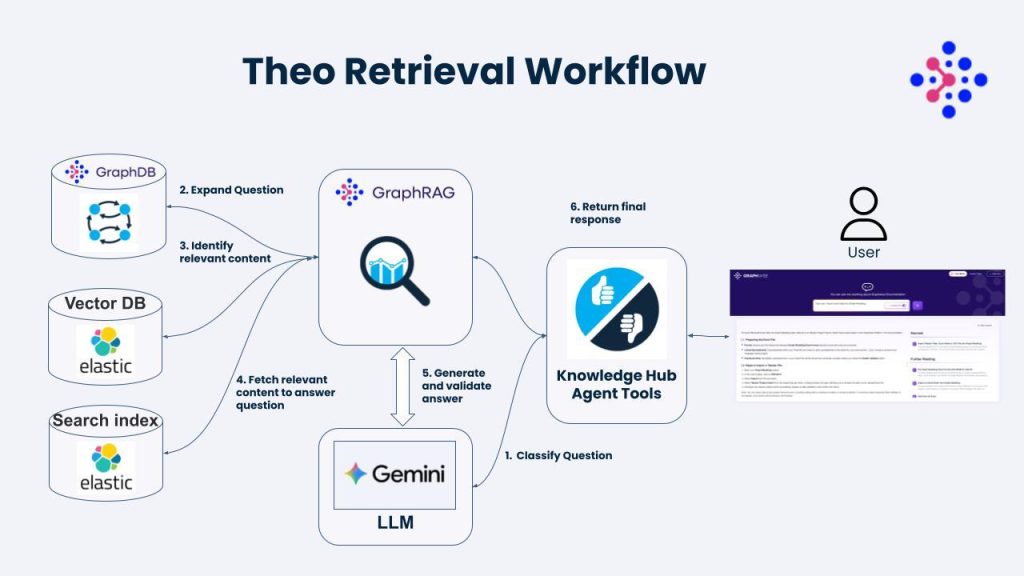
By combining LLM with a domain-specific knowledge graph, Theo understands the context of our products documentation. So, it retrieves the most relevant documentation (version included), enriching the results with graphics, diagrams, and formatting.
The result is a search experience that connects concepts instead of isolated documents, delivering contextual answers and guiding users to the information they need, without the frustration of endless searching and sifting through too many results.
Theo in Action
Let’s have a look at Theo in action.
Suppose you’re building an integration and need to understand how to create a new GraphDB repository. Instead of navigating through multiple documentation sections, you simply ask:
“How do I create a GraphDB repository using the REST API?”
Theo interprets your request, retrieves the most relevant documentation, and assembles a complete response. Rather than presenting a list of keyword matches, it combines retrieval, reasoning, and knowledge discovery into a single workspace.
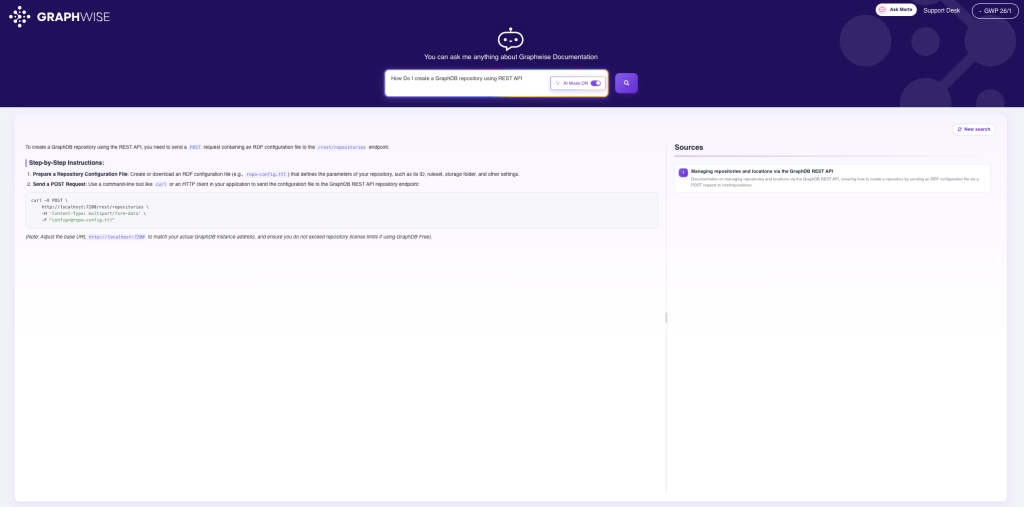
As you can see from the result, you get three sections as a response to the query: an answer, the sources from where the answer was constructed, and a set of related documents for further reading.
- Answer (Documentation-grounded AI-generated response)
The main response panel provides a concise, actionable answer synthesized from the Graphwise documentation. Instead of copying a document verbatim, Theo identifies the relevant procedure, summarizes the required steps, and includes practical details such as the HTTP endpoint, configuration file, and example request. This is the reasoning layer of the system, where the LLM combines retrieved knowledge into a coherent explanation.
- Sources (Provenance of the results)
On the right hand side of the screen you get the sources from which the AI-generated answer was derived. Every generated answer Theo produces is grounded in documentation. Thus the user can identify the documents used to generate the response, inspect them, and get to know if needed more about the context of the answer.
- Further reading (Related documents recommendations)
The Further Reading section expands the search by retrieving semantically related documents from the knowledge graph. In this example, Theo recommends topics such as repository management, repository configuration, REST API usage, RDF4J integration, and repository creation.
These recommendations are powered by GraphRAG, combining the contextual understanding of a knowledge graph with the generative capabilities of AI. Instead of relying solely on keyword similarity, GraphRAG uses the relationships between concepts, products, technologies, and pieces of documentation to understand how different pieces of information are connected.
This allows Theo to go beyond simply finding documents that contain similar words. It can follow meaningful connections across the knowledge graph, identify relevant supporting information, and surface documentation that provides additional context to the user’s question.
What the page rendered when we asked our example question demonstrates the importance of effective interaction with documentation pages: less time spent searching and more time using the product to achieve the user’s goal.
As you can see from the example, Theo was able to:
- Understand your question in natural language
- Retrieve the most relevant documentation
- Generate a concise explanation
- Point you to the exact API endpoints
- Recommend related topics such as authentication, repository configuration, and example requests.
To wrap it up: Building for answers, not just search
Theo is not just an AI application. It combines software engineering, semantic technologies, user experience design, documentation practices, and continuous feedback from real users. Building Theo is as much about understanding people and their information needs as it is about developing code.
Want to see an AI-assisted documentation system that transforms fragmented technical content into contextual, trustworthy, and developer-friendly answers?
Details
What is Semantic Search
Semantic search is a sophisticated technology that optimizes how we explore the internet or the internal systems of an organization. Unlike traditional search based on keywords matching, it enables AI systems to understand the meaning of concepts and the relationships between them, mimicking human cognitive associations.
Learn moreRecommended Content
Lessons Learned from Building an AI-ready Knowledge Hub
Read about how we reimagined content to deliver actionable, context-aware knowledge through the Graphwise Knowledge Hub.
Read more
Beyond the Search Box: Transforming M365 into a Smart Knowledge Hub
Read about how the Graphwise for M365 integration transforms Microsoft 365 into a knowledge hub.
Read more
Beyond the Chatbot: Why Marta is the Smarter Way to Navigate Graphwise
Read about our AI assistant designed to give instant, contextually accurate answers about our products, use cases & business value.
Read moreFAQ
Any Questions? Look Here
AI-powered search uses Retrieval-Augmented Generation to ground answers. It retrieves specific facts from verified documents. This prevents guessing based on statistical probability. Knowledge graphs further enhance accuracy by mapping complex data connections. This structured context restricts the AI to reliable information. Every response is anchored to a trusted source of truth.
Conversational search interfaces simplify access to complex technical data. They provide direct answers instead of long lists of documents. Users save time by asking natural questions. These systems understand specific technical context and synonyms. This approach helps non-experts find information without knowing exact terminology. It bridges the gap between massive documentation and immediate user needs. Efficient data discovery is now essential.
Source traceability in AI-generated answers works by linking the output directly to its original data sources. Each response includes explicit citations and provenance metadata to track the origin of the information. In advanced systems like GraphRAG, the AI maps statements back to specific documents or knowledge graph entities. This process creates a clear reasoning path that reveals how an answer was derived. Users can verify these claims by accessing source URLs or inspecting the retrieved context. Such transparency effectively reduces hallucinations and ensures compliance in regulated environments. Ultimately, these mechanisms transform opaque AI processes into verifiable and trustworthy systems.
Trustworthy AI answers are grounded in verified facts and curated data. Plausible-sounding responses are merely probabilistic text predictions based on training patterns. Trust is built when a system uses knowledge graphs to provide factual context and traceable reasoning. This grounding prevents hallucinations by forcing the AI to rely on a reliable information source. Explainability allows users to verify how the AI reached its conclusion. Ultimately, accuracy depends on connecting the model to a structured semantic layer.
Knowledge graphs improve search relevance by connecting data into a structured web of entities and relationships. This framework helps search engines understand the specific intent and context behind a user's query. Instead of matching simple keywords, the system recognizes actual concepts and things. It effectively distinguishes between different meanings of the same word to avoid irrelevant results. Knowledge graphs also reveal non-obvious connections between disparate datasets. These capabilities ensure that search results are more precise, discovery-oriented, and meaningful.
Companies build accurate AI assistants by grounding them in dynamic knowledge graphs. They use GraphRAG to connect the AI with a live semantic layer of enterprise data. Automated tagging and integration pipelines update this layer as documentation changes in real-time. A built-in AI flywheel also captures user interactions to identify and fill knowledge gaps. This process ensures the assistant always references the most current and relevant information. Traceable links back to source documents help maintain trust and precision over time.