
What is an LLM Hallucination?
What is an LLM Hallucination? A Simple Definition
LLM hallucination is when a Large Language Model (LLM) generates factually incorrect or senseless information that looks grammatically correct and feels confident. It is usually in the form of false facts, fake URLs, or invented studies. They are different from the standard software errors because hallucinations are not malfunctions but rather statistical prediction fallacy where AI tries to predict the next word but does it badly.
How LLMs Generate Answers?
When you type a question into a chatbot, the model is not looking anything up. It predicts the next token, a word or part of a word, then the next, based on everything that came before.
It learned this by processing enormous amounts of text and encoding the statistical relationships it found into its parameters. That knowledge is not stored as a database of verified facts, like in a knowledge graph. The source material is gone, so there is nothing to check an answer against. This core ability is what allows LLMs to perform language tasks like summarization and translation. The catch is that the model is predicting what is plausible, not independently checking whether every statement is true. When information is incomplete or rare, it generalizes from related patterns and produces something plausible but incorrect.
The prompt matters too. LLMs do not treat every word in it equally. Transformer-based models use self-attention to relate different parts of the input and decide which information is most relevant to each token they generate, which is how they follow instructions and connect ideas across a passage. Having the right information inside the context window does not guarantee the model uses it correctly. Research has shown that LLMs can overlook or underuse relevant information, particularly in long contexts, which leads them to rely on other patterns instead.
Why Do LLMs Hallucinate?
LLM hallucinations rarely come from a single flaw. Their root causes are deeply embedded in how models are designed to compress, process, and generalize information, as well as in the data and grounding they rely on.
Information is lost in compression
LLMs are trained on enormous amounts of data, usually measured in petabytes. To make sense of such volume, the model compresses it, and most of the nuance is lost in the process.
When it’s asked a very niche question, it reconstructs the fact from what is statistically probable. The result is called a statistical smearing. The answer sounds reasonable, and it’s close enough to the truth to pass a quick read while being wrong.
For example, Google’s Bard once claimed the James Webb Space Telescope took the first image of an exoplanet. That image was captured in 2004, seventeen years before Webb launched.
In academia this is called Information bottleneck theory. It describes how a model has to discard what looks like noise in order to learn efficiently. When recalling facts, the nuance and the noise are often the same thing.
Models Are Often Rewarded for Guessing
A model with no idea what the answer is has two options – say so or guess. Almost every benchmark used to evaluate these systems treats both the same way. A wrong answer scores zero. An honest “I don’t know” also scores zero.
That math is not neutral. A model that guesses will sometimes land on the right answer, so it scores higher than a model that admits uncertainty. Training pushes toward a higher score. Repeated a million times, the model learns that answering always beats abstaining.
Researchers at OpenAI made this argument directly in a 2025 paper on why language models hallucinate. Their framing is that hallucination is not a bug in the training process. It is what the training process is currently optimizing for.
Generalization Is Not Verification
Generalization is what lets LLMs handle questions they have never seen before. They use patterns they learned to make a reasonable guess. However, this backfires when you must use facts.
Facts must be definitive and verified, not plausible. The problem occurs when the model has a gap in its knowledge and thinks its way through rather than admitting it’s wrong. That’s why LLMs work well with a source of truth like knowledge graphs.
Dataset Limitations
Training data is always incomplete. Some facts can appear many times, while others can be false or conflicting. Because an LLM learns statistical patterns from this data, it can learn existing data patterns that do not reliably describe the real world.
These gaps become a problem when the model is asked about something it has little information about. However, it may still have enough related patterns to construct a convincing answer, even when the factual support behind it is weak. Almost all the time it will hallucinate an answer just to satisfy the user.
Malicious Attacks
Some hallucinations are engineered. Adversarial attacks manipulate the information or instructions an AI system receives in order to change its behaviour.
Prompt injection introduces instructions that interfere with the task the model was given. Indirect versions hide those instructions inside external content such as a webpage, document, or email the model reads later, and the model treats them as legitimate.
Data poisoning targets the evidence instead. Attackers insert misleading content into training data or an external knowledge source, and research on knowledge poisoning has shown that malicious documents placed in a retrieval database can steer an LLM toward attacker-chosen answers. This applies to RAG systems as much as to base models.
Grounding reduces how often the model has to guess, though it does nothing to verify what it retrieves. For enterprise AI, the source, meaning, relationships, and provenance of that information have to be known and governed.
Types of LLM Hallucinations?
Hallucinations occur in different ways and for different reasons. Researchers use typologies to distinguish between different kinds of failures. It’s similar to having a headache because the symptom feels the same, but the cause can be dehydration, illness, or just lack of sleep. Thus, understanding the differences matters because different AI failures require different solutions.
When AI ignores information
When you give AI specific data such as a PDF or a spreadsheet, it can sometimes ignore it and rely on its training data. This is called knowledge overshadowing.
If the new information is conflicting with the one AI already “knows,” AI can also blend information together using different sources, making a patched together answer.
Imagine a global manufacturing company that uploads a new safety compliance PDF to its internal AI. The document states that due to new laws, the maximum operating temperature for a specific engine is now 80°C. However, the AI was originally trained on general engineering data where the “standard” limit for that engine type is 100°C.
When AI invents information
This occurs when AI creates new information about the world, which sounds believable. It usually happens because LLMs prioritize satisfying the requests of the user.
A subset of this is when the model generates an answer that contradicts its own safety filters or system-level rules, often “bluffing” to resolve the conflict between the user’s intent and its architectural guardrails.
For example, if you ask AI to “summarize the 2025 merger between Apple and Boeing,” it may invent a merger instead of questioning the assumption.
When AI gets a real fact wrong
Here, the concepts are real, but the relationship between them is incorrect. “Vienna is the capital of Germany” sounds structurally normal but is factually false. These errors can be particularly difficult to detect because nothing in the wording appears unusual. Important enterprise claims may therefore need external verification through databases, APIs, or authoritative sources.
When reasoning breaks down
Process hallucinations occur during multi-step or Chain-of-Thought (CoT) reasoning. The model performs the first three steps of a calculation or logical deduction correctly, but at step four, it suffers an “inference drift.” It generates a statistically likely next step that is logically disconnected from the previous steps.
For example, a model might identify €10 million in revenue and €8 million in costs, then calculate €3 million in profit. These reasoning failures become more important with AI agents, where one incorrect step can influence later actions.
Why do LLM Hallucinations matter for Enterprise AI?
Enterprise AI differs from regular consumer AI because it is often deployed in heavily regulated industries. In Europe, regulations such as DORA impose strict requirements on financial institutions around ICT risk management and operational resilience. If AI hallucinations contribute to critical errors in reporting, risk management, or operational resilience, financial institutions can face regulatory investigations, remedial measures, and significant penalties.
Beyond the immediate monetary consequences, companies can lose the most important resource they have – their clients’ trust.
In 2026, German cosmetic surgery provider Aesthetify was held responsible after its AI chatbot falsely told prospective patients that its doctors held medical qualifications they did not have. The court ruled that the chatbot’s responses constituted misleading commercial practices and that the company was responsible for what its AI told customers.
LLM hallucinations also introduce a significant “bad data tax” that undermines the fundamental value proposition of Enterprise AI. While Large Language Models (LLMs) are marketed as efficiency boosters, models without a semantic foundation frequently need manual correction because they don’t understand meaning and context. This forces knowledge workers into a cycle of constant verification, reducing time savings that AI promised them.
Real-World Examples
Mata v. Avianca
One of the most documented LLM hallucination examples occurred in the 2023 legal case of Mata v. Avianca. A legal team used LLM tool to perform research, resulting in a brief that cited six entirely non-existent judicial decisions, complete with elaborate internal citations and quotes.
When the model could not find a case that perfectly matched the lawyer’s specific criteria, it hallucinated a “perfect” case by blending the names of real judges with plausible-sounding legal terminology.
This happened because LLMs prioritized the structure of the citation over checking if it even existed. For legal and academic professionals, requires manual cross-referencing that becomes impractical when scaled.
Fake Installation Packages
AI dev tools can recommend software packages that do not exist. The package often looks legitimate because it follows the conventional naming of either Python or JavaScript libraries. In the code suggestion this is accompanied by commands such as “import,” “pip install,” or “npm install”.
This attack is known as slopsquatting. An attacker identifies which package names LLMs will most likely hallucinate and registers them as a real package under one of those names on repositories such as PyPI or npm. Attackers rely on developers willingly installing AI-recommended packages, which allows them to also install malicious scripts that can compromise the system.
To illustrate the point better, a large USENIX Security study tested 16 code-generating LLMs across 576,000 Python and JavaScript samples and found 205,474 unique hallucinated package names. The results showed that the problem was not limited to occasional random mistakes:
- Commercial models hallucinated packages in roughly 5% of generated samples.
- Open-source models hallucinated packages in roughly 21% of generated samples.
- Around 45% of hallucinated package names were reproduced every time the researchers repeated the same prompt.
API Hallucinations
Another type of hallucination happens when AI writes code using an API, function, or parameter that does not exist. This is dangerous, especially for enterprises that utilize AI because their code is usually private and project-specific. When LLMs don’t understand how an internal system works, they can guess a function’s name or how it should behave and still produce legitimate code.
A developer may approve it, or an AI agent may directly execute it as part of a coding workflow. In situations where testing only checks for code running and not whether the API call performs the functionality that it purports to perform, that code may get deployed to the production environment.
A permission check hallucination by the AI may result in a security breach. An incorrectly used internal API may be used for accessing user data or making changes to user records (billing information or account information). An incorrectly used infrastructure call may result in disruption of a service. It takes a long time to restore services and much effort to track the issue to the root cause.
How to detect LLM hallucinations?
Latent steering
Latent steering looks for hallucinations inside an LLM model rather than just reading the answer it produces. During its thinking, AI holds the answer internally as a pattern of numbers. They contain a weak signal representing the answer’s reliability. When an LLM produces a response, it represents information internally as patterns of numbers called activations or latent representations. These patterns can contain signals about whether an answer is likely to be truthful or hallucinated, but the difference is often difficult to detect because the two can look very similar.
The Truthfulness Separator Vector (TSV), is a method designed to make that difference easier. It learns a small adjustment from examples where the researchers already know which answers are truthful and which are hallucinated. That adjustment is applied to one of the model’s internal layers without changing the model’s underlying weights, making truthful and hallucinated answers easier to separate. TSV can also improve this separation using additional unlabeled model responses. A new answer can then be given a truthfulness score based on whether its internal pattern looks more like previously truthful or hallucinated answers.
TSV is useful because it can help flag risky responses even when no external source is available. However, TSV does not prove that an answer is true or false, so its score should be treated as a warning to verify the answer. It also requires access to the model’s internal activations, which means it generally cannot be applied by an organization to a closed model accessed only through a standard vendor API.
Testing for Consistent Answers
If you suspect a model is hallucinating, you can ask the same question several times to check for consistency. Because AI models can generate slightly different responses each time, we can compare those answers to see whether the model is stable and confident about the information it provides.
For example, if all five answers say that a merger happened in 2019, even with different phrasing, the model is highly consistent.
Warning: consistency doesn’t mean that the model is telling the truth. Models can consistently hallucinate. Conflicting answers need checking, but matching answers are probably stable but still unverified.
Prompt Reconstruction
InterrogateLLM is a zero-resource hallucination detection method that tests if an answer is still connected to the question that produced it. Rather than verifying facts against an external source, it reverses it. The model answers a question, then a model is given only that answer and asked several times to reconstruct what was originally asked. The original question and the reconstructions are converted into embeddings and compared for semantic similarity. Close reconstructions suggest a consistent answer. Divergent ones suggest the answer has drifted somewhere the question never went.
What the score measures is consistency, not truth. A low similarity score is a useful warning sign. A high one only tells you the answer stayed anchored to its question, which an entirely false answer can also do. That makes InterrogateLLM a cheap detection signal to run over outputs at scale and a poor substitute for verification against a governed source.
How to measure LLM hallucinations?
Measuring hallucinations is important for enterprises to understand how reliable their AI tools really are. It creates a baseline for tracking errors, comparing changes, and proving whether the system is improving over time or stagnates.
Human Gold-Set Evaluation
A gold set is a collection of questions, edge cases, and failure scenarios where the correct answer has already been established by domain experts. The LLM is repeatedly tested against the set, so the enterprise can establish a trusted benchmark for different LLM models or tools. Enterprises can also benefit from incorporating traceability -the ability to point back to the documents or sources explaining why an answer is correct.
The value is not simply getting an “accuracy score.” A gold set gives an organization its own definition of acceptable AI performance. A bank can test compliance questions, a manufacturer can test product specifications, and a pharmaceutical company can test regulated terminology. Additionally, when the system changes, teams can rerun the benchmark and see if they improved their performance. The trade-off is that good gold sets require expert review and need to evolve as real-world questions and failure cases change.
Atomic Claim Verification – FActScore
An AI response can be partly right and partly fabricated, which makes scoring it as simply “correct” or “incorrect” too hard. A method to check this is FActScore. It breaks down an answer to the smallest statements it can independently verify and checks each one against a reliable knowledge source. The percentage of correct answers becomes the FActScore, providing a clear measurement of AI’s precision.
For example, an AI might correctly identify a product, its manufacturer, and its purpose but can invent a variable like its weight. Atomic verification separates those facts so the three correct ones do not hide the hallucinated fourth one. This process can be automated using retrieval and a strong language model, making evaluation practical across thousands of responses rather than requiring humans to verify every claim manually.
In practice, the system checks the 4 facts from a trusted source of truth and uses a strong LLM like ChatGPT to judge whether the retrieved evidence supports each claim.
Preventing LLM Hallucinations
There are various methods and strategies to keep your LLM tool hallucination-free or at least mitigate the effect. Here we are going to name a few.
Ground the Answer in a Trusted Source of Truth
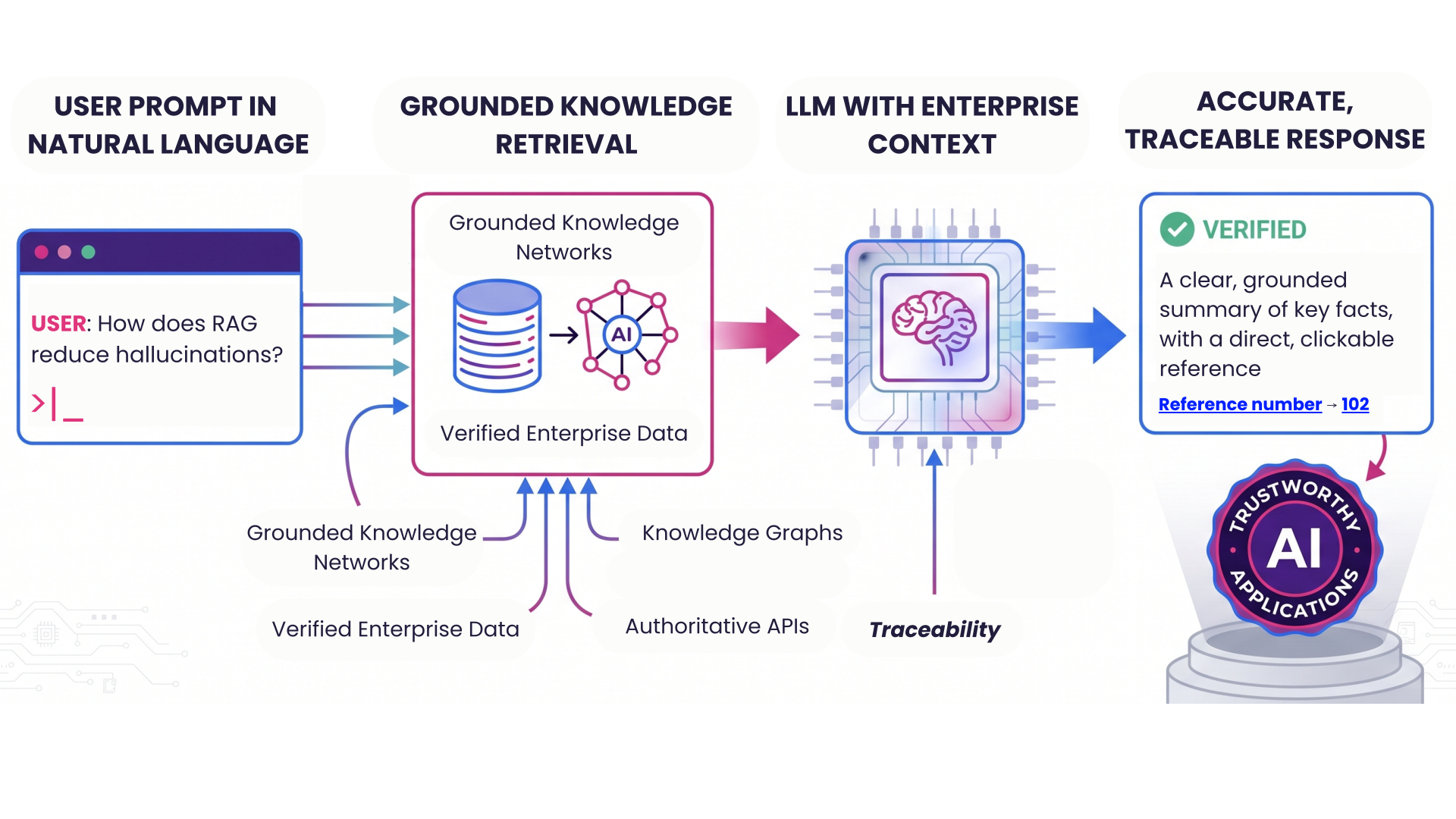
Regular RAGs reduce hallucinations by grounding the LLM in external, trusted information instead of solely relying on its training data. But traditional RAG usually retrieves isolated text chunks based on similarity. That works well for many questions, but it can struggle when the correct answer depends on understanding the data’s context and relationships.
GraphRAG, on the other hand, adds a knowledge graph to that grounding layer. Now it can retrieve entities, relationships, hierarchies, and supporting source information together. This approach gives LLMs richer, more structured context and preserves provenance back to the underlying enterprise knowledge. The advantage is not that GraphRAG makes hallucinations impossible, but that it reduces how much the LLM has to infer or reconstruct on its own.
Human in the loop
While grounding AI in verified facts is a major leap forward, “human-in-the-loop” remains the golden safeguard against hallucinations. The advantage the domain expert has over AI is the understanding of nuance and deep context. By keeping humans in the loop, you stop blindly trusting an algorithm but build a collaborative system where people validate the AI’s reasoning. This ensures that every answer is technically correct and safe for production.
This approach scales AI over time. Your team focuses on the bigger picture and corrects the AI when it gets something wrong or misses important context. Those corrections can then be fed back into the system so it works with better information in the future. Over time, the AI becomes more accurate, more relevant to your business, and more dependable for important decisions.
Using prompt engineering
Prompt engineering ensures AI thinks in a more narrow, straight path. You should provide the model with a structured request that abstains from vagueness. Using a framework such as “Chain of Thought” that forces it to break down its reasoning step-by-step before delivering a final answer. By setting explicit boundaries, such as instructing the AI to only use provided data or to admit when it doesn’t know an answer, you remove the statistical “guesswork” that typically triggers hallucinations.
In an enterprise environment, this is about replacing ambiguity with precision. Techniques like “few-shot” prompting, where you provide clear examples of successful outputs, train the AI to follow your specific business logic and tone. While grounding tools like GraphRAG provide the necessary facts, prompt engineering ensures the AI knows exactly how to process those facts, transforming a probabilistic engine into a reliable tool for mission-critical workflows.
- What is an LLM Hallucination? A Simple Definition
- How LLMs Generate Answers?
- Why Do LLMs Hallucinate?
- Types of LLM Hallucinations?
- Why do LLM Hallucinations matter for Enterprise AI?
- Real-World Examples
- How to detect LLM hallucinations?
- How to measure LLM hallucinations?
- Preventing LLM Hallucinations