
Context Is Everything: How Knowledge Graphs Make RAG Actually Work
Two real-world deployments show that grounding retrieval in a knowledge graph provides measurably more accurate, explainable, and context-aware answers than vector-only RAG.

Main Takeaways
- A knowledge graph isn't just a fancier database — the crucial step is adding semantics and inference, so the system can reason about relationships (e.g. "indigo is a shade of blue"), not just look things up.
- Vector RAG's core flaw is fragmentation — chunking severs the natural links between related content, and similarity search can't reconstruct those connections, leading to incomplete or misleading answers.
- GraphRAG makes retrieval explainable and auditable — because answers follow a traceable path through explicit relationships, you can cite the exact concept, clause, and source — not just "the LLM said so."
- Two real deployments, same verdict — whether starting from structured DITA XML or 600 unorganized PDFs, GraphRAG delivered measurably more accurate, complete, and consistent answers than vector-only baselines.
Retrieval Augmented Generation (RAG) has quickly become the default architecture for grounding large language model (LLM) responses in factual, domain-specific information. However, as enterprise adoption matures, awareness of its limitations has also grown – fragmented retrieval, semantic ambiguity, poor explainability, and brittleness that scales poorly with data complexity.
The question is no longer whether RAG is useful, but whether the vector-only implementation that most teams initially choose is actually fit for purpose. In this post, we argue that it often is not. We also explain exactly what GraphRAG offers instead, supported by two anonymized enterprise deployments from our work at Graphwise.
From graphs to knowledge graphs
It is important to begin with a distinction that is crucial for downstream AI applications: the difference between a plain property graph and a knowledge graph. A raw property graph is useful for traversal and pattern matching, but it cannot generalize beyond what is explicitly encoded. There is no mechanism for the graph to recognize that “sneakers” and “running shoes” belong to the same category or that “indigo” is a shade of blue. It can answer literal queries but cannot reason.
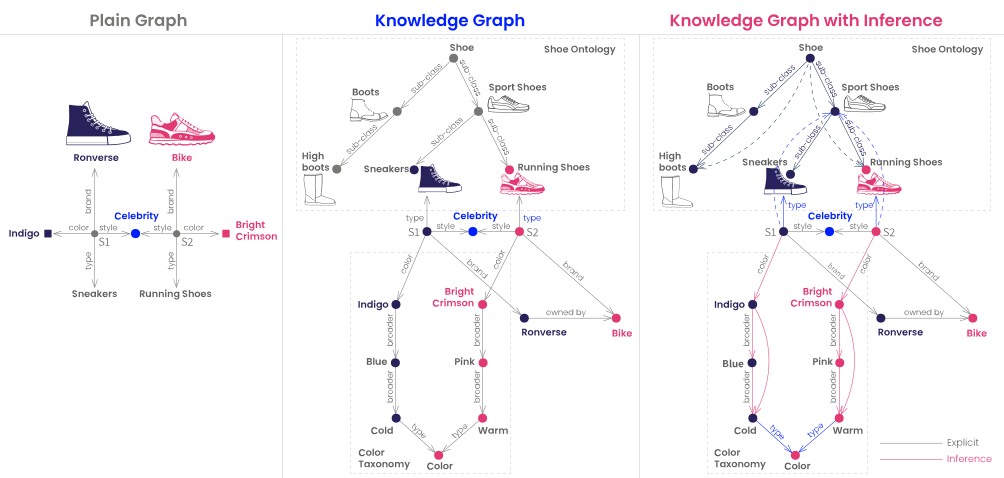
First, semantics are layered in – domain ontologies and taxonomies are imported and mapped onto the existing data, giving concepts shared meaning and arranging them into coherent hierarchies. Colors become organized into warm and cool palettes. Product types nest under common categories. This alone materially improves data quality, search precision, and governance.
The second step is inference: an inference engine runs over the enriched graph and generates new relationships automatically – relationships no human has explicitly typed in, but which follow logically from the rules and ontology in place. The result is a graph that can reason, not just retrieve.
This distinction matters at enterprise scale because knowledge graphs are not just a storage mechanism. They are a semantic layer that sits between raw data and every downstream consumer.
On one side, unstructured content such as documents, emails, and SharePoint sites is processed by generative AI components that extract entities and index them into a content hub. On the other, structured source systems are connected via a semantic data fabric that preserves lineage and governance. The knowledge graph unifies both sides into a single queryable layer that feeds generative AI applications, BI dashboards, operational systems, and analytics pipelines alike.
What RAG does and where it falls short
Standard RAG is conceptually straightforward. Documents are split into chunks, embedded into vector representations, and stored in a vector database. At query time, the user’s question is embedded and matched against stored chunks using a similarity metric such as cosine similarity. The closest matches are ranked and subsequently retrieved and provided to an LLM as context. This approach works well for simple question-answering over relatively homogeneous document sets. Problems arise at scale and in knowledge-intensive domains.
The first issue is knowledge fragmentation. Chunking is a destructive operation; it severs the links between sections of a document that were intended to be read together, thus creating disjoint pieces of knowledge. For example, a healthcare policy document may spread a single coverage rule across multiple chunks. If we retrieve any one of these in isolation, the answer is incomplete.
The second issue is contextual mismatch.Vector similarity fundamentally struggles with the nuances of human language, especially when handling complex, technical, or domain-specific concepts. It maps both questions and potential answers into a vector space, but often fails to capture underlying relationships, logical connections, and factual context between pieces of information. As a result, the system frequently retrieves content that is semantically similar – using similar vocabulary or covering the same general topic – but is contextually or factually irrelevant to the user’s specific query.
The third problem is semantic ambiguity. This type of ambiguity occurs when a word or phrase has multiple possible meanings, and without further context or explicit relationships (like those a graph provides), a system (like a RAG system) struggles to determine the intended meaning. For example, the term “benefit” has two different healthcare-related meanings (insurance coverage vs. wellness services), which a simple text search might fail to distinguish, leading to irrelevant or mixed retrieval.
Beyond these retrieval-quality issues, there are systemic challenges related to cost and maintainability. Updating a vector index when source data changes requires re-encoding, which is computationally expensive at scale. Because the system operates as a black box – similarity scores are not explanations – provenance is poor. Prompt engineering can nudge an LLM toward citing sources, but it cannot make the retrieval process genuinely explainable. Hallucination risk remains high because there is no structured semantic guardrail on what is retrieved or how it is assembled into a response.
What GraphRAG adds
GraphRAG is best understood as an architectural extension of RAG rather than a replacement. It retains the LLM as the generative component but replaces or augments the vector retrieval layer with a knowledge graph that preserves the structure, context, and relationships of the underlying data. As a result, the content passed to the LLM is not just a collection of similar-looking text chunks; it is semantically structured, relationally aware, and traceable to explicit sources.
The practical benefits are clear. Knowledge graphs enable multi-hop reasoning: instead of retrieving only the most similar chunk, the system can traverse a graph to follow a chain of relationships – linking, for example, a physiotherapy treatment to an insurance coverage rule to a specific policy clause – before assembling a response. This greatly reduces the noise problem, as the graph acts as a guardrail, constraining retrieval to semantically relevant paths rather than relying solely on embedding similarity.
Entity disambiguation also improves substantially. For example, a knowledge graph can encode that HER2 and ERBB2 refer to the same gene, or that “benefit” in a healthcare context maps to distinct concept nodes depending on the surrounding entities or context.This is the type of expert domain knowledge that vector embeddings simply average out.
Explainability is another meaningful gain. Because the retrieval path through a knowledge graph is a sequence of explicit relationships, it is auditable. The system can cite not just a source document but the specific concept node, relationship, and document section that informed the answer. This matters in regulated industries and enterprise contexts where “the LLM said so” is not an acceptable justification for a decision.
Case study 1: Technical documentation for a construction company
The first deployment we want to share involved a construction company with a large collection of technical product documentation structured according to the DITA standard. The problem was familiar: a technician on a construction site needing precise, actionable information about a hydraulic system would get generic answers from a public LLM and imprecise results from keyword search. The knowledge was in the documentation; the challenge was retrieval quality and specificity.
The project had five distinct phases.
The first phase was data transformation. DITA-structured XML was converted to RDF, with careful attention to mapping the DITA content model to RDF triples. This preserved the document structure and the relationships between topics, components, and procedures.Documents that did not conform to DITA were structured using IRI-based schemas, then linked to the DITA-derived graph nodes to provide a unified semantic layer across the entire content corpus.
The second phase involved initializing the project using the knowledge graph. This required identifying which documents corresponded to specific parts of the product taxonomy and making those relationships explicit and queryable.
The third phase involved building the search interface. It provided semantically aware answers that included not only text but also images, URLs to web documentation, and troubleshooting videos stored in separate systems. The goal was to consolidate all relevant content into a single, coherent retrieval surface, regardless of its original storage location.
The fourth phase focused on improving query understanding. User intent, not just keyword matching, could now be captured. The system returned results specific to the product and fault context rather than generically plausible ones.
The fifth and final phase was the deployment of the GraphRAG prototype. The working application used structured technical content and the knowledge graph to deliver contextually aware and precise answers. It significantly outperformed both baseline LLM responses and vector-only RAG in correctness and specificity, a result validated by early stakeholder feedback confirming improved relevance in real-world queries.
Case study 2: Unstructured internal documents for a research organization
The second deployment addressed a different starting point: a large German research organization with approximately 600 internal PDFs and documents in German and English, without an existing structured data model or manual annotation. The question we set out to answer was whether GraphRAG could deliver meaningful gains over vector-only RAG without requiring an expensive upfront knowledge engineering effort.
Our approach focused on taxonomy-driven semantic enrichment. We first applied standard chunking and multilingual embedding, resulting in a vector layer comparable to a conventional RAG baseline. The differentiating step was overlaying our Graph Modeling taxonomy and ontology on top of every chunk, automatically annotating each one with concept tags drawn from a custom knowledge model.
These tags gave each chunk a semantic fingerprint, anchoring it to a position in the domain concept hierarchy instead of leaving it as a free-floating embedding. SPARQL-based enrichment rules were then applied to merge raw tags with broader and related concepts. This captured the full domain hierarchy and made cross-concept relationships explicit. The knowledge model was built using our corpus analysis tools to extract candidate concepts directly from the document set. In this way, the semantic layer emerged from the content rather than being imposed externally.
The resulting index combined full-text search with faceted filtering over the taxonomy. This allowed retrieval to be constrained by concept, category, or relationship type, in addition to embedding similarity.
The following example illustrates the performance gap. When a user asked for the full duties and responsibilities of the Chief Information Officer (CIO), the vector RAG system returned brief, generic sentences that omitted key responsibilities and did not highlight the relationship between the CIO and the IT Management Director. As a result, the user had to open multiple PDFs and verify answers manually.
Our GraphRAG system returned a multi-sentence answer listing all six CIO responsibilities with the relevant policy clause. Across the full evaluation set, GraphRAG achieved 95% correctness, on average, and significantly fewer hallucinations than the vector baseline. It also showed a smaller standard deviation, indicating more consistent performance across query types.
Building a semantic layer for AI
Both projects highlight the same underlying requirements for a production-grade GraphRAG system. Data preparation is essential – the garbage-in, garbage-out principle applies regardless of how sophisticated the retrieval architecture may be.
For structured data, this requires upfront investment in transformation to RDF, careful ontology mapping, and relationship modeling. The initial effort is greater than for unstructured data, but the result is a graph that is highly customizable, easy to extend as new data arrives, and reusable across projects beyond GraphRAG.
For unstructured data, the investment is lower – automated tagging and taxonomy-driven enrichment can deliver significant gains without manual annotation – but some knowledge modeling is still required to maximize the value of the semantic layer. LLM integration and prompt design remain important but are increasingly secondary concerns. Fine-tuning is largely impractical for most enterprise organizations due to data and compute requirements. The more practical approach is effective prompting combined with a rich, well-structured retrieval layer that reduces the work the LLM must do in synthesizing an answer. Retrieval and reasoning quality depends directly on the quality of the knowledge graph – which is why the data preparation phase cannot be shortcut.
Evaluation should be integrated from the beginning, not added at the end. In both projects, we used a combination of quantitative scoring against test case sets and qualitative stakeholder feedback to identify where retrieval was falling short and which parts of the semantic layer needed refinement. This iterative evaluation loop enables a GraphRAG system to improve over time rather than stagnate at its initial accuracy level.
To wrap it up
The case for GraphRAG over vector-only RAG is not primarily theoretical – it is demonstrated in production. Our deployments show that, whether the starting point is well-structured technical documentation or a heterogeneous corpus of internal PDFs, grounding retrieval in a knowledge graph delivers measurably better answers. More accurate, more complete, more explainable, and more consistent.
For data engineers and architects evaluating RAG architectures for knowledge-intensive enterprise applications, the evidence is clear. Vector embeddings are a powerful tool, but they are not truly semantic. In domains where context, relationships, and domain-specific meaning are essential to the user, the graph-based semantic layer is not optional. It is the foundation that enables the rest of the system to function.
Want to dive deeper into Graphwise GraphRAG solutions?

Details
What is GraphRAG
Retrieval Augmented Generation or RAG enhances LLMs with external knowledge for more accurate, contextual question answering. See how RAG can evolve into GraphRAG, which uses knowledge graphs as a source of context or factual information.
Learn moreRecommended Content
Accelerating Discovery — How GraphRAG Drives ROI in R&D and Knowledge-Intensive Workflows
Read about how GraphRAG helps organizations cut search time, speed up discovery, and turn AI pilots into measurable ROI.
Read more
Bring Your Enterprise Information Security Management System with GraphRAG to the Next Level
Read abou how GraphRAG systems enhance enterprise information security management by using knowledge graphs
Read more
Building Smarter, Faster — How GraphRAG Cuts AI Development Costs and Complexity
Read about why traditional RAG systems become costly at scale and how GraphRAG reduces complexity and improves cost predictability.
Read more
GeoAI: How GraphRAG Unlocks Complex Geospatial Knowledge
Read about how LLMs struggle with spatial queries, but connecting them to structured geographic knowledge graphs through GraphRAG improves accuracy.
Read more
From Data to Decisions — How GraphRAG Accelerates Time to Insight and Boosts ROI
Read about how GraphRAG connects data, context, and meaning to deliver faster and verifiable insights that accelerate decision-making and boosts ROI
Read more
AI-ready Graph Environments: The Key to Scaling AI with Graphwise’s Knowledge Graphs
Read about why most enterprise AI fails and how Graphwise creates graph environments using knowledge graphs and semantics.
Read moreFAQ
Any Questions? Look Here
The primary difference between a property graph and a knowledge graph lies in their focus on traversal performance versus semantic integration: property graphs (Labeled Property Graphs or LPGs) are optimized for efficient storage and rapid traversal of direct relationships, typically utilizing proprietary query languages for performance-heavy, single-dimensional tasks. In contrast, knowledge graph—primarily semantic and RDF-based—are designed for web-scale interoperability, data unification, and information reuse, leveraging formal ontologies to provide context, handle multi-dimensional data, and enable automated reasoning. While property graphs were traditionally preferred for their ability to attach metadata to edges, modern standards like RDF-star have largely bridged this gap, allowing knowledge graph to deliver both complex data alignment and the detailed edge-level properties once unique to the property graph model.
Traditional RAG systems often produce incomplete or incorrect answers to complex questions because they rely on local semantic similarity, which fails to capture multi-hop relationships and global context spread across fragmented data silos. By breaking information into isolated text chunks and retrieving them based on vector proximity rather than structured relationships, the system suffers from "tunnel vision," missing the connective tissue and inter-dependencies required to bridge disparate facts. This architectural gap means that if an answer requires synthesizing information from multiple documents or performing operations like aggregation, the system may fail to retrieve all necessary evidence or lose the nuanced context, forcing the language model to work with a disjointed and insufficient set of facts.
Multi-hop reasoning in GraphRAG works by traversing the explicit semantic relationships and hierarchical connections defined within a knowledge graph to link information across multiple disconnected documents. Unlike traditional RAG, which relies on simple vector similarity to find isolated data chunks, GraphRAG follows logical paths through the graph to "connect the dots" between disparate entities and data silos. This process involves detecting concepts from a query, expanding it with related entities, and navigating the graph's structure to synthesize answers for complex, relational questions that require information from several different sources to form a coherent and verifiable response.
To make AI answers explainable and auditable, organizations must transition from "black box" models to hybrid architectures that integrate Large Language Models with Knowledge Graphs, a technique known as GraphRAG. By grounding generative AI in a structured semantic backbone, the system provides clear traceability and provenance, identifying the exact verified facts and source documents used to generate a specific conclusion. This approach replaces probabilistic guessing with deterministic reasoning pathways, allowing users to audit the logic behind an output and ensuring that AI-driven decisions are transparent, trustworthy, and compliant with regulatory standards.
Semantic ambiguity in AI search occurs when a word or phrase has multiple possible meanings—such as "Jaguar" referring to either a car or an animal—making it difficult for search engines to determine user intent based on keywords alone. To fix this, AI systems utilize knowledge graphs, taxonomies, and ontologies to provide a structured context that defines the specific relationships between concepts. By implementing Natural Language Processing (NLP) for word sense disambiguation and linking search terms to unique entities within a graph, the system can distinguish between homographs and synonyms, ensuring results are retrieved based on their actual meaning and relevance rather than just exact character matching.
Building GraphRAG without existing structured data is achieved through a text-to-graph extraction process that uses Large Language Models (LLMs) and NLP tools to automatically identify entities and semantic relationships within unstructured text. By leveraging integrated text analysis pipelines—such as those in GraphDB or Graphwise’s text analytics tools—you can transform raw documents into a structured knowledge graph by extracting triples and linking them to a defined ontology or taxonomy. This established graph then provides the context-rich foundation needed for RAG, enabling the system to perform multi-hop reasoning and deliver accurate, grounded responses by retrieving connected facts that were previously hidden in disconnected data.